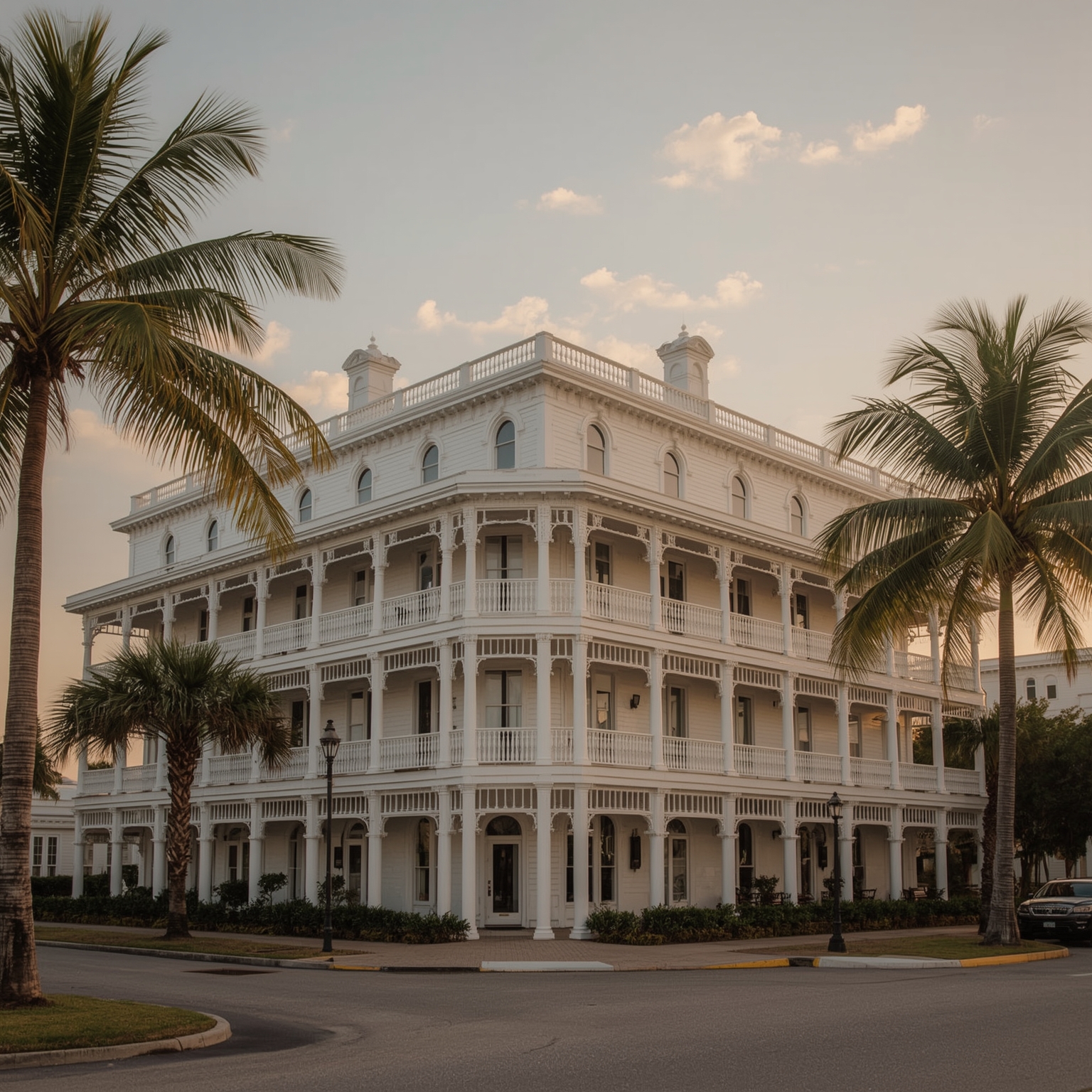
Although the Gilded Age has faded into history, leaving behind only fragmented echoes of its extravagant legacy, traces of the opulence that defined this transformative era remain scattered across the United States. Among the most notable remnants is the Belleview Hotel—later known as the Belleview-Biltmore—in Belleair, Florida, an iconic establishment that once embodied the grandeur, ambition, and exclusivity of the time. Built by Henry B. Plant, a railroad magnate whose expansive rail network reshaped Florida’s economic destiny, the Belleview opened its doors in 1897 as an exclusive retreat for the wealthiest figures of American society. Rising well above the Gulf Coast’s modest communities of the late nineteenth century, the hotel served as both a symbol of progress and a strategic enterprise designed to lure elite visitors to Tampa Bay, an area newly accessible thanks to Plant’s rail system.
Guests who traveled to the Belleview could conveniently arrive via the very trains that Plant’s system extended into the once-isolated region, stepping directly from the polished floors of Pullman cars into the sprawling wooden structure that soon became known as the “White Queen of the Gulf.” This magnificent nickname reflected more than its sheer scale; it captured the architectural ambition of its Queen Anne–style design, the gleaming white façade, and the unparalleled promise of luxury. At over 820,000 square feet and boasting 400 rooms, the Belleview was, at its peak, believed to be the largest continuously occupied wooden building in the world. For America’s industrial titans and ruling families—the Vanderbilts, DuPonts, Fords, alongside cultural icons such as Thomas Edison and Babe Ruth—the Belleview was not simply a hotel, but a stage on which status and sophistication could be reaffirmed. Even U.S. presidents, including Gerald Ford and Jimmy Carter, counted themselves among its distinguished guests.
Over the decades, the resort expanded beyond its original design, adding a prestigious country club and an eighteen-hole golf course, which would later become the oldest golf club in Florida. The property thus became a recreational paradise for the nation’s elite, combining lavish social facilities with the comfort of seclusion in a climate ideal for winter leisure. Yet despite its storied early decades, the Belleview’s fate grew increasingly precarious during the late twentieth century. By the 1980s its once celebrated glamour had begun to dim, challenged by the complex upkeep of its immense wooden framework and by shifts in tourism toward newer, more modern resorts. A destructive hurricane season in 2004 further weakened the structure, hastening its decline. By 2009, despite passionate debates over preservation, the financial burden to restore the Belleview exceeded $200 million. The reality that nightly room rates would have needed to reach astronomical levels for cost recovery sealed its closure.
Demolition followed in 2015, when approximately ninety percent of the original structure was lost. Only a fraction was spared and meticulously preserved. This surviving portion was carefully relocated nearly four hundred feet from its original foundation to accommodate surrounding townhomes and condominiums that now occupy its historic grounds. In 2018, the preserved remnant was reborn as the Belleview Inn, a boutique-sized hospitality experience encompassing just 38,000 square feet and thirty-five guest rooms. Though reduced in scale, the inn retains authentic architectural and interior elements—its original wooden floors, broad staircases, paneled ceilings, and crystal chandeliers—that allow visitors to feel directly connected to the hotel’s illustrious past.
Checking into the Belleview Inn today is more than a simple lodging experience; it is a journey into another era. Guests are greeted with Champagne at arrival, subtle gestures that recall the refined rituals of high society. Hallways adorned with historic paintings and archived illustrations narrate the hotel’s century-long story, while the lobby resonates with echoes of its former prominence. Rooms, though updated with modern conveniences such as televisions, mini-refrigerators, and plush furniture, still preserve architectural hallmarks of the nineteenth century, maintaining the delicate balance between comfort and authenticity. Prices, averaging between $260 for standard rooms and $350 for suites, allow twenty-first-century travelers to temporarily relive a past once limited only to America’s most privileged families.
Amenities supplement the historic character with contemporary practicality. Guests are offered access to the nearby Belleair Country Club, where golf, dining, and spa services extend the resort experience. A café within the inn, though modest, provides refreshments and souvenirs. Each morning, a breakfast basket—complete with a freshly baked croissant, Florida orange juice, fruit, and condiments—is delivered directly to guest rooms, reviving the tradition of attentive service in a more intimate way than grand buffets or crowded restaurants. The wraparound porches provide spaces for quiet reflection, overlooking grounds that remind visitors of both what has endured and what has vanished.
The Belleview’s long saga—marked by expansion, decline, near-erasure, and eventual revival—mirrors broader themes of the Gilded Age itself: conspicuous wealth, architectural audacity, and an ongoing tension between progress and preservation. Walking its hallways or sitting in its history room, which showcases photographs, artifacts, and recovered memorabilia, feels akin to exploring a living museum. Every corner amplifies the sense that one is not merely inhabiting a hotel, but stepping into a carefully preserved fragment of cultural memory. The inn’s very survival, despite demolition and development pressures, testifies to the value of safeguarding architectural legacies.
To stay at the Belleview Inn today is to inhabit a rare blend of nostalgia and modernity—a chance to touch the past while enjoying the present. Even diminished in size, the spirit of the “White Queen of the Gulf” remains vivid, offering modern travelers the chance to glimpse, however briefly, the shimmering allure of the Gilded Age.
Sourse: https://www.businessinsider.com/i-stayed-at-florida-gilded-age-hotel-vanderbilts-duponts-2025-7