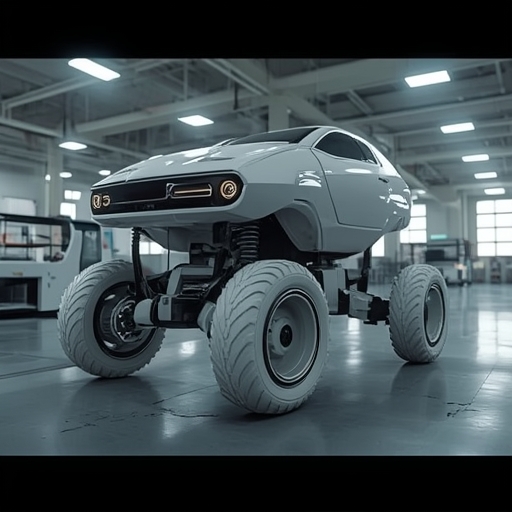
Travis Kalanick, the visionary entrepreneur who once reshaped global transportation through Uber, is stepping back into the innovation spotlight with his latest enterprise, Atoms. After several years of relative quiet following his departure from Uber, Kalanick’s new company has emerged from stealth mode carrying an ambitious mission — to develop what he calls the “wheelbase for robots.” This phrase alludes to creating a foundational technological framework upon which the next generation of mobile robotic systems can move, operate, and evolve.
Atoms appears to position itself at the intersection of robotics, automation, and mobility — a natural continuation of Kalanick’s longstanding interest in redefining how movement and logistics are structured in modern economies. In much the same way that Uber transformed human transportation with a digital platform connecting riders and drivers, Atoms seems poised to underpin the coming era of autonomous mechanical motion. The company’s focus on a “wheelbase” suggests a modular approach: a universal core that various robotic bodies could attach to, facilitating customization across industries such as warehouse logistics, delivery, manufacturing, and service automation.
While still in its early stages, Atoms’ emergence marks more than just another startup announcement — it represents Kalanick’s formal re-entry into the high-stakes world of frontier technology. His return invites speculation about whether he can once again disrupt entrenched systems and set new standards for innovation. The phrase “wheelbase for robots” evokes both a physical and metaphorical foundation: it signals a technological platform on which future autonomous systems might balance efficiency, adaptability, and intelligent mobility.
The broader robotics sector, meanwhile, is undergoing rapid acceleration. Companies worldwide are racing to develop machines that can not only perform predefined tasks, but also learn, navigate, and interact seamlessly with human environments. As automation continues to infiltrate logistics centers, urban infrastructure, and even domestic settings, a reliable, scalable mobility platform could become an essential building block. If Atoms succeeds, it may stand to robotics what Uber once was to urban transport — the unseen infrastructure enabling widespread innovation.
For Kalanick himself, this venture might also serve as a narrative of reinvention. Having weathered the turbulence surrounding his previous company, he now reappears as a leader focused not merely on consumer-facing apps, but on deep technological architecture with potential to shape the future of automation. Atoms embodies an evolution both in his entrepreneurial focus and in the broader tech landscape — a shift from digital marketplaces to the physical intelligence that will govern how machines move and interact.
The story of Atoms, therefore, is not just about another startup entering the robotics race. It represents a convergence of experience, ambition, and timing. Kalanick’s understanding of scale, platform strategy, and disruptive growth meets a world increasingly ready for autonomous solutions. Whether Atoms becomes a cornerstone of robotic mobility or a stepping stone in the next wave of tech experimentation, one thing is clear: the innovation narrative surrounding Travis Kalanick has entered an entirely new chapter, one that once again blends vision, controversy, and the relentless pursuit of transformation.
Sourse: https://www.businessinsider.com/travis-kalanick-ex-uber-misfits-entering-robotics-game-atoms-2026-3