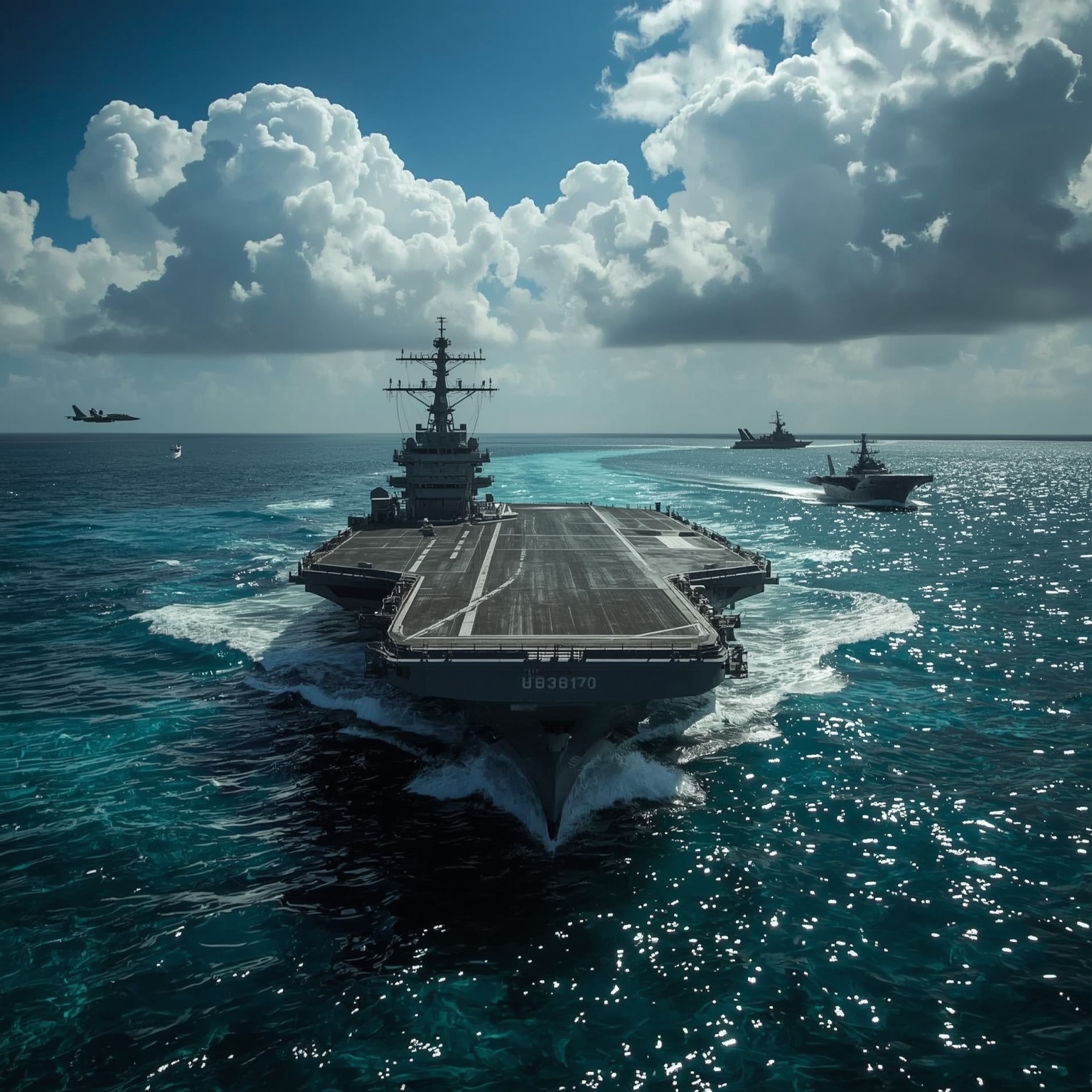
A substantial reinforcement of U.S. military power is being dispatched to bolster President Donald Trump’s renewed campaign against the international narcotics trade. According to a Pentagon announcement issued on Friday, the Gerald R. Ford Carrier Strike Group—spearheaded by the Navy’s most technologically sophisticated aircraft carrier—along with its fully equipped carrier air wing, will be redirected from its present assignment in the Mediterranean Sea to operate within the jurisdiction of the United States Southern Command (SOUTHCOM). This strategic redeployment represents a distinct and meaningful enlargement of American military presence in a region that has traditionally not hosted assets of this magnitude for counter-narcotics missions.
The geographic scope of SOUTHCOM’s responsibility encompasses the entirety of Central and South America, the Caribbean basin, and their adjoining maritime territories. This vast area includes key sea lanes often exploited by transnational narcotics traffickers and other illicit entities. The decision to divert such an advanced naval task force from the 6th Fleet’s operational domain reflects both an escalation in mission priority and a tangible expression of the U.S. government’s commitment to intensifying its efforts against organized crime operating across these waters.
In a statement accompanying the directive, Pentagon spokesman Sean Parnell emphasized that Secretary of Defense Pete Hegseth’s order aligns closely with President Trump’s broader strategic objective: the systematic dismantling of drug trafficking organizations and the confrontation of what the administration characterizes as “narco-terrorism,” all in the name of safeguarding the security of the American homeland. The policy underscores the administration’s resolve to employ not only law enforcement but also military power to disrupt and deter criminal networks that have extended their operations across international boundaries.
A carrier strike group, by its nature, represents a formidable instrument of combat capability, vastly exceeding the firepower, range, and tactical flexibility of an amphibious ready group. While the latter is composed primarily of amphibious assault ships and Marine contingents optimized for expeditionary operations, a carrier strike group brings with it a floating air base, missile-equipped escort destroyers, and advanced intelligence, surveillance, and reconnaissance systems. The deployment of such an asset to a region primarily associated with counter-narcotics enforcement is, therefore, noteworthy and somewhat unconventional.
Once in the area, the Ford and its accompanying warships will reinforce an already expanding U.S. naval presence. Over the past several months, more than half a dozen combat vessels have been redirected to the Caribbean, including the three-ship Iwo Jima Amphibious Ready Group. That formation, which carries Marines trained for rapid-response and emergency combat operations, has been instrumental in providing versatile options for deterrence and humanitarian assistance alike.
In the Pentagon’s official release, the Department conveyed that this heightened force posture within U.S. Southern Command’s operational sphere is expected to significantly augment the nation’s ability to identify, track, and neutralize individuals and organizations engaged in illicit enterprise—activities that endanger U.S. safety, economic prosperity, and stability throughout the Western Hemisphere. The statement framed the move as a protective measure designed to restore and preserve order in an area where narcotics trafficking and related criminal activity have long undermined governance and security.
Prior to making this formal announcement, SOUTHCOM published a short video presentation highlighting recent operations under its purview, illustrating naval patrols, aerial surveillance, and multinational coordination efforts along the maritime corridors connecting the Caribbean to the Pacific and Atlantic Oceans.
The Gerald R. Ford itself, an emblem of American maritime supremacy, had originally set sail in January for deployment under the U.S. 6th Fleet, whose area of operation extends across Europe and North Africa. Commissioned in July 2017 after a staggering investment approaching $13 billion, the Ford stands as the most advanced and largest aircraft carrier ever constructed. The vessel can accommodate approximately seventy-five aircraft across a diverse range of types—among them F/A-18 Super Hornets, EA-18G Growlers specialized in electronic warfare, airborne early-warning aircraft, and multi-purpose helicopters. These capabilities enable the strike group to conduct air superiority missions, precision strikes, and support complex joint operations over both sea and land.
In addition to the carrier’s air wing, the strike group is accompanied by escort vessels, most often guided-missile destroyers or cruisers, each equipped with offensive and defensive missile systems capable of engaging aerial, surface, and subsurface threats. This composition provides the fleet with a layered defense and a wide operational reach, allowing it to respond swiftly to emerging security challenges.
Beyond the naval assets concentrated in SOUTHCOM’s theater, the United States has also positioned thousands of military personnel, F-35 fifth-generation stealth fighters, and various bomber squadrons in regional exercises and deterrence missions. These activities serve a dual purpose: tightening control over illicit trafficking routes while signaling military readiness amid elevated tensions with Venezuela, a country identified by Washington as both a regional destabilizing factor and a source of illegal narcotic shipments.
Since September, U.S. forces have executed at least ten precision strikes against targets believed to be connected to the narcotics trade, resulting, according to administration officials, in the deaths of at least forty-three individuals. Eight of these missions took place in the Caribbean Sea, while the most recent operations extended into the Pacific theater, illustrating the geographic breadth of this expanded campaign. Officials argue that such strikes are intended to interrupt the flow of drug shipments before they approach U.S. territorial waters.
Earlier in the year, the Trump administration formally classified major drug cartels as transnational criminal organizations—a designation carrying significant legal implications. This classification enables the U.S. government to invoke extraordinary legal authorities usually reserved for counterterrorism, including the capacity to target suspected operatives outside conventional law enforcement frameworks. By doing so, the administration aimed to streamline military engagement against these networks.
However, observers and legal experts have raised concerns regarding the scope of executive authority in these operations. While some intercepted vessels and personnel have been confirmed to be part of criminal trafficking activities, not every target has met that threshold. Critics argue that, under the Constitution, the power to authorize sustained military engagement rests with Congress, not the executive branch. Acting without proper legislative approval, they caution, could expose U.S. military personnel to legal jeopardy, particularly in cases where non-combatant casualties occur.
Ultimately, this substantial shift in U.S. military posture within the Western Hemisphere demonstrates the administration’s willingness to utilize the full spectrum of American power—diplomatic, economic, and military—to address the continuing challenges posed by transnational narcotics organizations. The arrival of the Gerald R. Ford Carrier Strike Group stands not only as a projection of strength but also as a declaration of intent: the fight against illicit trafficking has been elevated from a policing initiative to an operation of international strategic consequence.
Sourse: https://www.businessinsider.com/hegseth-diverts-navy-carrier-strike-group-to-caribbean-drug-war-2025-10


