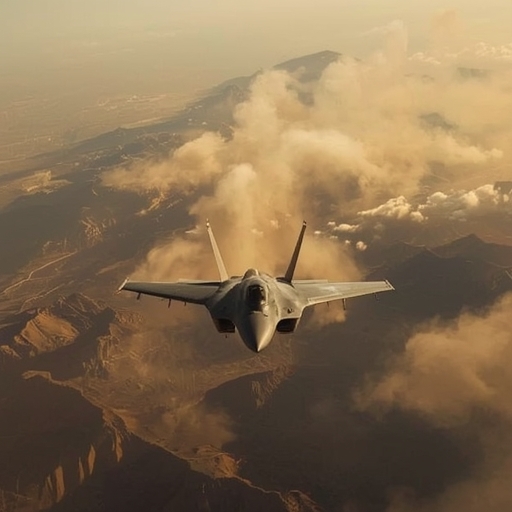
According to emerging and increasingly credible reports from regional and military sources, the United States has suffered the loss of a fighter jet over the skies of Iran. This marks a significant and sobering milestone — the first verified instance of a U.S. combat aircraft being downed within Iranian airspace during the ongoing conflict. The gravity of this event extends well beyond the immediate tactical implications, symbolizing a deeper and escalating dimension of the confrontation now enveloping parts of the Middle East.
At this moment, coordinated search and rescue operations are being conducted with urgency and precision, as military authorities and allied forces strive to determine both the fate of the aircraft and the status of its crew. The mission involves aerial reconnaissance, satellite tracking, and ground-based recovery teams operating under highly challenging conditions. Every passing hour underscores the complexity and danger inherent in such a mission, carried out in a region defined by volatile airspace, shifting alliances, and widespread tension.
This latest incident does not exist in isolation. It contributes to a steadily lengthening record of aircraft losses that have occurred since the outbreak of renewed hostilities in the region — a pattern that is reshaping both strategic calculations and public perception of the conflict. Each downed aircraft represents not only a material loss but also a human story and a vivid reminder of the risks faced by those who serve in high-stakes operations. Analysts have already begun to frame this event as part of a broader trend in modern warfare, where advanced technology, intricate defense systems, and rapid escalation dynamics converge in unpredictable ways.
Strategically, the confirmed downing of a U.S. jet within Iranian airspace raises pressing questions about the scope of direct engagement and the evolving rules of engagement between opposing forces. It also underscores the perils of a highly contested aerial theater, where national borders, early-warning systems, and international protocols are frequently tested to their limits. While officials have not yet disclosed further details regarding the specific type of aircraft or the cause of the loss, the implications are unmistakably serious, suggesting an intensification of operational hazards amid an already fragile geopolitical climate.
As global observers monitor developments, attention remains fixed on the progress of the rescue mission and on official statements expected from U.S. defense authorities. The event reverberates as a powerful reminder of the human cost of conflict, the unpredictability of military escalation, and the fragility of stability in one of the world’s most sensitive regions. With the number of downed aircraft continuing to rise, this singular tragedy illustrates how rapidly the balance of power and perception can shift in a modern war marked by both technological sophistication and relentless uncertainty.
Sourse: https://www.businessinsider.com/us-combat-aircraft-over-iran-2026-4