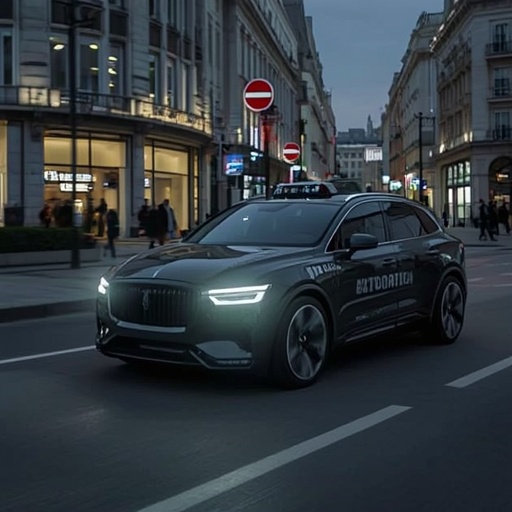
London is on the threshold of a profound transformation in how people move throughout the city. Uber has officially announced a forward‑thinking alliance with the autonomous‑vehicle pioneer Wayve, marking the beginning of a new era where artificial intelligence merges seamlessly with daily urban life. Later this year, the two companies plan to introduce fully self‑driving robotaxis onto London’s bustling roads, a milestone that could redefine the very concept of modern transportation.
This initiative represents far more than a technological trial; it signifies a major leap toward an interconnected ecosystem where mobility is efficient, sustainable, and increasingly independent of direct human control. By joining forces with Wayve—a firm recognized for its advanced machine‑learning systems that allow vehicles to adapt intelligently to complex driving environments—Uber aims to test its autonomous capabilities in one of the world’s most dynamic and challenging metropolitan settings. The partnership reflects an invitation to Londoners themselves: through an early‑access program, selected riders will have the opportunity to experience what it feels like to be transported by a fully autonomous vehicle while the technology continues to evolve under real‑world conditions.
For Uber, this experiment is not simply a local pilot but a blueprint for the future of global mobility management. London, known for its intricate roadways, cultural diversity, and forward‑thinking infrastructure policies, serves as the perfect proving ground for testing how AI‑driven vehicles integrate with human operators, existing services, and city regulations. The outcome could influence transportation strategies in other major urban centers around the world.
Beyond the spectacle of driverless cars weaving through historic streets, the collaboration demonstrates Uber’s long‑standing vision of leveraging artificial intelligence to make travel safer, cleaner, and more accessible. It also signals a shift in public perception: the idea of stepping into a car without a driver, once a concept belonging to science fiction, is steadily becoming an attainable reality. As technology advances, the focus moves from curiosity to trust—trust in the algorithms that perceive traffic, pedestrians, and signals just as a human would, if not better.
The launch of these robotaxis, therefore, is not only a technical achievement but also a social experiment in how people adapt to innovation. Riders may soon find themselves gliding through London’s lively avenues, observing how seamlessly software interprets every intersection, every curve, and every unexpected obstacle. It is a glimpse into a near future where convenience meets intelligence, where sustainability combines with precision, and where cities like London lay the groundwork for the mobility networks of tomorrow. In essence, Uber and Wayve’s venture invites society to witness the unfolding of a transportation revolution—one that could ultimately reshape the rhythm of urban life across the globe.
Sourse: https://www.theverge.com/transportation/945614/uber-wayve-robotaxi-interest-list-launch-london