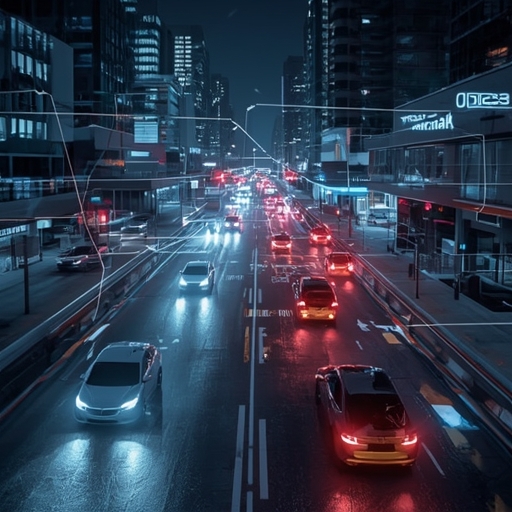
Uber is undertaking a remarkably ambitious transformation that extends far beyond its traditional identity as a ride-hailing company. The global mobility leader now envisions turning its extensive network of millions of active drivers into a sophisticated, interconnected web of mobile sensors designed to collect and share real-time data from cities across the world. This effort signifies a major step forward in Uber’s commitment to the development of autonomous vehicle technology, illuminating how the company plans to fuse human-driven mobility with cutting-edge artificial intelligence. By reimagining its existing infrastructure not merely as a transportation network but as a vast, data-rich ecosystem, Uber intends to generate the kind of comprehensive, continuously updated road and environmental information that is critical to advancing self-driving innovation.
As explained by Uber’s Chief Technology Officer, Praveen Neppalli Naga, this initiative—anchored within the company’s AV Labs program—represents a leap in technological ambition. The idea is that every trip completed by a driver can serve as a tiny piece of a much larger digital puzzle, with each vehicle acting as a live sensor node feeding valuable information into a unified data map. This approach could enable Uber to accelerate the pace at which its autonomous vehicle systems learn, adapt, and improve, using insights derived directly from real-world conditions. For instance, drivers navigating through changing weather, heavy traffic, or complex intersections can passively contribute to datasets that teach AI models how to handle similar challenges safely and efficiently.
The AV Labs initiative exemplifies Uber’s larger strategic evolution—one that integrates human experience and machine learning into a continually self-improving symbiosis. Rather than replacing its drivers outright, Uber is leveraging their collective journeys to serve as the foundation for the next generation of mobility intelligence. Through this union of human perceptiveness and algorithmic precision, the company aims to craft one of the most accurate, detailed, and dynamically updated road networks ever assembled.
Beyond its technical sophistication, this project also carries broad implications for the future of urban infrastructure and mobility. Transforming ordinary vehicles into intelligent data-gathering components opens up vast possibilities: improved navigation, smarter traffic management, predictive maintenance for roads, and richer mapping capabilities. Uber’s decision to meld its driver base with advanced sensor analytics thus positions it as a pivotal player in the race toward an autonomous driving future—one defined not just by machines operating independently, but by technology that learns organically from the motion of everyday life. In short, Uber’s global sensor network initiative foreshadows a future in which the boundaries between human-driven and self-driven travel are subtly blurred, giving rise to a transportation system that is more adaptive, safe, and profoundly intelligent than ever before.
Sourse: https://techcrunch.com/2026/05/01/uber-wants-to-turn-its-millions-of-drivers-into-a-sensor-grid-for-self-driving-companies/


