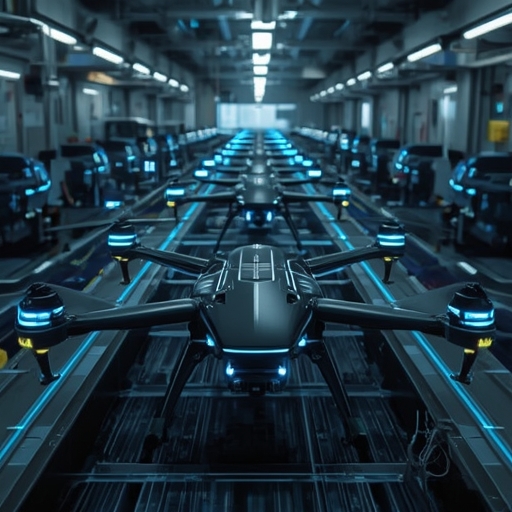
Ukraine’s Ministry of Defense announced on Thursday that, beginning in early December, it has maintained an extraordinary rate of supplying its armed forces with approximately 950 interceptor drones every single day. According to the ministry’s statement, these unmanned aerial vehicles have been specifically designed and deployed with the primary mission of countering enemy Shahed-type drones—an aggressive class of unmanned systems frequently used in recent Russian offensives.
This output represents a major achievement for Ukraine’s rapidly evolving defense manufacturing capabilities. Attaining nearly one thousand interceptors per day signifies a dramatic industrial upscaling, particularly notable because, at the beginning of the year, many of these technologies remained confined to the experimental or prototyping phase. The accomplishment not only illustrates the progress in domestic defense production but also signals a broader national adaptation toward modern aerial warfare technology.
The interceptor drones in question operate as first-person-view systems, which means that their operators utilize a live video feed to precisely direct them toward incoming threats. Their purpose is straightforward yet highly technical—to eliminate hostile aerial devices through either explosive detonation or direct physical collision. Typically powered by four compact motors driving propellers, they resemble small quadcopters in mechanical function. However, their aerodynamic structure diverges from ordinary commercial drones; they are most often streamlined into shapes reminiscent of bullets or miniature rockets to minimize drag and maximize acceleration during pursuit and interception.
Originally engineered to destroy high-altitude reconnaissance drones, these devices have since undergone several design evolutions in Ukraine’s hands. They have been modified to engage and neutralize long-range attacking drones efficiently and at a fraction of the traditional defensive cost. This evolution has been crucial as a countermeasure against Russia’s increasing deployment of large formations of Iranian-designed Shahed attack drones throughout the year.
In Thursday’s statement, Ukrainian Prime Minister Denys Shmyhal—speaking on behalf of the defense establishment—emphasized the strategic importance of these systems. He explained that the newly expanded fleet of interceptors effectively fortifies Ukraine’s aerial defenses, mitigating what he termed “drone terror,” while simultaneously conserving more complex and expensive munitions intended for intercepting cruise or ballistic missiles. Such resource prioritization enables the country to sustain a longer-term defense effort without depleting critical higher-tier armaments.
The defense ministry further detailed its collaboration with over ten domestic manufacturers specializing in interceptor drone production, indicating that additional procurement contracts have already been placed for the coming year. These partnerships reflect a concerted national initiative to ensure steady growth in both technological refinement and production volume.
For Ukraine’s battlefield requirements, interceptor drones must achieve a delicate balance between speed and affordability. They need to be sufficiently fast to intercept Shahed-136 drones, which cruise at approximately 115 miles per hour, while remaining inexpensive enough to support the deployment of hundreds daily without straining defense budgets. This balancing act is vital, especially in light of Russia’s recent tactic of launching an estimated 5,500 Shahed-type drones each month.
Ukrainian engineers and independent drone developers are concurrently attempting to create advanced interceptor prototypes capable of combating the Geran-3—the Russian iteration of the faster, jet-powered Shahed-238—which reportedly reaches speeds close to 230 miles per hour. These efforts underscore the continuous technological arms race unfolding in the skies above Ukraine, where speed, precision, and cost-efficiency determine tactical success.
This surge in production follows earlier remarks by President Volodymyr Zelenskyy, who stated in November that Ukraine’s daily output of interceptors was then between 600 and 800 units, falling short of his aspiration to reach the 1,000-per-day mark. That benchmark, initially set in July, has now effectively been met, signifying not only a manufacturing breakthrough but also an important morale boost for the country’s defense sector.
In addition to government-backed programs, several Ukrainian volunteer movements have been instrumental in supporting frontline units with smaller but meaningful contributions of interceptor drones. Although these civilian-sponsored deliveries cannot match the sheer scale of state production, they play a significant symbolic and practical role. For instance, the production and distribution of the Wild Hornets’ Sting—a relatively low-cost, $2,500 interceptor—have been largely financed this year by the Sternenko Foundation, a domestic crowdfunding organization committed to strengthening Ukraine’s defensive capacity through grassroots funding initiatives.
Together, these governmental and civilian efforts reflect a broader national mobilization, demonstrating how a mixture of technological innovation, public solidarity, and industrial adaptation is enabling Ukraine to maintain a resilient and forward-looking defense posture under persistent aerial assault.
Sourse: https://www.businessinsider.com/ukraine-interceptors-production-goal-drone-warfare-russia-shahed-2025-12