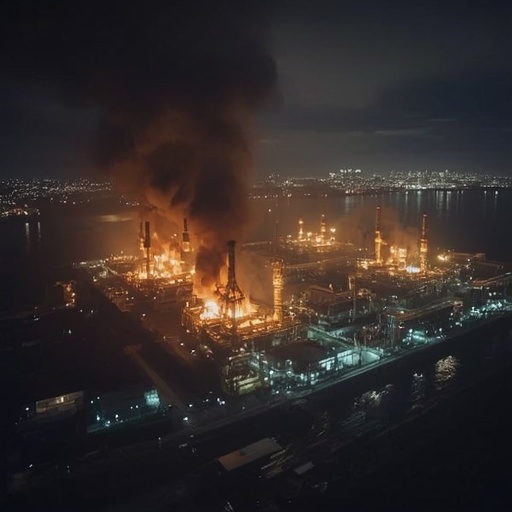
As international attention focused on Russia’s flagship economic forum — a high-profile meeting that annually draws business leaders, policymakers, and foreign dignitaries — newly released satellite imagery unveiled a striking juxtaposition of commerce and conflict. The captured images revealed a Russian oil storage terminal near St. Petersburg engulfed in fierce flames, reportedly ignited by a Ukrainian strike. The timing of the incident is deeply symbolic: while officials gathered to discuss fiscal growth, investment strategy, and economic resilience, the stark reality of war intruded visually and politically, reminding the world of the ongoing volatility that defines the region.
According to visual analyses, the inferno illuminated the night sky over an expansive network of fuel tanks and industrial infrastructure, producing towering columns of smoke visible from miles away. The composition and magnitude of the fire suggested a targeted assault on strategic energy assets — a continuation of Ukraine’s broader campaign to disrupt Russia’s fuel logistics and supply routes. Although detailed assessments of material damage remain under evaluation, the scale of the blaze, corroborated by multiple remote sensing datasets, underscores the strike’s operational precision and its potential impact on energy storage capacity.
This event highlights an increasingly intertwined relationship between geopolitical confrontation and economic narrative. The very forum intended to project Russia’s economic stability and international relevance instead became overshadowed by imagery of destruction — a vivid manifestation of the tension between crisis management and state-controlled messaging. Moreover, the attack raises renewed discussions about the vulnerability of critical infrastructure within contested airspace, the adaptability of energy markets under duress, and the broader implications for global trade security.
Observers note that such concurrent occurrences — military escalation coinciding with diplomatic pageantry — are emblematic of modern hybrid warfare, where physical confrontation operates in parallel with psychological and economic signaling. The juxtaposition of burning petroleum tanks against the backdrop of a meticulously staged economic convention offers a visual metaphor for the fragility of perceived normalcy during protracted conflict.
Ultimately, the satellite evidence stands as both a technological record and a geopolitical statement. It illustrates the ability of remote observation to transcend censorship and controlled narratives, revealing on-the-ground realities in vivid, data-driven detail. Beyond the immediate military implications, these images reinforce the global interdependence of energy, strategy, and perception — three forces continuously reshaping the contours of the Russia–Ukraine conflict and the world order that frames it.
Sourse: https://www.businessinsider.com/satellite-images-russian-oil-terminal-fire-ukraine-strikes-russian-davos-2026-6