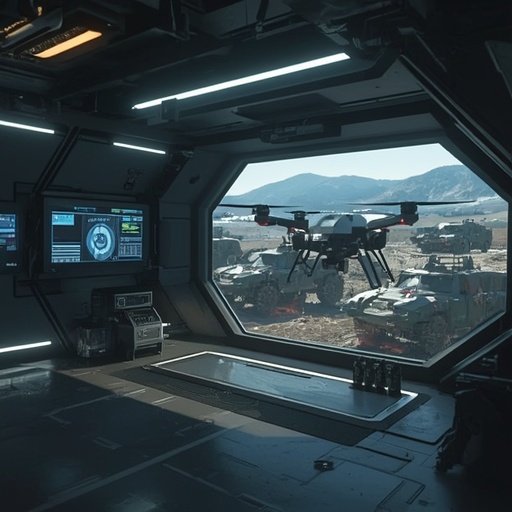
Ukraine’s approach to contemporary warfare provides a profound and transformative lesson for NATO and its allied defense structures—one that redefines the essence of survival, strategy, and technological adaptation on the modern battlefield. In Ukraine’s current conflict environment, the operational realities have shown that traditional static defenses or centralized command posts can no longer guarantee longevity or operational success. Instead, agility, speed, and the ability to relocate with minimal detection have become indispensable pillars of tactical superiority.
Drone command centers—those critical nerve hubs controlling aerial and reconnaissance systems—must maintain constant mobility to avoid detection by enemy forces utilizing advanced surveillance and precision-guided munitions. Each stationary asset represents a liability, a potential target whose destruction could cripple communication channels and intelligence flow. Therefore, the Ukrainian model emphasizes perpetual motion, rapid deployment, and concealment, particularly through subterranean or highly camouflaged facilities that blend seamlessly into the landscape.
This evolution in warfare underscores an essential truth: adaptability is now as important as firepower. NATO observers have noted that the ability of Ukrainian units to remain hidden and flexible directly impacts mission endurance and effectiveness. Such strategies redefine what it means to command in the digital age, where sensor networks, drones, and electronic warfare leave minimal room for error. Protection no longer lies solely in armor or structural fortification; it resides in unpredictability, dispersion, and innovation.
Equally significant is the psychological and logistical discipline required to sustain continuous relocation. Drone operators, technicians, and analysts must function effectively in fluid operational environments, often under immense time pressure and resource scarcity. The Ukrainian forces have demonstrated a capacity not only to adjust physically but also to reconfigure operational hierarchies on the move. This decentralized, highly responsive command methodology enables drones to deliver real-time intelligence and strike capabilities while minimizing exposure to countermeasures.
For NATO and other defense organizations, these lessons extend far beyond tactical efficiency—they touch the fundamental doctrines of military design. The conflict in Eastern Europe has illuminated how innovation arises from necessity: when command centers can no longer remain static, creativity and modular engineering fill the void. Future defense infrastructures will likely mirror this ingenuity through portable command pods, subterranean data networks, and AI-assisted relocation algorithms that continuously analyze and predict risk zones.
Ultimately, Ukraine’s strategic resilience demonstrates that survival in the twenty-first-century battlespace depends on fluid mobility, obscured electronic signatures, and the seamless synthesis of technology with human adaptability. Concealment and motion are no longer supplementary measures—they are the new foundations of military endurance. NATO, in observing and learning from these developments, is confronted with a pivotal realization: success in modern combat is not determined by the size of one’s arsenal, but by the ability to move unseen, communicate securely, and reinvent strategy moment by moment.
Sourse: https://www.businessinsider.com/ukraine-tells-west-drone-command-centers-must-be-mobile-underground-2026-5