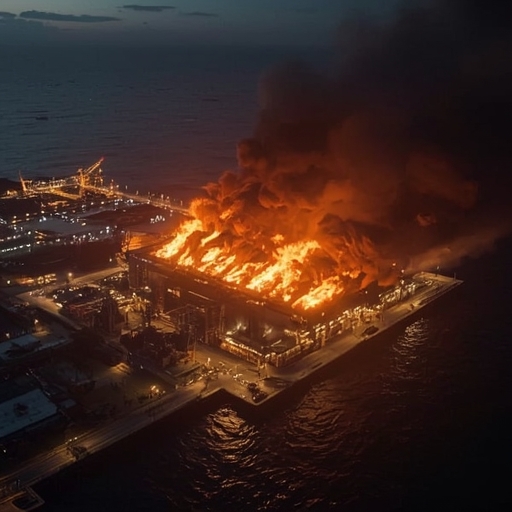
Ukraine has launched a new wave of long-range precision strikes that have reached far into the interior of Russia, targeting two particularly critical industrial sites: an explosives production facility located nearly one thousand miles from the Ukrainian border and a strategically vital oil terminal positioned along the Black Sea coast. These coordinated attacks, remarkable both for their depth and accuracy, represent a striking evolution in Kyiv’s operational reach and its ability to influence the broader dynamics of the war.
By successfully hitting infrastructure that lies deep within Russian territory, Ukraine demonstrates an increasingly sophisticated capacity to project force far beyond the front lines. The choice of targets—the explosives plant, essential for sustaining the Russian defense industry, and the maritime oil terminal, a node deeply woven into the country’s energy export network—suggests a deliberate strategic calculus. Each strike inflicts not only physical damage but also psychological pressure, signaling that the conflict’s geography is no longer confined to the immediate battlefield.
This development marks a notable stage in Ukraine’s broader defense campaign. What was once defined mainly by tactical resistance and territorial defense has now expanded into a campaign of strategic disruption—one designed to undermine Russia’s logistical foundations, interrupt production chains, and constrain its wartime economy. The precision of these long-distance operations illustrates that Ukraine’s defense sector continues to integrate advanced intelligence gathering, targeting technology, and international collaboration to achieve measurable results.
The implications of these deep strikes are far-reaching. On the geopolitical stage, they serve notice that Kyiv can no longer be viewed merely as a regional actor defending its own borders but as a force capable of shaping the security equilibrium across Eurasia. For global observers in the energy and security sectors, the attacks reverberate through multiple markets and diplomatic corridors, reminding analysts that the conflict is not only a military confrontation but also a contest over infrastructure, resilience, and control of strategic resources.
In essence, these operations communicate a message of endurance and tactical innovation from Ukraine. They embody the country’s endeavor to impose strategic costs on its adversary and illustrate how the character of modern warfare continues to evolve—intersecting precision technology, energy geopolitics, and the psychology of deterrence. As the conflict endures, such actions point to a new phase in which reach, timing, and impact may prove as decisive as the battles fought closer to the front.
Sourse: https://www.businessinsider.com/ukrainian-strikes-hit-russian-factory-black-sea-oil-security-source-2026-2