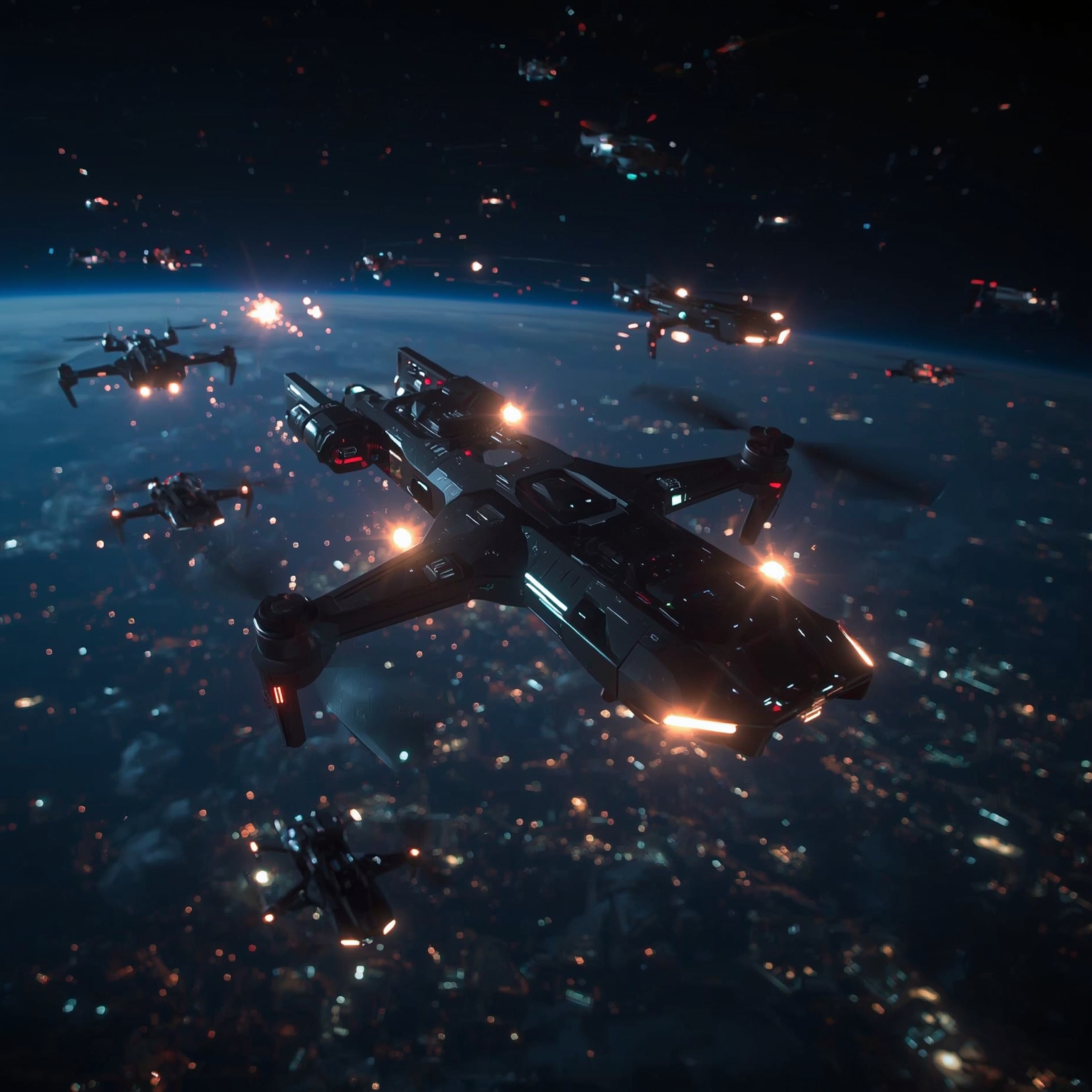
Ukraine now appears to be on the verge of achieving a decisive milestone in its evolving strategy of aerial defense. The country is preparing to construct the large-scale arsenal of interceptor drones it urgently requires — a development that could usher the world into an entirely new era of air combat. In this emerging form of warfare, skies will no longer be dominated solely by piloted aircraft or long-range missiles; instead, swarms of autonomous drones are expected to engage one another in fast-paced, machine-versus-machine battles that redefine air defense altogether.
On Monday, President Volodymyr Zelenskyy outlined his government’s updated production goals for these unmanned defensive systems. He explained that Ukraine aims to reach a manufacturing capacity of approximately six to eight hundred of these agile, low-cost quadcopters each day by late November. Each of these interceptors is engineered to track, pursue, and neutralize Russian attack drones during flight, thereby creating a protective barrier over Ukrainian territory. Although this latest target falls short of the president’s earlier and more ambitious objective — a thousand interceptors produced daily, announced in July — it offers a more pragmatic and realizable benchmark, providing a credible indicator of Ukraine’s near-term manufacturing capability.
Acknowledging the difficulty of sustaining such an intensive production effort amid a protracted war, Zelenskyy conceded that the plan was anything but simple. “I said that in the fall, there will be up to 1,000 interceptors produced per day. Of course, it’s not an easy story,” he noted, emphasizing the challenges of maintaining uninterrupted operations under the constant threat of hostile bombardment. The president further stressed that the success of this initiative depends on the absence of major disruptions stemming from Russian strikes or acts of sabotage. These attacks, he observed, frequently target not only Ukraine’s energy infrastructure but also its manufacturing and logistical facilities, thereby creating potential obstacles for the nation’s expanding defense industry.
Interceptor drones — uncrewed aerial vehicles engineered for exceptional speed, responsiveness, and maneuverability — are designed to engage enemy drones directly in flight, sometimes physically colliding with their targets or detonating small onboard explosives to ensure destruction. The concept provides a cost-efficient alternative to traditional Western surface-to-air missile systems, which can cost anywhere from several hundred thousand to several million dollars apiece. This dramatic cost disparity explains Kyiv’s strong commitment to producing these smaller, nimbler defense assets en masse. Russia has increasingly adopted tactics intended to saturate Ukrainian air defenses, often releasing dozens or even hundreds of Shahed attack drones, accompanied by Gerbera decoys and advanced missile barrages, within a single coordinated assault. Ukraine’s interceptors thus serve a vital purpose: to offer an affordable and scalable countermeasure capable of neutralizing these threats in real time.
The cost-effectiveness of this approach is particularly evident when one considers that the Iranian-designed Shahed-136 — one of Russia’s primary attack drones — is believed to cost between twenty thousand and seventy thousand U.S. dollars per unit. Given such figures, Ukraine’s challenge lies in finding a way to eliminate these drones using defensive systems that are inexpensive enough to be deployed in comparable numbers. Over the past year, Ukrainian engineers and private manufacturers, supported by local defense initiatives, have been refining the performance, durability, and control systems of these interceptors. Their goal has been to make them faster, more agile, and more responsive, all while reducing production costs. This effort has unfolded in the context of continued Russian strikes that have damaged energy systems, disrupted supply chains, and devastated urban areas, underscoring the urgency of creating an air defense solution that is both resilient and sustainable.
President Zelenskyy’s revised projections, paired with his confidence in the maturity of local manufacturing capacity, suggest that months of experimental development and field testing are culminating in a transition toward full-scale production. This transition reflects more than just industrial success; it marks a significant evolution in Ukraine’s broader defense doctrine, which has increasingly embraced technological innovation and decentralized manufacturing to maintain flexibility under wartime pressure. As with numerous other military systems first tested in Ukraine’s conflict, the rise of interceptor drones will almost certainly draw the attention of defense ministries and research institutions across the globe. Many foreign militaries are already pursuing their own programs to build similar unmanned aerial interceptors, studying Ukraine’s experience as a real-time laboratory for modern air warfare.
Indeed, Western defense firms have begun unveiling comparable designs, such as the German-developed Jaeger (‘Hunter’) drone, which illustrates how the concept of autonomous aerial interception is spreading internationally. Within Ukraine, organizations such as the ComeBackAlive foundation have played an essential role in connecting private innovation with military needs. Taras Tymochko, a project lead associated with this group, reported that local interceptor drones currently cost between three thousand and six thousand dollars each, depending on their technological configuration and the level of technical support included. These relatively low prices — when measured against the cost of intercepting enemy ordnance with traditional weapons — make the concept attractive not only to Ukraine but potentially to other nations seeking economical air defense solutions.
Whether the rapid expansion of interceptor drone production will fully relieve the pressure on Ukraine’s air defense network remains uncertain, but early battlefield reports provide encouraging signs. The Sternenko Foundation, another Ukrainian crowdfunding initiative, announced to its donors in late October that its financed interceptors, known as the Sting, were credited with destroying nine of ninety incoming Russian drones detected during a single night of combat. On a broader scale, President Zelenskyy stated in September that Ukrainian interceptor systems had successfully hit one hundred and fifty Russian Shahed and Gerbera drones out of a total wave of eight hundred ten in a single operation. These figures, while subject to operational conditions and ongoing refinement, point toward increasing effectiveness and hint at how drone-on-drone engagements may come to define the next chapter of global air defense tactics.
Sourse: https://www.businessinsider.com/ukraine-interceptor-drone-war-800-production-zelenskyy-2025-11


