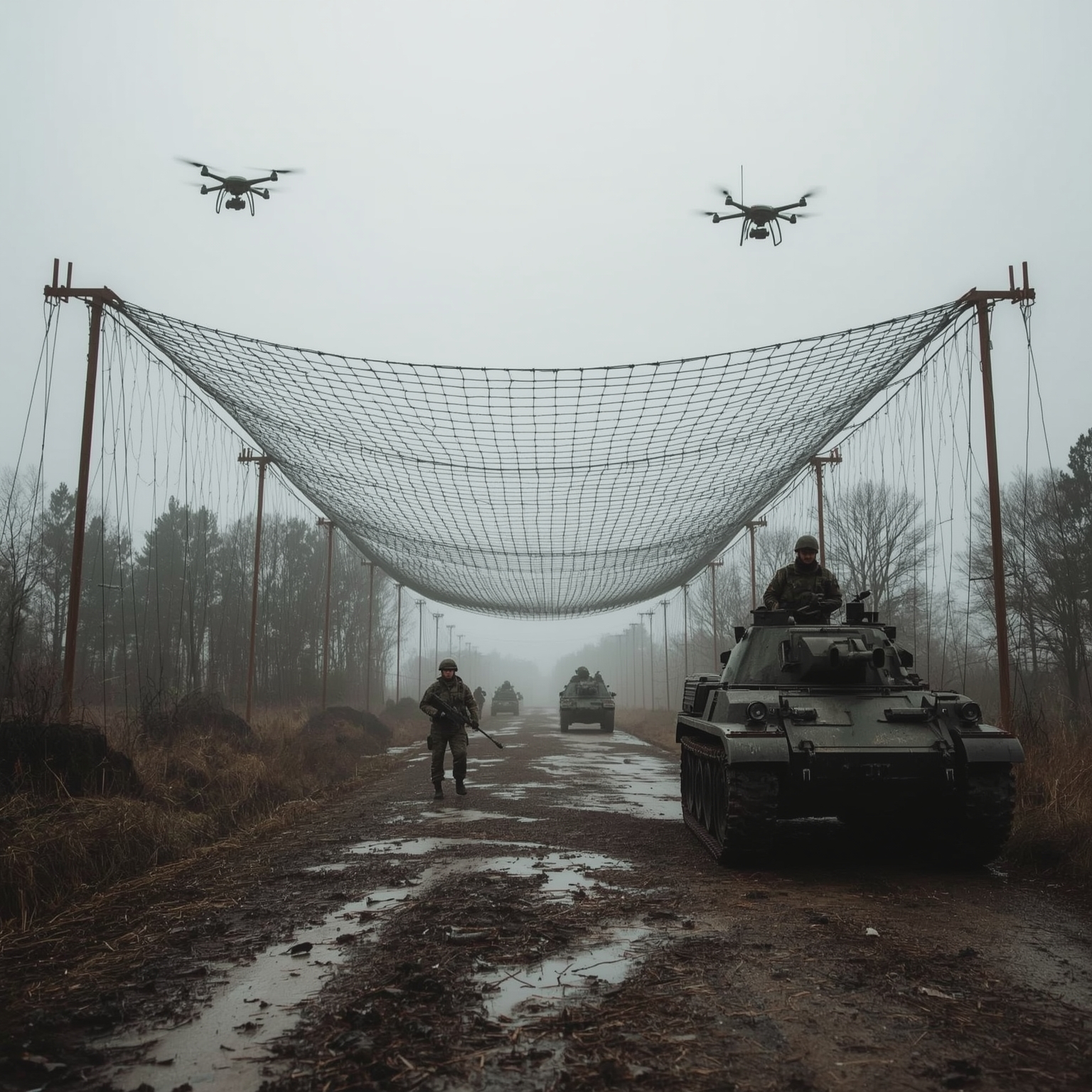
Living under the unrelenting menace of aerial surveillance and attack, Ukrainian troops have devised an improvised yet increasingly sophisticated method to safeguard their movements near the volatile front lines. By covering vital supply routes and frequently used roads with expansive layers of netting, they transform otherwise exposed passageways into makeshift protective tunnels. This network of overhead defenses does not eliminate the danger posed by Russian drones, yet it substantially improves the chances of vehicles and personnel surviving a sudden strike while in transit.
The ingenuity behind this so‑called anti‑drone netting lies in its simplicity. Raised on tall poles positioned strategically along the edges of crucial roadways, the mesh forms a canopy that obstructs or entangles incoming drones. These nets are reminiscent of large fishing lines stretched across water, designed to ensnare the small propellers of unmanned aircraft that rely on precision to track and strike moving military convoys. By installing these barriers, Ukrainian forces create an artificial roof under which logistics and frontline supply operations can continue with a measure of concealment and protection, offering a vital buffer from weapons that have become synonymous with modern battlefields: highly mobile, inexpensive, and explosive‑laden drones.
Despite the cleverness of this defensive measure, Russian drone operators still demonstrate a significant capacity to adapt. Even when confronted with the daunting obstacle of netting, skilled pilots identify weaknesses and exploit openings in coverage, occasionally laying ambushes by waiting patiently for the opportune moment to strike as Ukrainian vehicles travel down the otherwise protected roads. Such tactics illustrate both the cat‑and‑mouse nature of drone warfare and the constant evolution of countermeasures. According to reports reviewed by Business Insider, some attackers have even emulated techniques from earlier conflicts, positioning drones along the roadside in a manner reminiscent of improvised explosive devices used extensively in the Middle East. Yet these airborne versions have the added menace of being able to pursue and engage targets directly, heightening the risk for those on the move.
Visual evidence underscores the effectiveness and prevalence of this defensive approach. One recorded video, filmed from within a Ukrainian military vehicle, captures rows of poles that, at first glance, could be mistaken for ordinary telephone lines. Instead, they stretch across a gravel road to support interlaced netting above, forming a grid of protective strands. In the absence of this innovation, the occupants of the vehicle would have been dangerously vulnerable, subjected to direct observation and possible destruction by encroaching Russian drones.
The widespread adoption of this tactic has been rapid. As explained by Alex Eine, a section commander within Ukraine’s Separate Presidential Brigade, initially only limited areas close to the front benefited from such netting. Within a matter of weeks, however, entire networks emerged, extending through key arteries not only between rural villages but also along interior streets as much as ten kilometers behind active front lines. The swift proliferation reflects both the pressing necessity of countering drones and the adaptability of Ukrainian soldiers in implementing makeshift but effective solutions. According to Eine, the results have been encouraging, with the nets forming perhaps the only reliable defense against certain classes of drones, particularly fiber‑optic types tethered to pilots by cables that render them nearly invulnerable to conventional electronic jamming or other counter measures affecting radio‑controlled aircraft.
Nevertheless, vulnerabilities remain. Gaps in the overhead grids create exploitable paths, and only highly skilled drone operators can maneuver through the inconsistencies in coverage, given challenges such as fluctuating terrain and signal interference. Fiber‑optic drones, while resistant to electronic disruption, are constrained by the finite length of their cables, making it exceptionally uncommon for them to navigate from effective range, locate an opening, and successfully breach the defenses. On the other hand, radio‑frequency drones face difficulties flying at low altitudes with sufficient control due to uneven ground elevations, which restricts their capacity to make use of small intervals in the netting.
Yet Russian forces have demonstrated persistence in overcoming these obstacles, deploying strategies such as landing their drones on the shoulders of roads and lying in wait, a practice echoed from past insurgent campaigns against Western militaries but adapted to suit the unique dynamics of airborne threats. Inevitably, some Ukrainian vehicles have been destroyed in such ambushes, emphasizing the limits of any single protective system. Still, the effectiveness of the nets in reducing overall vulnerability cannot be dismissed. Even partial shielding can mean the difference between safe passage and devastating loss.
This emphasis on innovative protection strategies reflects the broader transformation of warfare in Ukraine, where drones have emerged as one of the deadliest and most influential tools. Both Kyiv and Moscow have institutionalized such technologies, not only by refining aerial strike capabilities but also by constantly adjusting ground defenses. The netting represents just one example of this evolving landscape. Another adaptation visible on both sides has been the attachment of cage armor to tanks and other armored vehicles, a defensive measure initially considered experimental yet now a common sight across theaters of war. These lattice‑like additions act as external shields against aerial munitions, reinforcing the broader trend of militaries repurposing readily available materials to offset the threat from above.
In sum, the rapid deployment of anti‑drone netting above Ukraine’s frontline roads highlights both the ingenuity and vulnerability inherent in modern combat. While no defense is flawless, these improvised tunnels showcase the determination of Ukrainian soldiers to mitigate the deadliest threats facing them. At the same time, their existence testifies to the central role drones now play in shaping strategy, survival, and the very nature of twenty‑first‑century warfare.
Sourse: https://www.businessinsider.com/ukraine-anti-drone-road-nets-effective-russian-pilots-finding-holes-2025-9