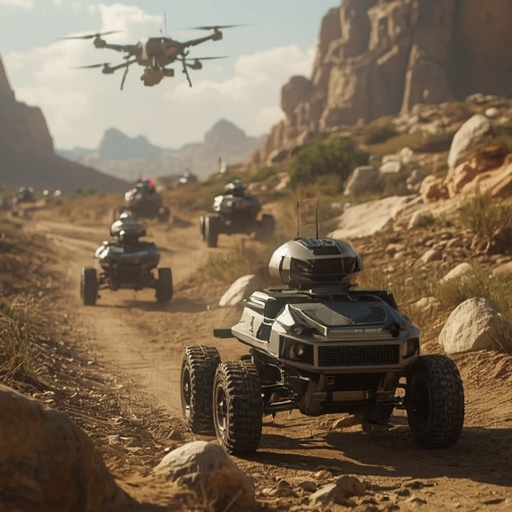
Ground-based drones, although increasingly visible across Ukraine’s active front lines, continue to be vastly outmatched in both deployment and operational significance by their airborne counterparts—the small, agile aerial drones that have come to symbolize the evolving nature of the war. Despite growing public interest and ongoing experimentation, these terrestrial machines still represent only a minute fraction of Ukraine’s overall drone activity. In fact, as of November, uncrewed ground vehicles (UGVs) constituted less than 0.66% of the total drone missions recorded—a figure that dramatically emphasizes their still-limited role compared to the massive presence of aerial technology.
This data was formally presented on a Tuesday by Oleksandr Syrskyi, the Commander-in-Chief of Ukraine’s Armed Forces, during an official briefing that outlined the broader military and strategic conditions facing the country through the approaching winter months. In his report, Syrskyi observed that at this phase of the conflict, unmanned aerial vehicles (UAVs) are responsible for executing roughly 60% of all offensive actions and precision strikes targeting Russian positions. These airborne assets have become indispensable to modern Ukrainian warfare, serving as critical instruments for both reconnaissance and direct engagement.
Syrskyi revealed that during November alone, Ukrainian UAVs carried out in excess of 304,000 missions—a staggering operational tempo that resulted in approximately 81,500 successful strikes or confirmed target destructions. He further added that this indicator, reflecting the use and effectiveness of aerial drones within Ukrainian forces, has shown a steady upward trajectory for six consecutive months. Meanwhile, ground-based systems lagged far behind in comparison: Ukrainian UGVs conducted only around 2,000 missions within the same time frame, highlighting the technological and logistical disparity between the two categories.
Such figures demonstrate, with striking clarity, that aerial drones continue to dominate Ukraine’s contemporary battlefield landscape. UGVs, while technologically promising, are still in the early stage of tactical integration. Ukraine’s defense establishment and innovation sector are actively seeking ways to broaden their deployment, aiming for a future where these autonomous ground systems operate alongside more established technologies. In this context, dozens of Ukrainian firms and military units have embarked on the development of their own prototype vehicles—ranging from small, nimble wheeled machines built for reconnaissance or supply delivery to full-sized, heavily outfitted trucks equipped with remote-controlled weapon stations and machine-gun turrets.
The utilization of uncrewed ground platforms by both Ukrainian and Russian forces has been gradually increasing over the past year, yet the scope and specialization of these machines remain relatively nascent. Ground drones prove particularly valuable because they can undertake perilous missions that would otherwise endanger human soldiers—tasks such as mine-clearing, transporting supplies under fire, or advancing in contested zones fraught with enemy surveillance. Ukrainian engineers are designing them for diverse operations: direct combat assaults, road monitoring, logistical support, and even reconnaissance in low-visibility conditions. In some areas, combat units have already begun to coordinate aerial and ground systems in synchronized formations. For instance, in Pokrovsk, Ukrainian troops reportedly used a UGV to detect Russian vehicles through dense fog, later coordinating attacks with explosive-equipped aerial drones to devastating effect.
Meanwhile, Russia has accelerated its own efforts in the sphere of autonomous warfare. Moscow has been not only expanding the design and manufacture of UGVs for logistical and rocket artillery applications but has also introduced innovative types of aerial platforms with advanced features, such as fiber-optic, unjammable drones. These systems, once rare, have now started to proliferate across the battlefield. Reports throughout the year have repeatedly indicated that the Kremlin’s military establishment is integrating drone warfare ever more deeply into its operational doctrine—boosting mass production, forming official drone regiments, and devising novel combat tactics inspired by Ukrainian successes.
At one stage, according to Syrskyi, Russia achieved what he called a temporary “period of parity” with Ukraine in the use of FPV (first-person-view) drones—custom-modified hobby models adapted for precision attacks by carrying explosive payloads directly into enemy targets. Intelligence assessments now indicate that Russia aims to scale its production to the unprecedented goal of delivering up to half a million FPV drones per month to its frontline troops. However, Syrskyi noted that Ukraine has recently regained the advantage in this technical race, surpassing Russian forces in FPV drone utilization and effectiveness. Reinforcing this point, he stressed that Ukraine’s response must remain both asymmetric and efficient—emphasizing the need to neutralize hostile drone activity and dismantle the infrastructure that sustains Russia’s unmanned warfare units.
In summing up his remarks, Syrskyi delivered a sobering reflection on the broader course of the war. He warned that Ukrainian forces have faced some of their most formidable challenges since the beginning of the full-scale invasion. The coming winter, he cautioned, will compound these difficulties, as civilians and soldiers alike must again prepare for weeks of subfreezing temperatures expected to intensify through January and February. With continued Russian attacks targeting Ukraine’s energy infrastructure, access to heat and electricity has grown increasingly precarious, underscoring the human toll and the technological adaptation defining this phase of the conflict.
Sourse: https://www.businessinsider.com/ukraine-ground-drones-popular-less-missions-oleksandr-syrskyi-2025-12