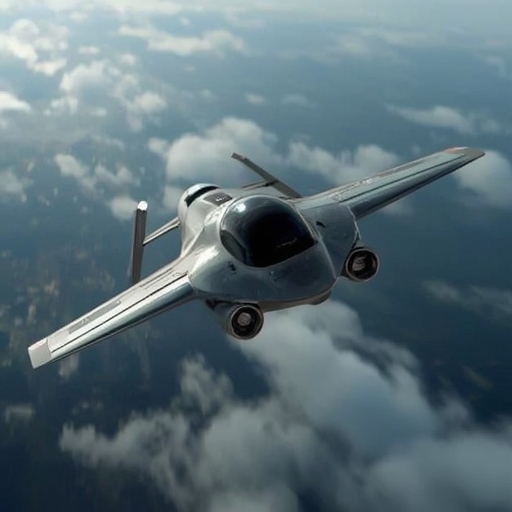
A compact Ukrainian-made drone, specifically engineered to pursue, intercept, and neutralize other unmanned aerial vehicles, has recently accomplished a remarkable technological feat by accelerating to a speed of approximately 400 kilometers per hour, or nearly 248.5 miles per hour. This achievement, announced by Kyiv’s Minister of Digital Transformation, Mykhailo Fedorov, on Tuesday, highlights a striking advancement in the nation’s rapidly evolving drone industry. Fedorov revealed in a social media post that the high velocity was reached by what he described as an interceptor drone powered by a motor produced by Motor-G, one of the innovative entities operating under Brave1UA—a Ukrainian defense innovation platform that brings together private engineers, state institutions, and technology visionaries to promote cutting-edge defense solutions.
The drone’s capacity to reach this extraordinary velocity is not merely a matter of record-breaking statistics; it places the small aircraft in impressive company. For context, the drone’s achieved speed surpasses even the official Formula 1 record set in 2016 by Finnish driver Valtteri Bottas, who reached a peak of 231.46 miles per hour during a timed session. To further illustrate this, the interceptor now travels at nearly the same pace as the world’s fastest high-speed trains. The Shanghai Maglev, a train renowned for technological sophistication and precision engineering, reached 280 mph during experimental trials, although it typically operates commercially at about 186 mph. Thus, a small, propeller-driven drone achieving an airspeed comparable to that of advanced maglev systems underscores the extraordinary progress being made in Ukraine’s defense engineering sector.
Unlike fighter jets or supersonic projectiles, this interceptor drone relies on propeller propulsion and conventional motor-driven thrust rather than complex jet engines or high-combustion turbine systems. The fact that such performance can be achieved with relatively inexpensive materials and simple design principles speaks to the growing sophistication of Ukrainian aeronautical innovation. Economically, these interceptor drones represent cost-effective warfare technology: each unit typically costs under six thousand U.S. dollars, enabling mass production and deployment without placing heavy strain on the national defense budget. Their affordability further aligns with Ukraine’s broader wartime strategy of scaling up low-cost, high-performance solutions to counter enemy aerial threats efficiently.
This milestone exemplifies the transformative impact of the ongoing conflict on Ukraine’s domestic arms and technology industries. What once began as improvisational or semi-hobbyist projects—often handcrafted in small workshops—has evolved into a robust ecosystem capable of producing some of the fastest and most agile unmanned vehicles in modern combat. Just a few months ago, another Ukrainian-built interceptor drew significant attention for achieving a top flight speed of about 195 miles per hour, a record that now pales in comparison to this new benchmark.
Looking ahead, Kyiv has expressed increasingly bold ambitions to introduce and export its combat-proven drone and missile technologies to international markets. Officials assert that Ukrainian-designed drones, missiles, and anti-aircraft systems have undergone extensive real-world testing during engagements with Russian forces, giving them credibility and field validation that theoretical testing could never fully replicate. In his latest address, Fedorov shared a video documenting production growth, noting that it had once seemed inconceivable for Ukraine to produce high-performance drone motors domestically. Yet, only two years later, the company Motor-G is manufacturing an astounding 100,000 motors per month—a figure that epitomizes Ukraine’s accelerating industrialization under wartime pressure. “Today, more and more drones are taking flight on Ukrainian-made motors,” Fedorov emphasized, underscoring a decisive shift toward technological self-sufficiency.
The government’s concentrated focus on increasing drone velocity stems primarily from a strategic necessity: Russia’s continued development of new variants of the Iranian-designed Shahed loitering munitions. These drones, often launched in swarms, travel at speeds typically ranging from 115 to 180 mph and are designed to saturate and overwhelm Ukrainian aerial defense systems through sheer numerical advantage. This persistent challenge has spurred Ukraine’s defense innovators to devise affordable interceptor drones capable of rapidly neutralizing incoming threats before they can reach critical targets.
Nevertheless, reports from the front lines indicate that Russia has already begun experimenting with more advanced, jet-powered iterations of the Shahed, capable of reaching airspeeds around 230 mph. The emergence of these faster attack drones, first identified in early 2024, initially raised serious concerns among Ukrainian analysts who feared that the new generation of Shaheds might outpace domestic interceptor technology. However, recent combat footage and technical assessments suggest that Ukrainian engineers have successfully narrowed the performance gap. One notable video clip circulated in late November portrays a jet-powered Shahed being overtaken from behind by a Ukrainian interceptor in flight, a visual testament to the remarkable adaptability and engineering resilience characterizing Ukraine’s defense industry today.
Sourse: https://www.businessinsider.com/ukraine-small-propeller-drones-fly-faster-formula-car-fedorov-2025-12