Far beyond the immediate front lines, well behind the zone of direct engagement, Ukraine’s essential resupply convoys are facing an ever‑increasing level of danger. What was once a predictable, if hazardous, logistical operation has become a complex and perilous undertaking. Soldiers stationed at the so‑called “zero line” — a narrow and chaotic strip of terrain where Ukrainian defenses meet Russian offensives — spend weeks at a time immersed in a harsh landscape of shattered soil, interlaced trenches, and partially collapsed bunkers. Within this desolate environment, they depend entirely on lifelines of supply trucks that must traverse routes littered with landmines and exposed to unpredictable artillery fire. For years, this grim pattern has characterized life at the frontline. However, beginning in the spring, Russian forces have introduced a new and increasingly insidious tactic: the deployment of small, explosive‑laden quadcopters capable of infiltrating Ukrainian rear areas, where they lie in ambush, ready to strike unsuspecting logistics vehicles.
When a Ukrainian convoy approaches, these so‑called ambush drones can attack from shockingly close range — sometimes appearing only thirty feet from their targets before detonating. Certain variants are equipped with solar panels that enable indefinite lurking, while others are designed to be resistant to electronic jamming through the use of fiber‑optic communication links. Collectively, these adaptations have transformed the region behind the zero line into a kind of intelligent minefield, where each quiet patch of terrain could conceal a lethal, autonomous threat. Recognizing the urgency of this new battlefield reality, one Ukrainian entrepreneur believes his company’s technological innovation can help mitigate such dangers.
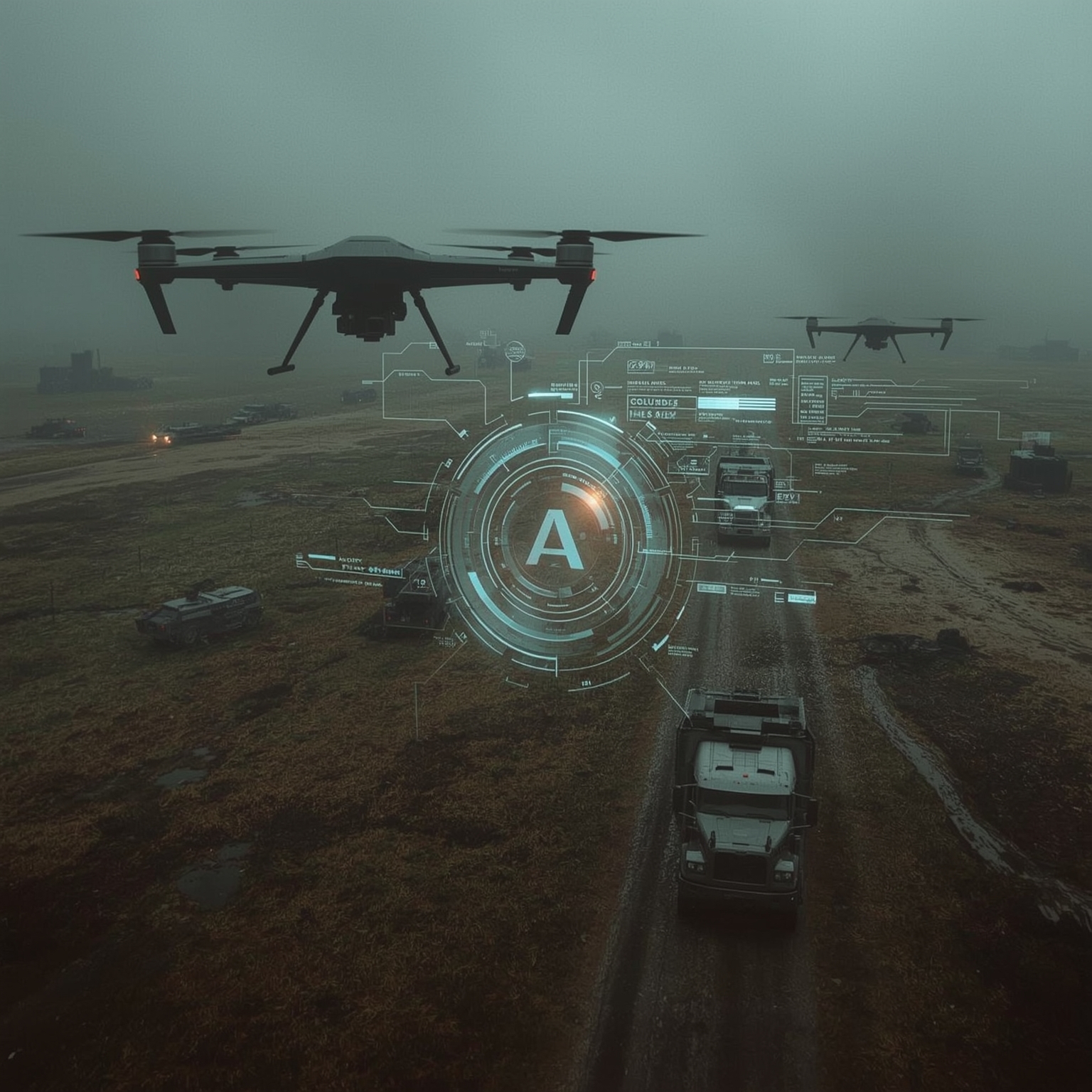
V’yacheslav Shvaydak, a Ukrainian engineer and founder of the Denmark‑based drone company Dropla, has been devoting significant effort to training an artificial intelligence system intended to identify hidden ambush drones before they strike. His team’s creation, an advanced software suite known as Blue Eyes, processes real‑time video streams from inexpensive reconnaissance quadcopters flying over supply routes. Originally, Shvaydak envisioned these drones simply scouting ahead of convoys, with Blue Eyes automatically analyzing both optical and thermal imagery to highlight anti‑personnel and anti‑tank mines that Russia often fires or plants near the front. The concept has since expanded dramatically, integrating AI‑driven detection for airborne threats as well.
Speed, Shvaydak explains, is not a luxury but an absolute necessity. The software must process imagery instantaneously because hazardous conditions on a battlefield evolve minute by minute. If surveillance drones were to complete a flight, return to base, and only then process data, operators might experience a thirty‑minute delay — enough time for the entire situation to change fatally for a moving convoy. Therefore, the drones and their convoy counterparts must operate in synchrony, continuously feeding live imagery to Blue Eyes, which immediately interprets the data and sends alerts to command units.
Behind the innovation stands a team of more than two dozen Ukrainian engineers who have spent months teaching the AI model to recognize over 170 distinct forms of explosive ordnance — from standard landmines to improvised traps scattered across local terrain. In response to the rising threat of ambush drones observed over the summer, Shvaydak’s group trained Blue Eyes to detect stationary quadcopters hiding above or behind cover. Once the system identifies a potential threat, it transmits exact coordinates to Ukraine’s digital battle‑management network. Commanders can then decide whether to reroute convoys around mines or, in the case of drones poised to attack, neutralize them before proceeding. Each successful detection potentially spares multiple lives or saves costly unmanned vehicles, underscoring the technology’s lifesaving potential.
Federico Borsari, a specialist in drone warfare at the Center for European Policy Analysis, emphasizes that Ukraine must move swiftly to counter these ambush drones, particularly in heavily contested regions such as Pokrovsk, Kupyansk, and Kursk. When combined with Russia’s remote deployment of new mines, ambush drones can disrupt entire logistical chains, forcing supply operations to maintain constant vigilance even in rear areas thought to be relatively safe. To mitigate the risks, convoys must maintain continuous situational awareness within fifty kilometers of the front line, essentially treating friendly territory as an active combat zone.
Traditionally, detecting hidden quadcopters would require an extensive network of radio and optical sensors — an expensive and time‑consuming infrastructure challenge. Yet as Borsari points out, Russia’s offensive tools are remarkably inexpensive relative to their devastating impact, compelling Ukraine to pursue equally cost‑effective defenses. In that context, Dropla’s Blue Eyes provides a promising solution. The system’s simplest variant consists of a compact 2.1‑kilogram metal housing that runs the AI software and connects directly to Ukraine’s command‑and‑control hubs. Compatible with virtually any quadcopter equipped with a camera, the device can also be paired with Dropla’s own drones and control hardware for integrated performance.
As a drone flies over a chosen route, Blue Eyes receives a continuous stream of footage, analyzing up to 130 video frames each second to identify potential threats. Shvaydak intends to increase this processing rate, thereby enabling drones to fly faster while maintaining detection accuracy. Currently, the scouting drones must travel at less than half the speed of trucks to ensure that the AI can review every frame in real time. Though he declined to reveal financial details, operational limits, or precise detection statistics, Shvaydak confirmed that several frontline units have been testing the technology under live combat conditions since early summer. Dropla plans to expand its field deployments fivefold over the coming months, reflecting confidence in the system’s practicality.
Ukrainian soldiers employing Blue Eyes receive continual updates derived from new AI training data, with model iterations released weekly. This rhythm mirrors trends in modern defense technology, where agility and continual software enhancement are central to maintaining superiority. Comparable philosophies underpin platforms created by global defense firms such as Anduril and Saab, which integrate sensors and autonomous decision‑making into cohesive digital ecosystems. Within Ukraine itself, AI‑assisted warfare has grown increasingly central, seen in systems like DELTA — a battle‑management platform that merges intelligence from open sources, satellites, drone imagery, and human observers. President Volodymyr Zelenskyy has publicly warned that the world is witnessing an accelerating “AI arms race,” one in which autonomous drones may soon engage targets with minimal or no human oversight, amplifying both strategic capability and ethical complexity.
Historically, route‑clearance operations have been elemental to warfare — from Iraq to Afghanistan — where convoys were persistently targeted by enemy explosives. Modern drones, however, extend that threat both vertically and geographically; they allow adversaries to strike targets over vast distances without risking personnel. The ongoing development of ambush drones starkly illustrates how contemporary armed forces must innovate continuously to survive. As Borsari notes, this dynamic carries lessons far beyond Ukraine: militaries that fail to iterate and adapt risk confronting evolving technologies faster than they can formulate countermeasures. In today’s battlespace, technological stagnation is synonymous with vulnerability, and innovations like Dropla’s Blue Eyes serve as a testament to how agility, intelligence, and resourcefulness can redefine defense in the era of autonomous warfare.
Sourse: https://www.businessinsider.com/ukrainian-startup-dropla-blue-eyes-russian-ambush-drones-artificial-intelligence-2025-10