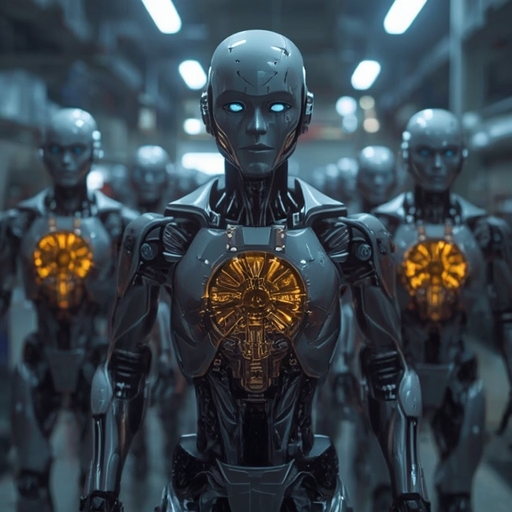
Beneath the polished exteriors and elegantly engineered casings of America’s emerging humanoid robots lies a profound tale of international collaboration—one that transcends borders, languages, and political boundaries. What might appear at first glance as a purely domestic technological triumph is, upon closer examination, the manifestation of a global ecosystem of talent, resources, and innovation. As leading American companies such as Tesla and a growing array of technology pioneers forge ahead to define the contours of the future, they do so through intricate networks of supply, design, and component integration that span continents. Within this delicate lattice of cooperation, components of Chinese origin often occupy crucial roles, serving as the silent enablers of motion systems, sensory arrays, and intelligent control frameworks that bring these advanced machines to life.
This emerging relationship between American ingenuity and Chinese manufacturing precision illustrates an essential truth about the twenty-first-century robotics revolution: progress in artificial intelligence and advanced automation is no longer an isolated national pursuit, but a global symphony of ideas and craftsmanship. The creation of humanoid machines capable of mimicking human dexterity, perception, and cognition relies on a rich constellation of global partnerships where innovation flows through shared knowledge, complementary expertise, and pragmatic interdependence.
At its core, the race to build the most capable autonomous machines has evolved into one of the most strategic technological competitions of our era—an arena where innovation serves not only economic ambitions but also geopolitical influence. As Western innovators refine robotic intelligence and design philosophies, their counterparts across Asia contribute vital material technologies, component manufacturing, and cost-efficient scalability. Together, they form a dynamic ecosystem in which the boundaries between collaboration and competition continuously blur.
Meanwhile, governments and industries in Washington and Beijing alike are recognizing that the development of humanoid robotics and artificial intelligence will help define the technological balance of power for decades to come. Each nation seeks leadership in this transformative field, aware that advances in robotics are poised to reshape labor markets, manufacturing systems, and even the philosophical relationship between humans and machines. Yet despite this strategic rivalry, the reality of global interconnection persists: the power that drives the servos of a robot’s arm or animates an intelligent sensor often embodies the shared effort of researchers, engineers, and manufacturers from across the world.
Thus, the narrative unfolding beneath the metal surface of these futuristic creations tells a story not of competition alone, but of collective progress. In the gleam of every sensor, in the synchronized rhythm of each actuator, one can trace the imprints of international collaboration—a testament to how deeply entwined modern technological advancement has become. The global race for robotics is no longer merely a contest of speed or supremacy; it is a demonstration of humanity’s shared drive to extend the boundaries of intelligence and embodiment, wherever innovation may arise. #AI #Robotics #GlobalInnovation #FutureTech
Sourse: https://www.wsj.com/tech/under-the-skin-of-americas-humanoid-robots-chinese-technology-27dd4fdf?mod=rss_Technology