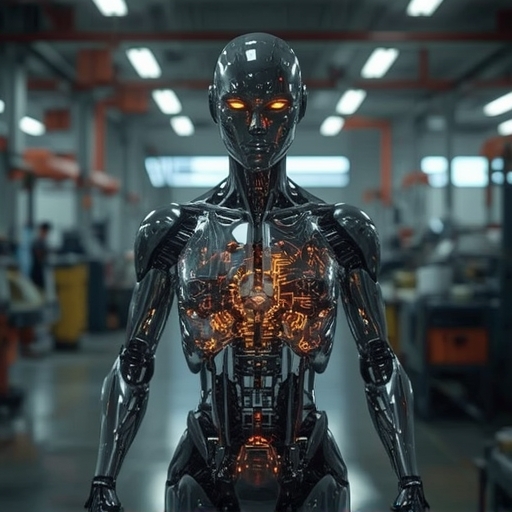
Beneath the captivating surface of America’s rapidly evolving humanoid robotics movement lies a web of global interdependence that reveals far more than sleek engineering and visionary ambition. What appears at first glance to be a distinctly American achievement—robots conceived, designed, and assembled by leading innovators such as Tesla and other U.S. technology pioneers—is, upon closer examination, a sophisticated collaboration that stretches deeply into China’s vast industrial and technological landscape. Chinese suppliers quietly furnish many of the foundational components essential to these machines’ very existence: precision sensors, advanced microchips, actuators, and other intricate technologies without which the dream of lifelike automation would remain unrealized.
This complex relationship illustrates how the global race for supremacy in robotics has evolved into a strategic contest that resembles an immense chessboard spanning continents. No longer can any single nation, however advanced, command the full spectrum of expertise and resources necessary to dominate this arena in isolation. The synergy between American creativity and Chinese manufacturing capacity underscores both the promise and the peril of globalization in the twenty-first century. On one hand, such collaboration accelerates innovation, reduces production costs, and fosters a planetary ecosystem where technological ideas traverse borders with unprecedented speed. On the other, it introduces pressing strategic questions about dependency, intellectual property, and the delicate balance between partnership and rivalry.
For policymakers, industry leaders, and researchers alike, the intertwining of U.S. and Chinese expertise forces a profound reevaluation of how nations approach security, supply-chain resilience, and cooperative innovation. Should American firms continue to rely on their Chinese counterparts for specialized hardware, or should they seek to develop more autonomous domestic supply networks? At the same time, can technological and political competition coexist with meaningful collaboration on shared global challenges such as standardization, ethics in artificial intelligence, or sustainable production methods?
What emerges is a nuanced portrait of the humanoid robotics frontier—a realm where innovation is born not only from mechanical ingenuity but also from diplomatic intricacy and economic interdependence. The next generation of humanlike machines may appear unmistakably American in form, their exteriors bearing the sleek signatures of Silicon Valley and U.S. engineering culture. Yet within their metallic frames and neural networks, the rhythm of progress echoes from workshops, laboratories, and semiconductor foundries across China. In this sense, the humanoid revolution is far more than a technological milestone; it is a global narrative of collaboration, competition, and shared destiny that defines the modern era of robotics.
Sourse: https://www.wsj.com/tech/under-the-skin-of-americas-humanoid-robots-chinese-technology-27dd4fdf?mod=pls_whats_news_us_business_f