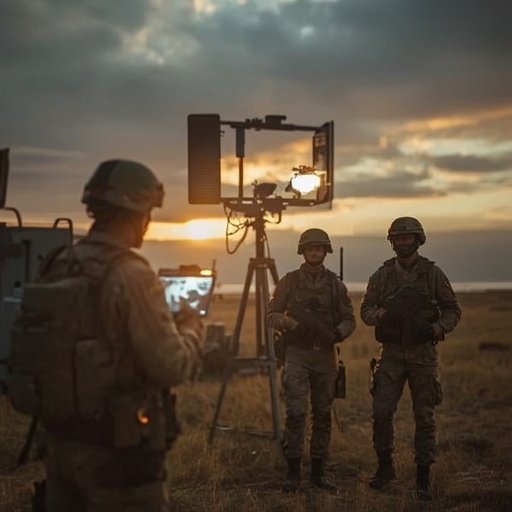
In a daring and highly controlled military experiment, the United States Army conducted a self-imposed test that pushed the boundaries of its most advanced command‑and‑control technology. Rather than simulating an enemy’s attempt to disrupt communications, the Army deliberately turned its own electronic warfare capabilities inward. This audacious decision allowed teams to experience—under safe but realistic conditions—what a total communications blackout would feel like in a real combat environment.
Once the deliberate jamming commenced, the entire network of communications and data exchange fell silent. What followed was a demonstration not only of technical capability but also of human ingenuity. Soldiers were forced to rely on contingency protocols, battlefield intuition, and cooperative problem‑solving to navigate an environment stripped of the very digital tools on which modern warfare depends. In moments, field units began to triangulate the source of the interference through observation, experience, and available equipment.
Their response showed the true purpose of the exercise: adaptability in chaos. Within a remarkably short period, teams identified the exact location of the jamming source and coordinated a precision strike using mortar systems. This swift and accurate neutralization exemplified the Army’s readiness to respond effectively to electronic warfare threats from adversaries. It transformed what could have been a debilitating handicap into an opportunity to prove the synergy between advanced technology and the tactical proficiency of its operators.
This exercise served as far more than a simple test of hardware endurance or signal integrity. It was a comprehensive assessment of resilience—of how leadership, training, and communication protocols perform under the stress of compromised systems. It also reinforced the importance of resilience-based innovation: designing systems that not only function in perfect conditions but also enable personnel to act decisively when those systems are degraded.
Beyond its immediate tactical implications, the test has strategic resonance. It suggests that the future battlefield will increasingly revolve around information dominance and electronic defense as much as physical maneuvering. By testing their own systems through self‑jamming, Army engineers and commanders gained valuable insights into vulnerabilities that could be exploited by adversaries, ensuring that new generations of command‑and‑control platforms will emerge even more robust and secure.
Ultimately, this self‑initiated disruption became a showcase of modern military philosophy: true technological advancement must always be paired with human adaptability, discipline, and creativity. By proving that its personnel could adapt swiftly in a digitally denied environment, the U.S. Army reaffirmed its commitment to maintaining supremacy not only through superior equipment but through the exceptional problem‑solving capabilities of its soldiers. What began as a controlled act of interference ended as a compelling demonstration of resilience, precision, and forward‑thinking innovation—a clear reflection of how the modern military redefines readiness for the electronic age.
Sourse: https://www.businessinsider.com/us-army-jammed-new-tech-ngc2-electronic-warfare-2026-2