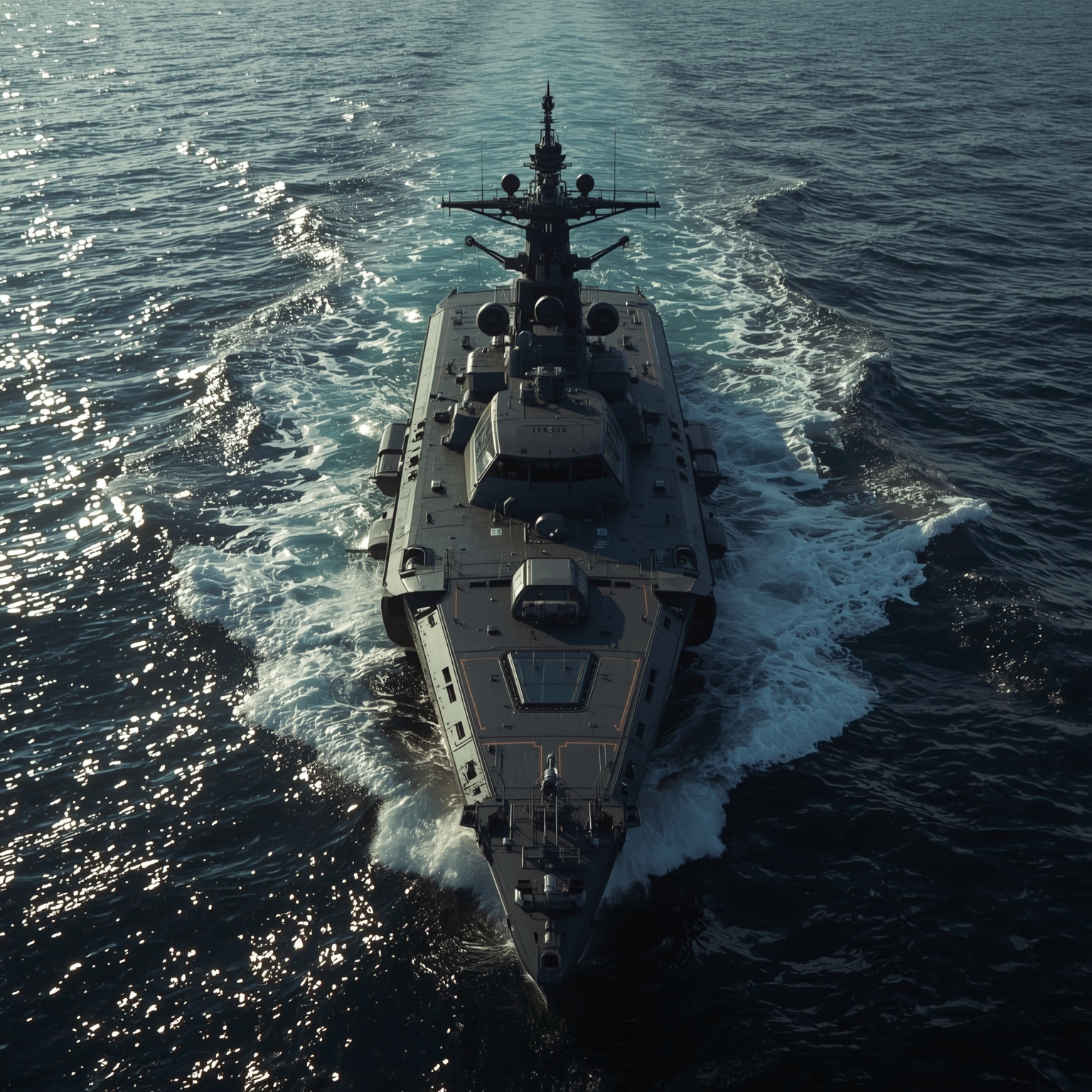
As the United States Navy intensifies its preparations for a potential future conflict with China, one of its most pressing and complex challenges lies in assembling a sufficiently large and well-suited fleet capable of conducting modern warfare across the Pacific. A crucial part of this evolving strategy centers on the development of long-range, autonomous maritime drones—uncrewed warships that could radically redefine the nature of naval engagements across such enormous distances. These advanced platforms, able to navigate and fight independently, promise to extend the Navy’s operational reach while significantly reducing direct human exposure to hostile environments and combat risks.
At the forefront of this transformation is Blue Water Autonomy, a Boston-based defense technology startup dedicated to creating these cutting-edge autonomous systems tailored to the Navy’s rigorous requirements. The firm recently announced a major milestone: successful tests of its maritime autonomy technology in live ocean conditions, marking a decisive step toward converting its conceptual designs into operational vessels. Company executives explained that Blue Water Autonomy distinguishes itself from industry peers by being the first organization to carry out iterative, full-scale testing of long-range, interchangeable ship-level components in real-world maritime settings rather than relying solely on simulations or laboratory trials. Its long-term ambition is to design and eventually mass-produce a fully autonomous combat vessel capable of participating in high-intensity warfare against technologically advanced adversaries like China—conflicts in which drone fleets could serve as force multipliers for traditional naval assets.
The potential strategic advantages of such uncrewed vessels are immense. In a theater as geographically vast and logistically complex as the Pacific Ocean, autonomous ships could expand the Navy’s total fleet presence and surveillance coverage, effectively functioning as extensions of existing battle groups. They could also enter and operate within highly contested maritime zones—areas too dangerous or politically sensitive for manned ships—thereby preserving human life while still asserting U.S. strategic influence. This shift mirrors a broader trend in contemporary warfare: from the Black Sea to the Red Sea, innovative militaries are adopting drone technologies at a rapid pace, forcing defense planners to reimagine not only modern offensive tactics but also defensive doctrines, fleet modernization strategies, and the delicate integration of emerging digital systems with established hardware.
The U.S. Navy’s official roadmap calls for a balanced future battle force composed of approximately 381 crewed warships augmented by 134 uncrewed surface and undersea vessels. Already, many smaller autonomous platforms—ranging from aerial and underwater drones to compact reconnaissance craft—are being developed by contractors throughout the American defense sector. Yet the Navy now seeks to take a decisive leap forward by cultivating a class of larger, ocean-spanning drone vessels capable of sustaining long-distance deployments and performing combat operations alongside crewed destroyers, cruisers, and carriers. Blue Water Autonomy sees itself as instrumental in achieving this vision, supplying the technological innovation necessary to counter China’s increasingly sophisticated and rapidly expanding naval capacities.
Founded in 2024, Blue Water Autonomy was conceived with a dual purpose: to build fully autonomous warships optimized for Pacific operations and to alleviate pressure on America’s overburdened, delay-plagued shipbuilding industry. These next-generation ships are designed to operate seamlessly alongside traditional human-crewed vessels, effectively multiplying fleet strength without demanding proportionate increases in manpower or shipyard output. According to CEO Rylan Hamilton—a former Navy engineer and surface warfare officer—the company has invested heavily in both physical hardware and proprietary navigational software, tested extensively along the Massachusetts coastline. Over the course of hundreds of hours at sea, its prototype system has demonstrated the capability to navigate independently, manage propulsion, and maintain operational endurance under realistic oceanic conditions. A larger, 150-foot-long prototype vessel is scheduled for launch in 2026, representing the next phase of scale and sophistication.
From a hardware perspective, Hamilton emphasizes that reliability is paramount. Autonomous systems operating thousands of miles from any crew support cannot afford mechanical failure; a motionless, uncrewed vessel stranded in open waters would negate the very advantages autonomy promises. Thus, Blue Water has concentrated on developing a robust propulsion architecture designed around redundancy—engineered so that even if one component fails, backups ensure sustained operation. In parallel, the firm’s software division focuses on refining autonomous navigation algorithms derived from technologies similar to those used in advanced self-driving vehicles such as Waymo’s in California. These algorithms allow the ship to chart, execute, and dynamically adjust its course between designated coordinates while responding to changing oceanic and weather conditions.
What sets Blue Water apart, Hamilton notes, is its insistence on iterative real-world testing prior to committing to full-scale shipbuilding. Unlike competitors that test autonomy modules in isolation, Blue Water integrates its entire system and trials it in maritime conditions, thereby identifying weaknesses early and improving design fidelity. The company has already secured an official contract with the Navy to continue this testing campaign and anticipates a production order within the next year to build operational versions at a Louisiana shipyard.
The backdrop to this innovation, however, is sobering. America’s domestic shipbuilding industry remains beset by systemic delays, cost overruns, and a declining skilled workforce—factors that severely constrain output at a time when naval demand is increasing. Although federal initiatives have been introduced to revive the sector, meaningful recovery could take years. Meanwhile, China’s naval shipyards continue to operate at staggering efficiency, producing new vessels at a rate that has already given Beijing the world’s largest naval fleet by sheer numbers. U.S. naval strategists see autonomy as a partial remedy: autonomous warships can be produced more rapidly, at lower cost, and in smaller facilities compared to traditional billion-dollar destroyers or carriers.
Co-founder and chief strategy officer Austin Gray elaborated earlier that Blue Water’s modular manufacturing approach enables the production of dozens of medium-sized autonomous ships within months, each built at compact yet technically advanced shipyards. Hamilton further revealed that these vessels are being engineered with sufficient endurance, payload capacity, and seakeeping ability to traverse the immense distances of the Pacific theater—capabilities essential for missions ranging from surveillance and electronic warfare to missile delivery and radar operations. Although each platform is expected to cost tens of millions of dollars—a considerable investment—they remain far more economical than crewed warships costing upward of several billion each.
In practical terms, a vessel with the range to sail from California to Taiwan and return—over 6,000 nautical miles—illustrates both the endurance and strategic reach envisioned for this fleet. Its structural design ensures stability in stormy conditions that would overwhelm smaller craft, making it a viable and reliable complement to the Navy’s core strike groups. Nonetheless, creating such a system poses formidable engineering challenges. Larger autonomous warships demand an unprecedented level of mechanical reliability, particularly in components like the engine room, which must function independently for extended periods without human intervention—a radical departure from traditional designs that rely on teams of engineers ready to respond instantly to malfunctions.
Hamilton acknowledges the magnitude of the endeavor: constructing a truly autonomous combat vessel, one capable of operating sustainably without a single on-board crew member, requires surmounting technological barriers that the Navy has never before fully tackled. Yet this monumental leap, he suggests, represents the logical evolution of naval warfare—a transformation in which digital intelligence, robust engineering, and strategic necessity converge to redefine how the United States projects power across the seas in the decades ahead.
Sourse: https://www.businessinsider.com/us-company-long-range-drone-ships-china-war-tested-tech-2025-11


