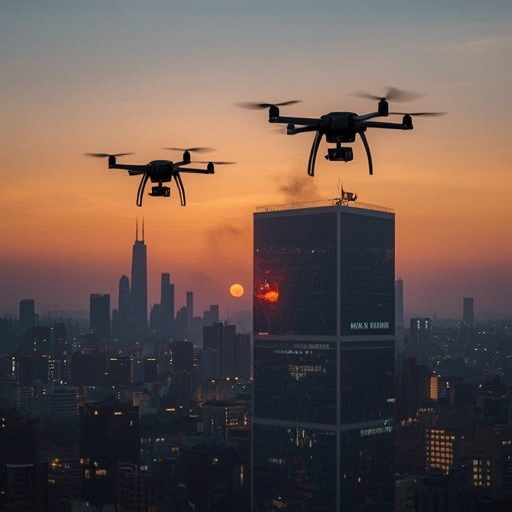
Saudi Arabian authorities have officially confirmed that the United States Embassy located in Riyadh was struck by two drones, an alarming event that briefly disrupted operations and sparked a localized fire. The flames were swiftly contained, resulting in only minor damage to the building’s exterior, yet the incident has prompted serious concern among both Saudi and international officials. According to the initial governmental brief, investigators are meticulously analyzing the debris and flight data in an effort to determine the exact trajectory, launch origin, and potential perpetrators responsible for the assault.
Witnesses in the diplomatic district reported hearing a faint buzzing sound moments before a small explosion illuminated part of the compound. Rapid emergency response measures were immediately enacted, and security personnel swiftly diffused the situation, preventing any escalation. Despite the relatively limited structural impact, the symbolic weight of the episode is significant; targeting an embassy represents not only a violation of international norms but also an implicit challenge to diplomatic sovereignty and regional stability.
This event comes amid an already volatile geopolitical landscape, where heightened tensions in the Middle East have contributed to an atmosphere of uncertainty and fragile alliances. While no group has formally claimed responsibility, analysts believe that such an action could be intended to test the defensive readiness of high-profile foreign institutions or to send a political message disguised as a low-casualty strike. The Saudi Ministry of Interior, in coordination with U.S. diplomatic security teams and intelligence agencies, has launched an intensive investigation aimed at identifying those involved and preventing potential future attempts.
Beyond the immediate security concerns, the drone strike underscores a wider global issue: the increasing accessibility and weaponization of unmanned aerial systems. In conflict-prone regions, this technology allows non-state or loosely affiliated actors to conduct operations that were once the domain of conventional militaries, expanding the threat landscape significantly. Security experts emphasize that even minor incidents, when directed at diplomatic targets, have the power to strain bilateral relations and necessitate renewed commitments to protective infrastructure and policy coordination.
For the citizens of Riyadh and the broader international community, the reassurance offered by authorities—that there were no fatalities or serious injuries—has provided some relief, though the episode serves as a sobering reminder of the unpredictability of modern security challenges. The U.S. State Department expressed gratitude toward Saudi emergency services for their prompt intervention and reiterated a joint dedication to ensuring the safety of diplomatic personnel stationed in the kingdom.
As the inquiry continues, both nations are expected to strengthen their surveillance networks and upgrade air-defense systems around key diplomatic zones. The incident, though physically contained, reverberates symbolically as another chapter in the evolving dynamics of global security and the persistent tension between technological advancement and political conflict. The attack on the U.S. Embassy in Riyadh thus stands as a critical moment calling for vigilance, preparedness, and international cooperation in defending the principles of diplomacy amid a rapidly changing threat environment.
Sourse: https://www.businessinsider.com/us-embassy-riyadh-attacked-drones-saudi-arabia-officials-2026-3