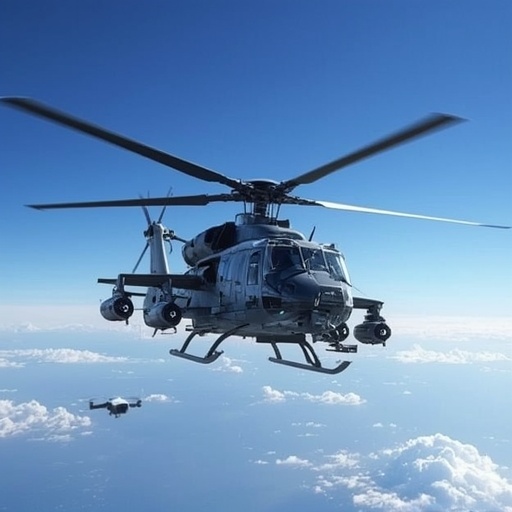
In a remarkable display of how advancing technology continually reshapes modern warfare, the United States Marine Corps has embarked on a groundbreaking project that redefines the very concept of airborne command and control. Their current experiments involve adapting standard military helicopters into fully functional ‘airborne motherships’—sophisticated aerial platforms capable of deploying, guiding, and managing FPV (First-Person View) drones directly from the sky. Through this initiative, the Marines are not only testing the physical capacity of helicopters to operate as launch and supervision hubs but are also exploring new tactical paradigms for synchronized operations between manned and unmanned systems.
The essence of this innovation rests in its ability to fuse situational awareness, rapid technological adaptability, and mission flexibility into a coherent airborne ecosystem. Whereas traditional drone control typically originates from ground-based units or stationary command centers, these modified helicopters would enable operators to maintain direct aerial oversight, shortening the latency between action and response. This transformation effectively turns the helicopter into a dynamic node within a networked battlespace—an airborne control room capable of executing tasks ranging from reconnaissance to offensive drone swarming maneuvers.
Beyond the immediate military implications, such experimentation indicates the broader trajectory of defense technology: a shift toward integrated multi-domain operations where conventional platforms are enhanced through digital augmentation. For example, during combat or surveillance missions, multiple FPV drones could simultaneously relay high-resolution visual data back to their host helicopter, allowing pilots, mission commanders, and data analysts to make decisions with extraordinary speed and precision. This convergence of autonomy and human oversight represents the future of warfighting—symbiotic collaboration between manned craft and robotic extensions that amplify operational reach.
Strategically, turning helicopters into command and coordination hubs for FPV drones offers numerous advantages. It allows for the rapid redeployment of unmanned assets over fluid or unpredictable combat zones and provides redundancy by ensuring that leadership and communication functions remain mobile, rather than dependent on vulnerable ground installations. Even more impressive is the modular nature of this system, which can, in theory, be adapted across various aircraft types, scaling from smaller tactical units to heavy-lift platforms capable of servicing multiple drones at once.
Ultimately, what the Marines are developing is not simply a technical upgrade but an entirely new doctrine of aerial operations. By integrating traditional aviation platforms with drone swarm tactics, they are pioneering a model that could redefine how military engagements unfold in the coming decades. This initiative exemplifies a forward-thinking approach to defense in the digital age—one where innovation, responsiveness, and interconnectivity dictate strategic superiority. Through such experimentation, the skies are steadily transforming from mere airspace into a living, intelligent command domain capable of orchestrating complex missions with unprecedented agility and control.
Sourse: https://www.businessinsider.com/us-marines-helicopters-fpv-drone-motherships-flying-command-posts-2026-5