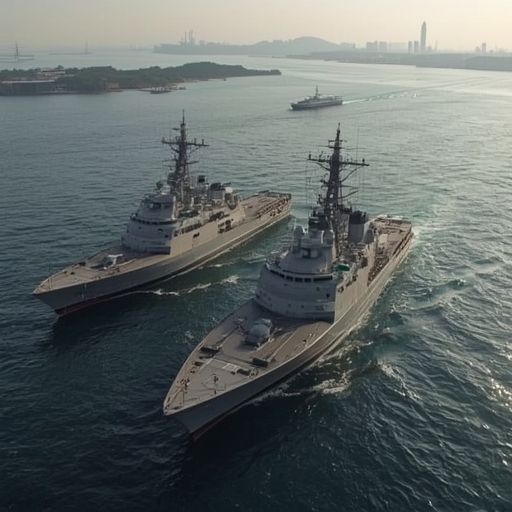
In a recent development that has attracted notable international attention, two of the United States Navy’s advanced littoral combat ships—vessels designed specifically for mine-hunting operations—were observed docked at ports across Asia. These Independence-class ships, typically assigned to missions and strategic responsibilities within the Middle Eastern theater, now appear in a distinctly different region, suggesting a temporary adjustment or recalibration of U.S. maritime presence.
This observation arrives at a moment of mounting geopolitical tension, particularly with renewed apprehension surrounding possible disruptions in the Strait of Hormuz, a crucial maritime corridor through which a significant share of global oil supply passes daily. Historically, the Strait has served as both a conduit of economic vitality and a flashpoint of military concern. Any suggestion that this vital waterway could be compromised—whether through mining operations or restricted transit—inevitably provokes heightened international scrutiny and precautionary activity among naval powers.
While some analysts interpret the presence of these ships in Asia as a standard rotation or a demonstration of operational flexibility within the U.S. Navy’s global deployment strategy, others view it as a deliberate show of readiness reflecting broader strategic calculations. Relocating mine-hunting vessels of this class could signal enhanced cooperation with regional allies, readiness drills within Indo-Pacific waters, or an unspoken message to adversaries regarding U.S. capability and agility.
The Independence-class ships themselves are noteworthy examples of innovation in naval engineering—light, fast, and capable of multiple mission modules. Their detection and neutralization systems are tailored to respond swiftly to underwater explosive threats, making them indispensable for ensuring navigational safety in contentious or strategically sensitive maritime zones. Deploying such specialized assets beyond their routine area of operation underscores both the complexity and the adaptability of U.S. naval logistics.
From a geopolitical perspective, this movement can be seen within the larger frame of fluctuating global alignments and the U.S. strategic pivot toward the Indo-Pacific. The redeployment could serve numerous overlapping purposes: to reinforce deterrence postures, to reassure partners amid regional uncertainty, or simply to exercise operational readiness across diverse maritime terrains. Whatever the underlying rationale, the timing of these maneuvers in relation to rising tensions near the Strait of Hormuz adds symbolic depth to what might otherwise appear as a conventional fleet rotation.
Ultimately, whether interpreted as a routine logistical measure or as part of a calculated geopolitical message, the sighting of these mine-hunting ships in Asia encapsulates the ever-evolving nature of modern maritime strategy. It demonstrates not only the Navy’s capacity for mobility and multipurpose deployment but also the intrinsic link between regional actions and broader questions of global security and stability.
Sourse: https://www.businessinsider.com/us-strait-hormuz-mines-independence-class-ships-malaysia-asia-2026-3