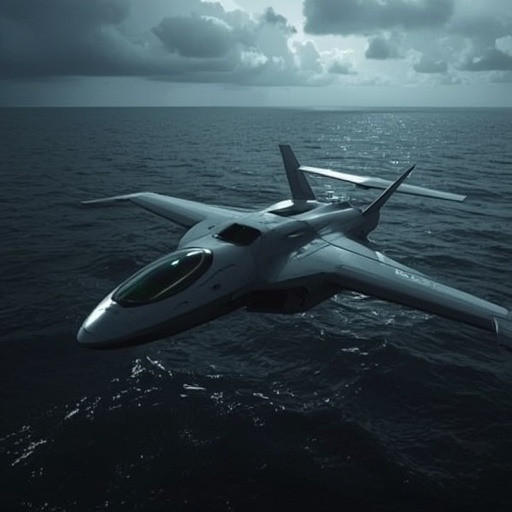
The United States Navy’s Corsair sea drones exemplify one of the most remarkable technological transformations in contemporary naval warfare. Originally designed as autonomous vessels dedicated to search-and-rescue missions—particularly the recovery of downed pilots amid difficult maritime conditions—these advanced machines have evolved at an astonishing pace. Within an exceptionally short period, the same technology once devoted to preserving human life has been reconfigured to perform precision offensive operations, including strategic strikes on targeted adversaries. This transition underscores both the extraordinary adaptability of modern defense innovations and the profound impact of artificial intelligence, automation, and mission modularity on twenty-first-century military strategy.
The progression of the Corsair program encapsulates the broader trajectory of naval innovation. Where earlier generations of sea-going machinery required extensive human supervision and manual control, these drones now operate through a combination of sensor fusion, real-time data transmission, and machine learning algorithms that enable them to assess dynamic environments and respond with a degree of autonomy once restricted to science fiction. This integration of AI-driven systems permits not only quicker decision-making in the field but also reduces the risks traditionally borne by human personnel. The sea drone’s versatility—its ability to shift from humanitarian efforts to combat-ready execution—illustrates a revolutionary model of multi-role adaptability that defines modern maritime doctrine.
In practical terms, the rapid adaptation of Corsair drones reflects a strategic realignment within the U.S. Navy itself. Defense planners and engineers increasingly view autonomous systems as indispensable force multipliers—capable of augmenting traditional fleets while preserving human lives and operational effectiveness. The drones’ progression from lifesaving platforms to offensive instruments also invites broader ethical and tactical reflection: how should emerging technologies that can both protect and destroy be deployed in the theater of conflict? This duality speaks to the complexity of innovation within defense industries, where every breakthrough inherently carries both promise and peril.
What makes the Corsair development particularly illuminating is the sheer speed with which it has occurred. Technological lifecycles that once spanned decades are now compressed into months, as advancements in computational modeling, robotics, and naval engineering converge. The shift from rescue to retaliation is not merely symbolic—it reveals an entirely new rhythm of military adaptation, where autonomous design and artificial intelligence are redefining how nations project power on the world’s oceans.
Ultimately, the story of the Corsair sea drones is more than a tale of mechanical evolution; it represents a pivotal moment in the dialogue between technology and strategy. Their transformation from life-saving guardians to instruments of precision warfare captures both the ingenuity and the moral tension of modern defense innovation. In this sense, the Corsair stands as a microcosm of twenty-first-century naval progress: an embodiment of human creativity harnessed through machines that act, decide, and adapt faster than ever before.
Sourse: https://www.businessinsider.com/us-navy-sea-drones-rescuing-airmen-attacking-iran-2026-7