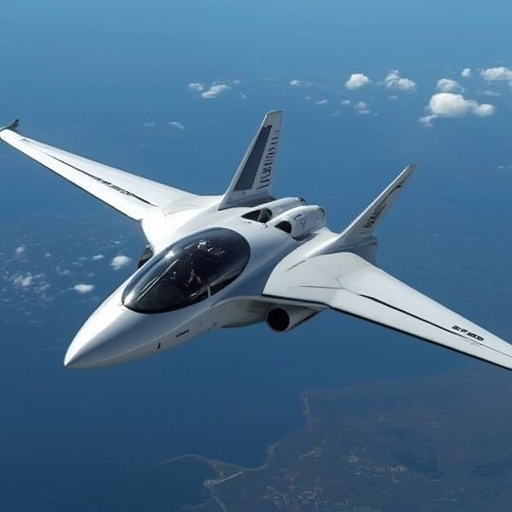
A transformative moment in modern aviation appears to be unfolding as yet another airline commits to the revolutionary concept of the “flying wing” aircraft—a daring and unconventional design that many experts within the aerospace industry increasingly regard as the next defining step in the evolution of commercial air travel. California-based aerospace startup Natilus announced on Wednesday that Indian carrier SpiceJet intends to place an order for as many as 100 units of its pioneering passenger jet, aptly named Horizon. This forward-looking aircraft departs dramatically from the familiar cylindrical fuselage and wing configuration that has dominated aviation since the dawn of jetliners. Instead, the Horizon embodies what engineers call a “blended-wing body” (BWB), in which the fuselage and wings merge into a single broad, triangular structure—essentially a vast, aerodynamic lifting surface that seamlessly integrates the cabin into the wing itself.
The rationale behind this design is rooted in both physics and efficiency. By abandoning the traditional tube-and-wing blueprint, Natilus claims its Horizon aircraft achieves significantly greater fuel efficiency, offers a more spacious cabin footprint, and produces fewer carbon emissions overall. The company envisions launching the Horizon into active service in the early years of the 2030s, marking the dawn of a new architectural paradigm for passenger jets. Aleksey Matyushev, Natilus’s co-founder and chief executive officer, emphasized in a press release that the decision to partner with SpiceJet is strategically aligned with India’s rapidly expanding aviation market. He noted that, by 2040, the nation’s air transport sector will face a shortfall of approximately 2,200 aircraft—a gap he believes the company’s next-generation BWB design is uniquely suited to help fill.
India, already the world’s fifth-largest aviation market, continues to experience meteoric growth. According to data from the International Air Transport Association (IATA), the country carried around 211 million passengers in 2024, reflecting an impressive 11 percent year-over-year increase. To facilitate the aircraft’s planned introduction into India’s regulatory ecosystem, SpiceJet has agreed to assist Natilus in navigating the country’s certification process. Their order, however, remains contingent upon Horizon ultimately obtaining full airworthiness approval from Indian authorities. In addition, Natilus revealed plans to source a portion of its manufacturing components locally and has already established a subsidiary—Natilus India—headquartered in Mumbai to coordinate and support operations within the region.
Although the agreement with SpiceJet represents the first publicly disclosed international airline order for the Horizon model, Natilus disclosed to Business Insider that its broader commercial order book is already robust. The cumulative tally now exceeds 570 orders, valued at approximately $25 billion, when including commitments for both passenger and cargo variants. Among these, the company’s BWB cargo aircraft, named Kona, has secured deals with operators such as the U.S.-based Ameriflight—known for its partnerships with global logistics giants FedEx, DHL, and UPS—as well as with Canadian airline Norlinor. Whether additional buyers exist yet for the Horizon passenger model remains uncertain, but industry observers regard SpiceJet’s order as a decisive milestone that could trigger wider adoption.
Should the Horizon proceed to production, it will introduce an entirely new aircraft type into Indian skies—one that could meaningfully disrupt the long-standing dominance of Boeing and Airbus in the single-aisle jet market. Matyushev has previously explained that the aircraft’s defining aerodynamic shape generates lift across a vastly larger surface area than conventional wings, resulting in an approximate 30 percent reduction in fuel consumption and as much as 50 percent lower operating costs compared with similarly sized aircraft, such as the Boeing 737 or Airbus A320. Visual renderings published by Natilus reveal a futuristic airliner that could carry up to 240 passengers in a dense configuration. Despite its radically different architecture, the Horizon has been engineered to integrate smoothly into existing airport infrastructure, easing its potential adoption by airlines. In practice, its broad, sweeping structure enables roughly 40 percent more internal cabin space—room that could accommodate unconventional interior features such as passenger lounges, family play spaces, or other amenities unthinkable in today’s narrow fuselage jets.
The mock-ups unveiled by Natilus expand upon these possibilities, depicting wide cabins with up to three parallel aisles, expansive business-class suites, and enclosed privacy pods designed to enhance passenger comfort. Nevertheless, innovating with such an unorthodox configuration introduces challenges as well as opportunities. Airbus CEO Guillaume Faury has publicly described the blended-wing-body concept as a likely future direction for aviation but cautioned that the curved geometry of these aircraft might preclude the inclusion of conventional side windows. If true, future passengers could face environments with minimal natural light, potentially causing sensory disorientation or claustrophobic sensations during flight. The broad cabin cross-section could also present safety complications, since those seated toward the center might be physically farther from emergency exits and therefore face longer evacuation times.
In response to such concerns, Matyushev has assured that Horizon will incorporate both side windows and strategically positioned skylights to emulate natural daylight and provide visual connection with the environment outside. These advanced lighting systems, coupled with meticulous design considerations, will seek to maintain passenger comfort even within this unconventional spatial arrangement. He has further reiterated that the aircraft will meet—and in some respects surpass—global aviation safety standards.
The idea of a blended-wing-body passenger aircraft, while now receiving renewed investment, is by no means unprecedented. Aeronautical researchers and engineers have been investigating its potential for decades. The most celebrated example remains the U.S. Air Force’s Northrop B-2 Spirit stealth bomber, which employs a similar aerodynamic philosophy to minimize drag and radar cross-section. Civilian applications have long been studied by major industry players including NASA, Boeing, Lockheed Martin, and Airbus, though none have yet achieved full-scale commercial certification. What Natilus aims to deliver with Horizon, however, is a market-ready, economically viable BWB that can compete head-on in the highly competitive commercial sector. Its team—comprising veterans from organizations such as Northrop Grumman and SpaceX—believes that this once-theoretical vision can now be realized through advances in materials science, computational modeling, and sustainable propulsion technologies.
Still, Natilus is not alone in pursuing this aerodynamic revolution. Airbus has been testing its own BWB demonstrator as part of its ZEROe program since 2017, intended to accelerate progress toward zero-emission airliners fueled by hydrogen rather than conventional jet fuel. The effort successfully flew a small-scale prototype in 2019, though the company has since delayed full-scale implementation by at least a decade beyond its original 2035 target. Another California-based startup, JetZero, has entered the race as well. Its Z4 model—a 250-passenger blended-wing jet projected for introduction in the early 2030s—also promises dramatic efficiency improvements, claiming up to 50 percent less fuel burn compared with legacy widebody aircraft like the Boeing 767 or Airbus A330. United Airlines Ventures, the investment arm of United Airlines, has expressed strong interest, planning potential orders of up to 200 units. Andrew Chang, the venture’s managing director, described the forthcoming aircraft not merely as a new mode of transportation but as an opportunity to revolutionize the very passenger experience—likening it to transforming an airplane cabin into a ‘living room in the sky.’ In his view, the BWB’s expansive internal volume allows for a complete reimagining of boarding procedures, in-flight services, and cabin spatial organization.
In sum, the Horizon project represents both a technological gamble and a bold vision—a synthesis of aeronautical innovation, sustainable design, and strategic foresight. As global air travel continues to rebound and environmental regulations tighten, the pursuit of more efficient and eco-conscious aircraft is becoming an urgent imperative. Should Natilus’s ambitions materialize, the Horizon may well stand as the most significant redefinition of passenger aircraft architecture since the introduction of the jet age itself.
Sourse: https://www.businessinsider.com/startup-building-natilus-blended-wing-jet-reveals-first-airline-customer-2025-12