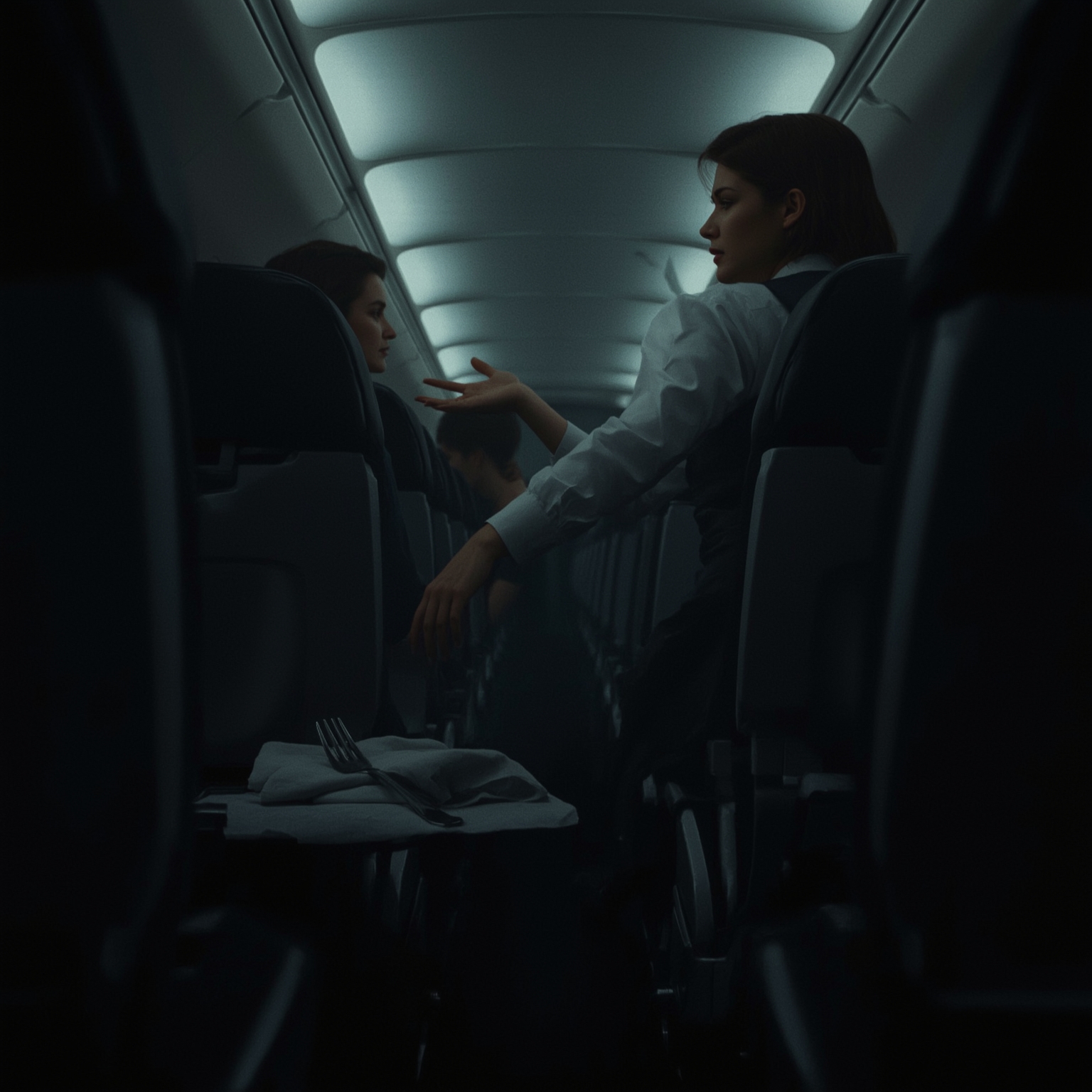
An incident aboard a Lufthansa transatlantic flight on Saturday transformed a routine journey from Chicago to Frankfurt, Germany, into a distressing episode that culminated in the aircraft’s unexpected return to the United States. According to authorities, a passenger allegedly stabbed two teenage boys with a metal fork during the flight, compelling the crew to divert the plane and initiate an emergency landing. The U.S. Attorney’s Office for the District of Massachusetts, a branch of the Department of Justice, later confirmed that the alleged assailant, identified as 28-year-old Indian national Praneeth Kumar Usiripalli, attacked two 17-year-old passengers shortly after the in-flight meal service had concluded. Lufthansa, Germany’s national flag carrier, was operating the flight at the time of the disturbance.
Federal prosecutors stated that when members of the flight crew attempted to restrain and subdue the suspect, he allegedly struck another passenger in the midst of the commotion. One of the teenage victims sustained a laceration to the back of his head as a result of the incident. Although the circumstances surrounding how the fork came into his possession remain unclear, it is noteworthy that the Transportation Security Administration (TSA) generally permits passengers to carry standard metal forks in their hand luggage. However, TSA regulations also specify that any utensil featuring a sharpened edge or a pointed tip—an implement that could potentially serve as a weapon—may be confiscated at the security checkpoint to prevent precisely such safety breaches.
Usiripalli has since been formally charged with the federal offense of “assault with a dangerous weapon with intent to do bodily harm” while aboard an aircraft subject to U.S. jurisdiction. The charge, as outlined by the U.S. Attorney’s Office, carries serious potential repercussions: a prison sentence of up to ten years, a subsequent three-year term of supervised release, and a maximum monetary fine of $250,000. As of Tuesday, publicly accessible court filings did not reveal whether the defendant had secured legal counsel to represent him.
Following the incident, the Lufthansa flight executed a midair U-turn and diverted to Boston Logan International Airport, where it landed approximately five and a half hours after its departure from Chicago. According to federal documentation, the Boeing 747 was carrying a total of 285 passengers and crew members at the time of the emergency. Upon arrival in Boston, law enforcement officers took Usiripalli into custody, and he is expected to make an appearance in federal court at a later date. The U.S. Attorney’s Office further indicated that Usiripalli had originally entered the United States on a student visa to pursue a master’s degree in biblical studies but currently lacks lawful immigration status in the country.
A Lufthansa spokesperson told Business Insider that, due to the unscheduled diversion, all passengers were required to remain overnight in Boston. The airline reportedly took steps to mitigate passenger distress by arranging hotel accommodations, rebooking affected travelers on later flights to Frankfurt, and offering psychological support for those shaken by the midflight ordeal. The company emphasized that every effort had been made to ensure passenger welfare and restore confidence following the incident.
While it remains uncertain whether Usiripalli will also face civil penalties from the Federal Aviation Administration (FAA) for his alleged conduct, such penalties could be severe. The FAA’s definition of “unruly behavior” encompasses not only refusal to comply with crew directives but also any form of violent or severely disruptive behavior that jeopardizes flight safety. Serious cases are frequently referred to the Federal Bureau of Investigation (FBI) for criminal evaluation. In ordinary circumstances, the FAA may impose fines of up to $43,658 for each individual violation, though the total could be significantly higher when an incident involves multiple offenses or particularly egregious behavior. Furthermore, passengers found guilty of such acts may lose eligibility for TSA PreCheck privileges and may be placed on an airline’s internal no-fly list, effectively barring them from future travel.
Although assaults aboard commercial aircraft remain statistically rare, unruly passenger behavior has surged in recent years, particularly since the onset of the COVID-19 pandemic in 2020. Between 2020 and 2024, the FAA issued almost $21 million in fines against passengers exhibiting disorderly conduct, including record-setting penalties of $81,950 and $77,272 in 2022 for two separate, highly publicized cases. The year 2021 marked the peak of such occurrences, with the agency reporting nearly 6,000 incidents—roughly six times the total from the previous year. While enforcement efforts and public awareness campaigns have helped reduce such events by roughly 80% since their pandemic-era high, the current rate of misconduct remains more than double what it was before 2020. In numerical terms, the FAA recorded approximately 2,100 cases in 2024, compared with about 1,000 in 2020. As of early 2025, nearly 1,200 new incidents have already been logged.
A number of recent events underscore the persistence of this troubling pattern. For instance, in May, an American Airlines flight en route to Chicago was forced to reverse course and return to Connecticut after a passenger allegedly attempted to drag a flight attendant down the aisle—a disturbing episode documented in an FBI agent’s affidavit. Similarly, in October, a passenger on a United Airlines flight tried to open an emergency exit door after landing in Houston, inadvertently triggering the aircraft’s emergency slide system. In another separate case last year, an Alaska Airlines passenger attacked an off-duty law enforcement officer using a makeshift weapon, while in a 2024 incident involving the same airline, flight attendants reportedly had to use a beverage cart to physically block a passenger from attempting to enter the cockpit mid-flight.
Together, these occurrences illustrate a growing challenge within commercial aviation: the enforcement of order and safety in the highly controlled, confined environment of an airplane cabin. The Lufthansa incident adds to an increasing body of evidence showing that even a single act of aggression at cruising altitude can have sweeping operational, psychological, and legal consequences for all involved. It serves as a sobering reminder of the fragile balance underpinning aviation security and the vital importance of passenger cooperation and composure.
Sourse: https://www.businessinsider.com/a-flight-u-turned-after-a-passengers-midair-fork-attack-2025-10


