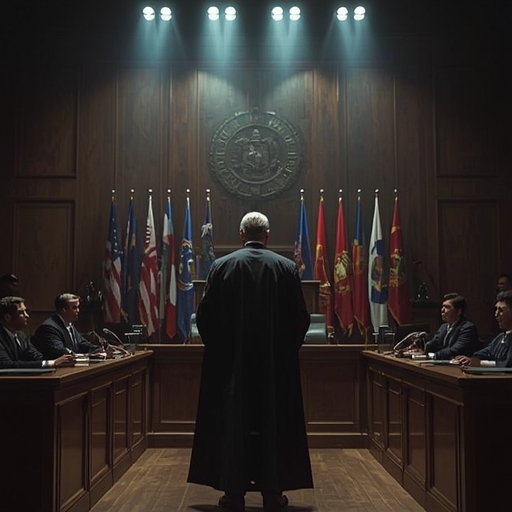
In an unprecedented legal and political development that has captured the attention of observers around the world, the Venezuelan president has formally entered a plea of ‘not guilty’ in a high-profile narco-terrorism case presented before a United States federal court. This pivotal moment represents far more than a routine procedural step; it symbolizes a collision between issues of national sovereignty, international law, and the far-reaching influence of global diplomacy. The proceedings mark a rare instance where a sitting or former head of state faces charges of such magnitude in a foreign judicial system, highlighting the growing complexity of transnational justice in the modern political landscape.
The charges, which allege involvement in large-scale drug trafficking and associated acts of terrorism, have been a focal point of tension between the United States and Venezuela for several years. By pleading not guilty, the Venezuelan leader reaffirmed his denial of all allegations, asserting his stance as a sovereign representative unfairly targeted by politically motivated accusations. His legal team, reinforced by experienced counsel in international and U.S. federal criminal law, maintains that the case reflects broader geopolitical strategies rather than irrefutable criminal evidence. The courtroom exchange therefore unfolds as much on the domain of public perception and diplomacy as within the confines of legal argumentation.
For analysts and political strategists, the significance of this event extends well beyond the courtroom in New York or Washington. The outcome could redefine diplomatic relationships throughout the Americas, recalibrate alliances, and shift long-standing narratives surrounding governance, corruption, and justice in Latin America. Countries within the region may find themselves compelled to articulate positions that balance respect for international legal frameworks with solidarity toward regional sovereignty. In doing so, they navigate a delicate path between cooperation and resistance to perceived interference from global powers.
Meanwhile, international organizations, legal scholars, and civil society observers are closely monitoring the proceedings, examining both the legal precedents and potential political consequences stemming from this case. Many view it as a test of how broadly U.S. jurisdiction can be applied in matters intersecting with global security and narcotics control. Others interpret it as a reflection of increasing attempts by the international community to hold political figures accountable for alleged crimes that transcend borders.
For the Venezuelan populace, reactions remain deeply polarized. Supporters of the president perceive the trial as an external attempt to undermine the nation’s leadership and sovereignty, while critics see it as a long-overdue moment of accountability for actions that have contributed to Venezuela’s political and economic crises. As hearings progress, emotions are heightened not only within Venezuela but also across Latin America and the global diplomatic community.
The world now watches this intricate legal drama—an intersection of justice, politics, and international relations—with acute anticipation. Whether the proceedings result in conviction, acquittal, or a prolonged diplomatic standoff, the case will undoubtedly influence future dialogues regarding how power, legality, and national identity intersect on the global stage. This event is not merely a trial; it is a defining historical episode that underscores how fragile and interdependent the architecture of international justice has become in the twenty-first century.
Sourse: https://www.businessinsider.com/nicolas-maduro-manhattan-court-charges-2026-1