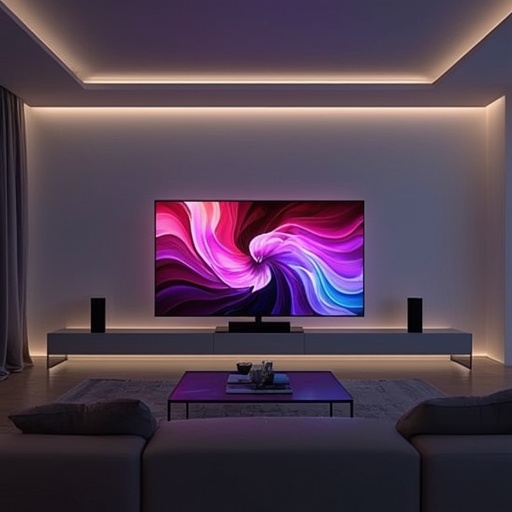
Vizio has introduced a television that may redefine what the industry considers excellent design by embracing deliberate simplicity. The brand’s new 65-inch Mini LED Quantum model stands out not because of an abundance of built‑in applications or complex connectivity features, but rather through the elegance of what it omits. By intentionally avoiding the integrations that typically turn a television into an advertising and data-collection platform, Vizio directs the viewer’s full attention toward the essence of the experience: extraordinary picture quality at a remarkably accessible price — just under four hundred dollars.
This television’s distinguishing characteristic is its focus on display excellence above everything else. The implementation of Mini LED technology ensures a precise distribution of light, yielding richer contrast, deeper blacks, and a stunning vibrancy that enhances every frame, whether one is watching cinematic content, live sports, or immersive gaming. The absence of so‑called “smart” components, rather than being a limitation, becomes an asset — freeing users from potentially intrusive tracking mechanisms and the constant need for updates or external data connections. It fosters an environment in which the viewer can immerse in the act of watching without distraction or digital noise.
In a market saturated with devices attempting to become multifunctional hubs of entertainment, Vizio’s design philosophy feels refreshingly contrarian. Instead of competing on the number of integrated services, voice commands, or algorithmic recommendations, this model competes on refinement of purpose. It represents a quiet rebellion against the prevailing assumption that technological advancement must always equate to added complexity. Here, innovation lies in restraint — in revisiting the original promise of a television as a simple, beautiful conduit for visual storytelling.
Beyond its technical merits, this product serves as both a cultural and commercial statement. It questions an industry narrative that increasingly prioritizes connectivity and data collection over user privacy and autonomy. Vizio’s choice to forgo smart functionality can therefore be read as a gesture toward consumer empowerment, allowing audiences to decide for themselves which external devices — streaming boxes, gaming consoles, or otherwise — they wish to connect. In doing so, the company invites customers to curate their own ecosystems without being confined by proprietary systems or preinstalled advertising networks.
Ultimately, the 65‑inch Mini LED Quantum is more than a commendable piece of affordable engineering; it is a philosophical experiment in redefining progress. By demonstrating that excellence can coexist with simplicity and that modern design need not depend on digital excess, Vizio has effectively reminded both consumers and competitors that sometimes the smartest innovation is the one that dares to be simple.
Sourse: https://www.theverge.com/tech/960916/vizio-mini-led-quantum-tv-review