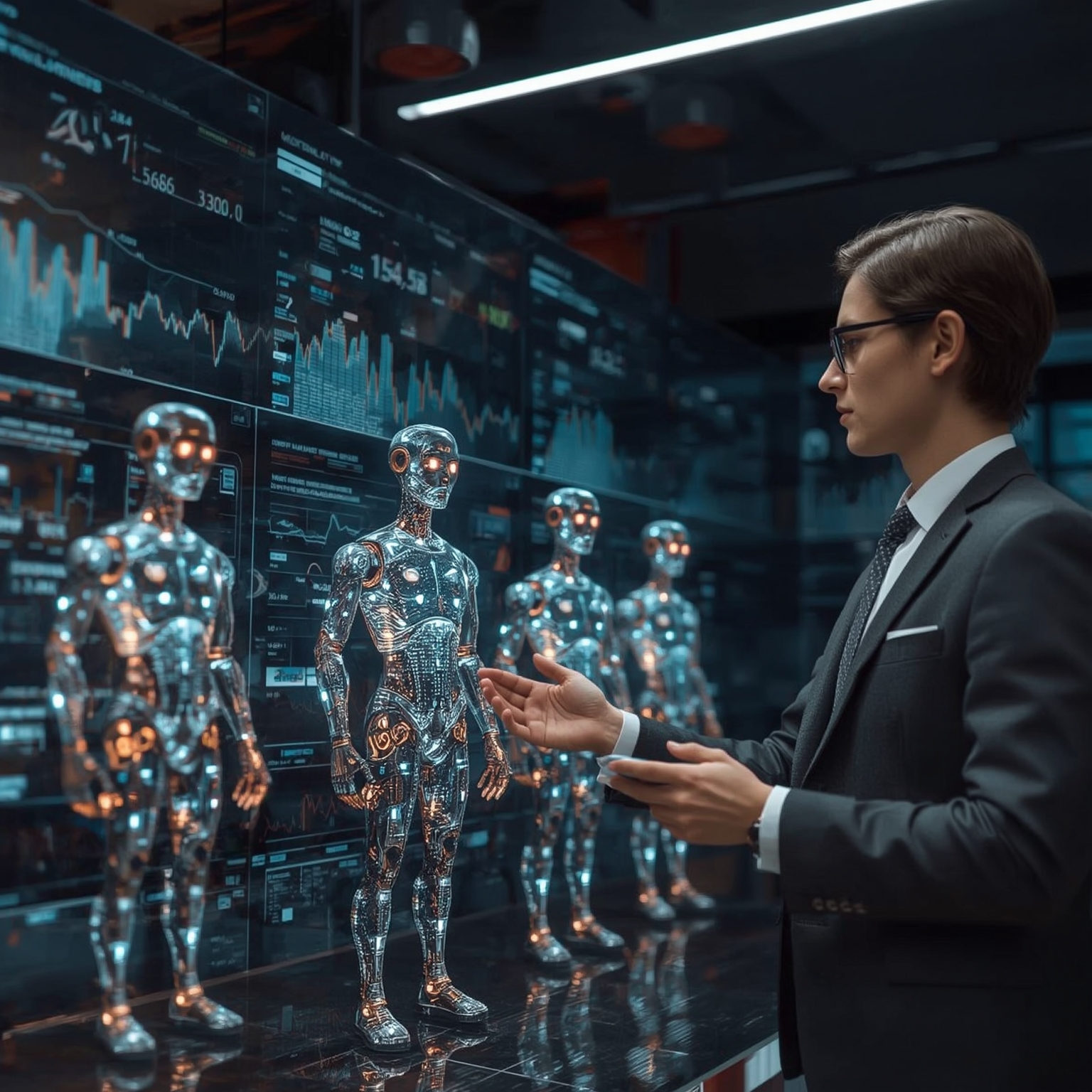
Even those who have only recently stepped onto the trading floors or into the bustling offices of Wall Street — the true neophytes of finance — may soon find themselves experiencing an unexpected and accelerated taste of managerial life. Yet, intriguingly, their first leadership assignments may not involve directing teams of human analysts or junior associates, but rather orchestrating the work of artificially intelligent digital agents. These young professionals, fresh from universities or early training programs, are on the cusp of becoming supervisors to fleets of autonomous AI bots designed to assist, optimize, and even independently execute essential financial tasks.
Teresa Heitsenrether, JPMorgan’s chief data and analytics officer, offered this provocative insight during her address to an audience of seasoned business executives at the Evident AI Symposium held in New York on Thursday. She explained that the traditional timelines that once defined the path to corporate leadership are shrinking rapidly. “I believe,” she observed, in a tone that blended optimism with realism, “that individuals will reach managerial roles far earlier than would have been conceivable under the conventional career trajectories that shaped the decades I grew up in.” The implication of her remark was clear: artificial intelligence is not only changing *what* work gets done but also *who* is given the chance to lead.
Crucially, Heitsenrether emphasized, these fledgling managers will not be guiding human teams at first. Instead, they will be responsible for “managing teams of digital colleagues,” an emerging concept that redefines the very meaning of workplace collaboration. By directing and supervising algorithmic entities — each capable of independently managing tasks such as data reconciliation, process optimization, or client communication — these early-career bankers will begin to acquire the critical skills of accountability, delegation, and technical oversight. This experience, she argued, could function as an invaluable preparatory stage for future leadership positions that involve human personnel, allowing them to build confidence in decision-making within a lower-risk, AI-mediated context.
A central theme of the conference was what experts have dubbed *agentic AI* — the next evolution of artificial intelligence characterized by autonomous digital agents able to perform complex, end-to-end business processes without constant human intervention. Such systems, while promising unprecedented efficiency and scalability, also introduce new challenges regarding data security, accuracy, and consistency. Industry leaders discussed the dual nature of this transformation: on one hand, the potential for AI to empower workers by automating monotonous jobs; on the other, the necessity of safeguarding institutional integrity. Observing the behavior of these bots and understanding how they interpret and execute instructions, Heitsenrether suggested, could one day prepare a generation of young analysts to better comprehend and manage the far more intricate dynamics of human teams.
This sentiment resonated throughout the symposium, where Goldman Sachs’ chief information officer and the firm’s principal technology strategist, Marco Argenti, contributed his perspective. Argenti noted that the impact of AI on the youngest tier of financial professionals was impossible to ignore — it had become a recurring subject of discussion across every panel and informal fireside chat during the event. Within Goldman’s own ranks, he remarked, the newest employees were already collaborating enthusiastically to teach each other how to harness these intelligent systems effectively. In his view, this peer-to-peer transfer of knowledge represents a subtle but profound expansion of investment banking’s iconic apprenticeship model: horizontally across teams rather than purely vertically through mentorship from senior to junior.
“Apprenticeship,” Argenti underscored, “remains absolutely central to our culture.” Yet he observed that the nature of this apprenticeship is transforming. Today’s recruits, whom he referred to as “AI natives,” are self-motivated to explore emerging tools and techniques, sharing discoveries and comparing notes in a way that accelerates collective learning. He elaborated that this new generation does more than absorb institutional wisdom — they actively refine and teach it forward, equipping one another, and even their senior colleagues, to coexist with and capitalize on the expanding role of artificial intelligence. In Argenti’s words, “these individuals will soon be the ones instructing everyone else on how to truly prepare for the coming transformation.”
Despite this excitement, Heitsenrether was careful to acknowledge that such rapid change naturally stirs unease, especially within a sector long known for its deeply rooted traditions. Wall Street has historically prided itself on its rigorous apprenticeship model — the classic “banking bullpen” where discipline, endurance, and precise craftsmanship are passed down from mentor to mentee. To those steeped in this heritage, she admitted, the abrupt shift toward digital collaboration can evoke apprehension. “It would be disingenuous,” she said candidly, “to claim that this transition doesn’t create a degree of anxiety.” For professionals who have invested years in perfecting their technical craft through a carefully structured hierarchy, the idea that the rules of the game are changing — that algorithms may soon share their desks or even report to them — is a significant emotional and professional adjustment.
Yet, according to Heitsenrether, this initial resistance has already begun to dissolve within JPMorgan, arguably America’s largest and most technologically ambitious bank. The firm’s substantial investments in both artificial intelligence and infrastructure have started to yield a shift in workplace sentiment. Lawyers, customer service representatives, and numerous other employees across departments have eagerly adopted newly released internal AI platforms. Once workers see that these tools are designed to simplify their daily responsibilities — removing monotonous administrative tasks or automating tedious calculations — they quickly recognize their tangible benefits. “When you demonstrate to someone that this technology can make their day more enjoyable and eliminate the repetitive tasks we all dread,” Heitsenrether explained, “the barriers of skepticism begin to fall.”
In her final remarks, she offered a simple yet powerful strategy for fostering acceptance of new technology: experiential engagement. “The most valuable thing you can do,” she advised, “is to give people access to the tools directly — to allow them to use and experiment with them.” By granting employees the autonomy to explore these systems firsthand, organizations can transform anxiety into empowerment, curiosity, and eventually mastery. In this way, the next generation of Wall Street leaders may not only adapt to the age of artificial intelligence but also help define its ethical and strategic boundaries, guiding a future in which humans and machines learn, lead, and progress together.
Sourse: https://www.businessinsider.com/wall-street-juniors-may-manage-bots-execs-say-2025-10


