Waymo, the autonomous vehicle company backed by Alphabet, temporarily halted its robotaxi operations across San Francisco on Saturday evening after an extensive citywide power outage left a significant portion of its self-driving fleet immobilized on public streets. What began as a localized infrastructure failure quickly evolved into a visible demonstration of how deeply even the most advanced transportation technologies remain intertwined with foundational utilities such as electricity.
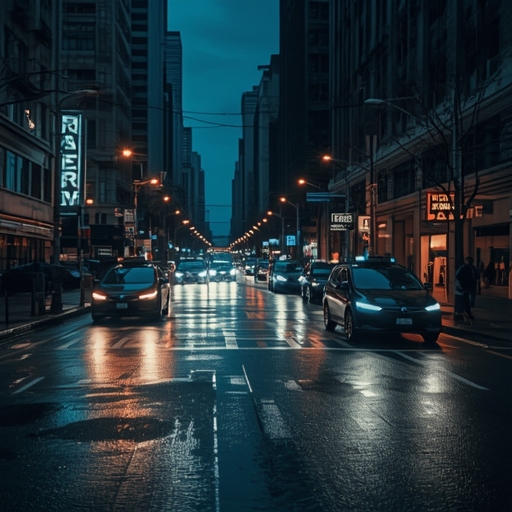
Numerous onlookers documented the unexpected standstill, sharing photographs and videos across various social media platforms. These images depicted rows of Waymo vehicles halted at major intersections, traffic circles, and along neighborhood roadways. In some instances, conventional drivers maneuvered around the disabled robotaxis, while in others, congestion built up behind them, underscoring how fragile automated traffic systems can become in moments of infrastructural instability. The sight of emptied self-driving cars positioned inertly under dim or extinguished streetlights captured both the fascination and the limitations of urban automation.
In an official statement released the same evening, Waymo announced that the company had decided to suspend its ride-hailing operations in the San Francisco metropolitan area as a direct response to the blackout’s impact. Spokesperson Suzanne Philion, reaffirming this position in a separate communication to TechCrunch on Sunday morning, elaborated that the company’s decision was precautionary. According to Philion, Waymo’s teams were collaborating closely with municipal agencies to assess the status of local infrastructure and ensure conditions were stable before resuming service. She emphasized that safety and reliability remain paramount, expressing appreciation for public patience while promising regular updates as new information became available. Philion concluded that the company hoped to restore service in the near future once operational confidence could be guaranteed.
Although Waymo did not immediately clarify the precise mechanism through which the blackout had affected its fleet, observers and industry analysts offered several plausible hypotheses. One prominent factor was the widespread loss of power to traffic control systems—San Francisco’s thousands of signal lights—rendering key navigational aids nonfunctional. Illuminated signals provide not only visual guidance but also real-time data that autonomous vehicles integrate to make driving decisions; when those visual and digital cues vanish, fail-safe programming may direct the cars to stop altogether. As the outage also disrupted sections of the city’s Muni mass transit network, Mayor Daniel Lurie issued a public advisory urging residents to remain off the roads except for essential travel, an appeal that reflected growing concern about street safety amid the compounded effects of the blackout.
Other observers proffered alternative explanations, suggesting that degraded cellular connectivity or interrupted data transmission from traffic-information networks could have contributed to the immobility of the autonomous fleet. Since Waymo’s vehicles depend heavily on continuous data flows—both for navigation and for remote monitoring by the company’s control centers—any interruption in communication channels could effectively paralyze their autonomous functionality, prompting the vehicles to default to stationary positions as a safety measure.
Subsequent investigations pointed to the apparent origin of the outage: a significant fire at a Pacific Gas & Electric (PG&E) substation within city limits. Local news outlet SFGate reported that the resulting power failure affected approximately 120,000 PG&E customers at its peak. Although repair crews worked through the night to restore electricity to the majority of those impacted by late Saturday, roughly 35,000 customers remained without power the following morning. As of Sunday, PG&E’s public website still reflected thousands of San Francisco accounts listed as affected, demonstrating the widespread scope and lingering consequences of the incident.
The event unfolded against a broader backdrop of rapid expansion in Waymo’s commercial ride-hailing operations. According to a letter from Tiger Global Management leaked earlier in the month, Waymo is currently facilitating approximately 450,000 autonomous rides each week—a figure nearly double the amount the company had disclosed earlier in the year. This remarkable growth underscores both the scale of the enterprise and the potential for disruption when large fleets of driverless vehicles encounter unforeseen challenges in urban infrastructure.
In sum, what occurred in San Francisco this weekend served as a tangible illustration of the delicate interdependence between cutting-edge innovation and the essential systems that underpin city life. The blackout not only interrupted electric service—it momentarily halted the dream of frictionless, self-operating mobility, reminding both technologists and residents that even the most intelligent vehicles are only as resilient as the grid that powers the city around them.
Sourse: https://techcrunch.com/2025/12/21/waymo-suspends-service-in-san-francisco-as-robotaxis-stall-during-blackout/