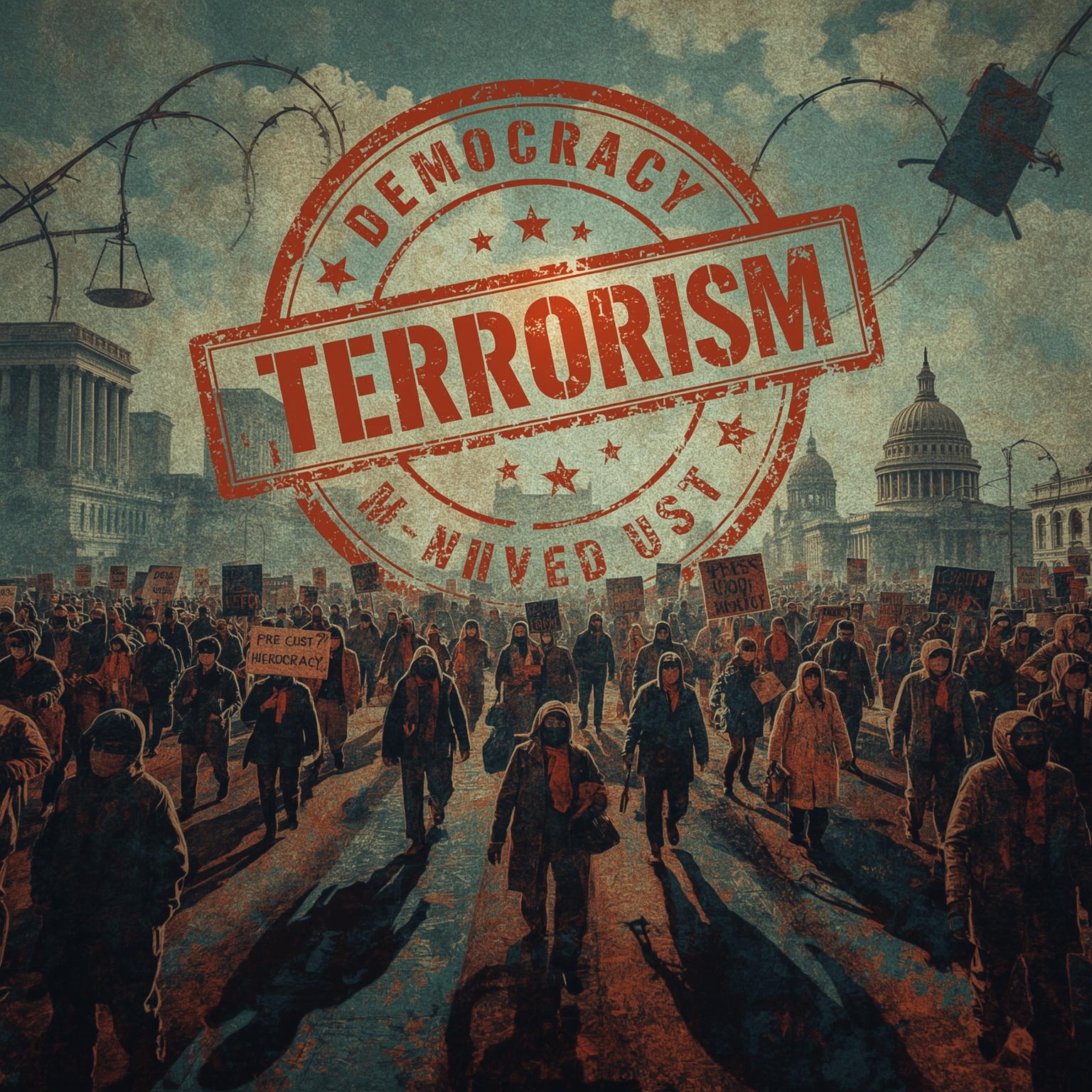
The Trump administration recently escalated its rhetoric by declaring what it called a war against the so-called “terrorist organization” antifa, accompanied by warnings about alleged networks associated with it. Yet when examined closely, such a declaration collapses under scrutiny: antifa is not a centralized conspiracy or hierarchical structure but simply a shorthand for the broader principle of opposition to fascism. The irony, often left unacknowledged, is that opposing anti-fascism places one uncomfortably close to a pro-fascist position — a contradiction deliberately ignored because recognizing it would expose the political maneuver for what it is. The true intention of the memorandum released by the administration appears less about security and more about instilling fear, discouraging Americans from naming fascism openly, and from acknowledging its dangers.
The sequence of executive actions began with President Donald Trump’s signing of an executive order that ostensibly sought to classify antifa as a domestic terrorist organization — a category that has no real existence within U.S. law. This was quickly followed by a national security presidential memorandum (NSPM), which framed anti-fascist speech or criticism of fascism as inherently tied to violent revolutionary behavior. The premise, therefore, became that identifying or condemning fascism could be reinterpreted as justification for terrorism. Such a position not only disorients ordinary political language but actively punishes dissent, twisting definitions of terrorism and violence into tools against civil liberties while disregarding the limits established by constitutional governance.
Crucially, as legal scholars have observed, there exists no statutory mechanism for designating a domestic terrorist group, nor is there a stand-alone federal domestic terrorism charge comparable to designations reserved for international organizations. Ironically, such a mechanism, if it did exist, might have targeted the violent rioters of January 6th, 2021, whose actions posed one of the gravest threats to democratic continuity in modern American history. Instead, the government’s hostile focus turned toward anti-fascism itself, inverting logic to construct an enemy out of its critics.
This distortion of language and meaning is far from unprecedented. During the George W. Bush administration, for example, the public was introduced to euphemisms such as “enhanced interrogation techniques” — essentially rebranded torture — or the simplistic assertion that extremists acted because “they hate our freedoms.” Throughout history, authoritarian governments have weaponized language to sever citizens’ shared sense of social reality, a theme that George Orwell famously dissected in his writings. In much the same way, Trump’s anti-anti-fascism directives attempted to erode shared definitions of terrorism, violence, and even fundamental aspects of government organization, creating legal confusion and undermining long-standing constitutional principles. These measures were never designed with practical enforcement in mind; rather, they functioned as symbolic gestures of intimidation, setting precedents for reframing dissent as criminal.
The vast surveillance infrastructure that already permeates American life — from digital monitoring of online activity to in-person intelligence gathering — compounds the danger. In this climate, blacklisting individuals for their speech or political affiliations becomes increasingly feasible. Beneath euphemistic language lies an unambiguous threat: dissenters risk becoming targets for punitive governmental action. By linking such a framework to the death of right-wing agitator Charlie Kirk, Trump operatives sought justification for reviving extraordinary powers reminiscent of the post-9/11 Patriot Act era. These mechanisms include surveillance excesses, financial blacklisting, and expanded interpretations of “material support” laws, historically reserved for international terrorism, now potentially aimed inward at American citizens.
Trump himself signaled intentions to deploy physical force. Two days after releasing his memorandum, he claimed to have dispatched troops into Portland, Oregon — explicitly mentioned in the NSPM — with local leaders acknowledging a sudden influx of federal personnel. Portland, symbolic in this narrative, was framed not only as an immediate target but also as a training ground for military involvement in domestic affairs. Nor was Portland unique; Trump openly threatened to extend such operations to cities like Chicago, underscoring the broader ambition to conflate public protest with insurrectionary violence.
The rhetorical construction of antifa within the memorandum exemplified deliberate ambiguity. Antifa was described simultaneously as everywhere and nowhere: in universities, nonprofits, social media networks, and protest movements across diverse cities. Whether engaging in direct action, such as the symbolic act of damaging surveillance equipment, or simply manifesting as peaceful protest — a grandmother holding a sign declaring “Donald Trump is a fascist” — all were swept under the same defamatory umbrella. Even community-oriented initiatives, digital tools like the ICEBlock app, or mutual aid fundraising posts could theoretically be reclassified as terrorism under such expansive definitions. By blurring these lines, the administration allowed any expression of dissent, no matter how benign or symbolic, to be prosecuted as a national-security threat.
While critics might be tempted to dismiss this rhetoric as mere political theater or Trumpian exaggeration, official communications from the White House revealed a more serious intent. Press releases referred to antifa in apocalyptic terms, portraying Portland as under siege by “radical left terror,” with the president mobilizing federal resources to “end Antifa-led hellfire.” This militarized framing prepared the ground for concrete crackdowns on civic freedoms under the pretense of battling terrorism.
Experts in national security have long emphasized that antifa, rather than being a structured organization, operates more as a decentralized movement. Reports by institutions such as the Center for Strategic & International Studies noted that modest increases in leftist militant activity corresponded directly with spikes in violent far-right mobilization, particularly from white supremacist groups. Put bluntly, anti-fascism often rises only because fascism itself is on the rise. Yet the Trump administration chose to invert this cause-and-effect relationship, vilifying those resisting authoritarian ideologies while enabling those who promote them.
By presenting anti-anti-fascism as a new crusade, Trump asserted to military leaders that such measures amounted to a “war from within,” echoing classic authoritarian tropes of an “enemy inside.” This rhetoric laid bare the administration’s desire to unleash military instruments and security forces against American civilians themselves, merging right-wing extremist ideology with institutional political power, and designating any opposition as an enemy to be purged.
National security presidential memoranda, in form, are not laws or direct executive orders but policy directives used to set administrative priorities for federal agencies such as the DOJ, FBI, and Treasury Department. This particular directive called for a coordinated mobilization of Joint Terrorism Task Forces to investigate individuals, nonprofits, financial donors, and supposed “illicit funding streams” associated with antifa. Such sweeping calls risked replicating the most repressive aspects of McCarthy-era suspicion while cloaking them in national security language. Disturbingly, the memorandum described antifa’s “common threads” as hostility toward “traditional American views” of family, religion, and morality, further claiming it was animated by anti-American, anti-capitalist, and anti-Christian beliefs. By equating dissent from conservative orthodoxy with terrorism, the state blurred ideological disagreement into criminal conspiracy.
Legal anxieties for the administration never presented barriers. Historical attempts to expand domestic terrorism frameworks, especially those designed to hold white supremacist groups accountable, were systematically undermined by Republicans. As early as 2009, a DHS report warning of right-wing radical mobilization provoked partisan backlash so intense that the report was withdrawn. Similarly, programs designed to disengage extremists from neo-Nazi movements were defunded during Trump’s tenure. These decisions laid the groundwork for selective targeting: right-wing militancy was tacitly tolerated or minimized, while left-wing dissent—no matter how scattered or non-violent—was inflated into existential threat.
Beyond rhetoric, financial intimidation emerged as a key strategy. Although U.S. law lacks the precise domestic frameworks for terrorist designation, international terrorism regulations involving financial surveillance and “material support” statutes were invoked as tools. Political opponents such as George Soros became prime targets, demonized as supposed financiers of unrest. Soros’ philanthropic support for human rights and democratic initiatives was painted as evidence of an organized campaign of violence, despite overwhelming factual evidence that the preponderance of domestic terrorism in America comes from white supremacist and far-right actors. By weaponizing financial oversight, the administration sought both to strangle opposition funding and reinforce conspiratorial narratives popular with its political base.
All this unfolded even as the United States experienced a documented epidemic of right-wing terrorism. From Timothy McVeigh’s Oklahoma City bombing in 1995 to the Charlottesville car attack in 2017 and the racially motivated massacre in El Paso in 2019, lethal violence has overwhelmingly originated from the political right. Comprehensive studies confirm that between 2011 and 2024, right-wing actors perpetrated far more violence, resulting in significantly higher casualty counts compared to left-wing incidents. Yet, paradoxically, the Trump administration’s national security apparatus declined to label such groups as terrorists, reserving the term exclusively for its political adversaries.
The broader implication of this linguistic and legal manipulation is a profound threat to democratic institutions. By defining ordinary protest, acts of civil disobedience, or even nonprofit advocacy work as terrorism, the administration staked a claim to criminalizing vast swaths of civic participation. The intent was unmistakable: to silence resistance, suppress speech, and weld authoritarian control under the guise of national security. In reality, the memorandum reads less like a coherent strategy against genuine threats and more as a confession of how right-wing extremism itself has used intimidation, organized campaigns, and violence to capture political power. What is described as terroristic violence designed to silence dissent mirrors precisely the tactics employed by its authors.
The imagined menace of antifa may not exist in any centralized or conspiratorial form. Yet the war declared in its name has devastating implications, not only for those caught in the dragnet but for the future of American democracy itself. The administration’s approach demonstrates that accusations of terrorism can, themselves, become instruments of terror. Despite these bleak realities, the capacity of ordinary citizens to resist — whether through protest, outcry, or collective resilience — remains an undeniable counterforce. In the struggle between authoritarian overreach and democratic resistance, everyday Americans, often unorganized and unwilling to accept silence, continue to embody the most enduring form of anti-fascism: refusing to be intimidated into compliance.
Sourse: https://www.theverge.com/policy/790510/trump-fascism-antifa-soros-ice