In late December 2025, I made an impromptu trip to Five Below for some last-minute holiday gift hunting, expecting the familiar thrill of finding quirky, budget-friendly treasures priced below five dollars — just as the store’s very name suggests. To my surprise, however, that promise no longer seemed entirely accurate. Many of the products on display, once celebrated for their accessibility, had crept beyond that symbolic threshold. Though still an undeniably economical destination for charming trinkets and impulse buys, the experience revealed a subtle but significant transformation underway within one of America’s best-known discount retailers.
When customers step into a Five Below location, they naturally anticipate discovering shelves brimming with items priced under $5 — a cornerstone of the brand’s identity since its inception. However, an economic reality check is now inescapable. My visit, intended for grabbing a few affordable presents on a modest $50 budget, echoed experiences from past years yet offered a markedly different picture. Compared with 2023’s prices, nearly every aisle showed signs of inflation. Five Below itself has attributed these increases largely to tariffs on imported goods and to the rising costs of global sourcing, a logical but noticeable shift in strategy.
According to reporting from outlets such as The Street, these tariffs have weighed heavily on the company’s finances, especially since roughly 60% of its merchandise originates from China. To offset this pressure, Five Below introduced what it described as “selective price adjustments” and focused more deliberately on its core customer base — primarily teens and tweens — by scaling back on adult-oriented categories, like travel gear and luggage. Despite the initial negative response, this recalibration seems to have strengthened the brand’s position. Although sales dipped by 3% earlier in the year, the company’s stock nonetheless soared an impressive 85% by mid-December, underscoring the long-term investor confidence in its evolving strategy.
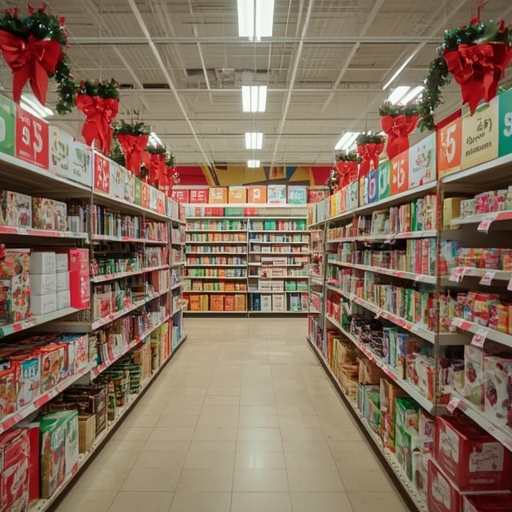
As I entered the specific New York City location I chose to visit — this time perched on a building’s second floor rather than tucked into a basement like my previous stop — I was welcomed by the same festive displays of edible crafts that have become seasonal staples. Gingerbread houses priced at $4 filled the entrance, accompanied by hot chocolate kits and DIY holiday treats. These cheerful “snacktivities” provided a warm nostalgia, yet the subsequent revelation of higher prices throughout the store quickly tempered that familiarity. Small stocking stuffers now ranged from $6 to $7, quietly surpassing the five-dollar benchmark that once felt unshakable.
Previously, items that exceeded the titular price point were segregated within a clearly designated section called “Five Beyond.” This time, there was no such spatial delineation. Higher-priced goods were dispersed throughout the store, blending seamlessly among the traditional bargains. While aesthetically uniform, this arrangement arguably blurred the store’s long-held identity as the land of five-dollar wonders. For example, plush Snoopy dolls labeled at $7 and other branded merchandise hinted that Five Below’s curated product mix was adjusting toward a slightly more upscale — albeit still affordable — assortment.
Statements from CEO Winnie Park earlier that year emphasized this directional shift. During a March earnings call, she asserted that the company was “raising the bar on adding value” to higher-priced offerings, thereby justifying select increases through enhanced quality or brand cachet. Nonetheless, she reaffirmed the unavoidable influence of economic factors, noting that 60% of Five Below’s goods being imported from China inevitably left it vulnerable to global cost fluctuations.
As I continued browsing, familiar staples like gift wrap reinforced the trend. Wrapping paper, a perennial must-have during December, carried a $5 tag — still inexpensive by general retail standards, yet notably higher than the single-dollar rolls once plentiful in earlier seasons. A mental calculation revealed how noticeable the difference had become: what previously cost $5 for five rolls now equated to a $25 expense.
Throughout the store, festive offerings abounded — from flannel pajama pants promoted under “2 for $10” deals to an explosion of officially licensed products tied to movies and gaming franchises. The transformation was most strikingly visible in a “Wicked: For Good” display, whose themed merchandise, ranging from figurines to bath accessories, spanned prices between $10 and $35. Though a few souvenirs could still be found for just $5, many exceeded that limit, and it became clear that licensing partnerships came with a distinct premium. The same pattern extended to plush figures featuring characters like Stitch, Pac-Man, and Minecraft icons, each tagged at $7.
The omnipresence of popular intellectual properties and brand collaborations lent the store a more contemporary, almost collector-oriented appeal. Yet even the unofficial imitations — known affectionately as “dupes” — had not escaped inflation. Five Below’s versions of plush Labubu toys, a phenomenon sparked by China’s Pop Mart, retailed at $6 instead of the expected five, further illustrating how the brand’s playful mimicry of viral collectibles remains core to its identity while adjusting to current financial pressures.
Among all sections, the beauty aisle stood out as the most crowded and arguably the most resilient in maintaining low prices. With the growing fascination of younger demographics in skincare and makeup, Five Below’s beauty category provided an appealing gateway to budget-conscious experimentation. Here, the prices largely held steady at $5, even while the products bore uncanny resemblances to those from high-end labels such as Summer Fridays, Touchland, Sol de Janeiro, Tower 28, and Drunk Elephant. For consumers familiar with luxury skincare trends, encountering these near-perfect substitutes at a fraction of the cost underscored Five Below’s ongoing strength — its ability to capitalize on cultural moments of viral desirability while still appearing accessible.
Navigating onward to apparel and accessories, I found the same mixture of affordability and incremental inflation. Socks fluctuated from $5 for a single novelty pair to $6 for multipacks, while fleece-lined slippers inspired by Uggs cost $7 — flattering lookalikes that nonetheless hinted at shifting price perceptions. The popular water bottle display, long a haven for Stanley and Owala competitors, now featured hydration vessels averaging $7. Even the small fitness gear section, where one could once find weights capped under six dollars, displayed items running to $8 or more.
The consistency of the trend extended into the technology aisle, where phone accessories and gadgets sat neatly aligned under brightly colored signage. Yet again, prices mirrored the broader storewide pattern: headphones and earbuds ranged between $6 and $10, while phone cases hovered around $7. A few outliers, such as screen protectors, clung to the historical five-dollar baseline, though only faintly anchoring the brand’s legacy pricing.
Interestingly, the candy section remained largely untouched. Whether by strategic choice or logistical coincidence, sweet treats and confectionery items persisted in the $3–$5 range, offering a nostalgic vestige of the store’s original charm — a small corner where customers could still indulge in the satisfaction of a true “Five Below” deal.
Ultimately, the visit painted a portrait of a retailer evolving within the constraints of economic necessity and market adaptation. Five Below remains, by most measures, an affordable and enjoyable shopping destination, particularly for budget-minded consumers seeking quirky décor, small gifts, or playful novelties. Yet the name that once symbolized a strict price limitation has gradually transformed into a more flexible guideline. With more and more merchandise reaching $8, $10, or even $20, the phrase “Five Below” now reads as both a nostalgic slogan and an aspirational brand identity — one that continues to strive toward value, even as the definition of that value subtly changes in response to global realities.
Sourse: https://www.businessinsider.com/five-below-holiday-shopping-review-items-cost-more-2025-12