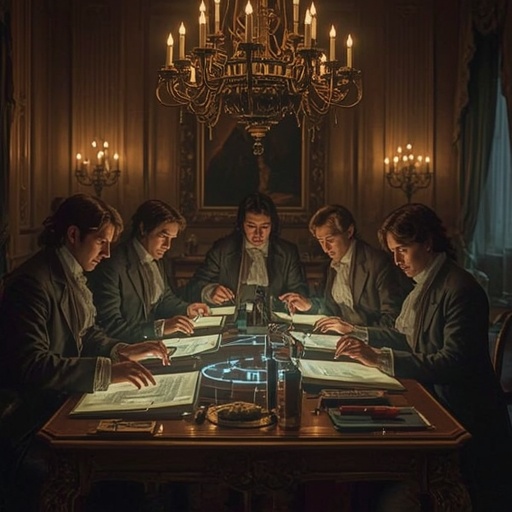
Google’s bold new commercial dares to reimagine one of the most pivotal moments in Western history—the signing of the American Declaration of Independence—through the lens of modern artificial intelligence. In this creative retelling, the revolutionary leaders of 1776 are not portrayed as dusty figures laboring over parchment in dim candlelight, but rather as visionaries collaborating through luminous digital interfaces, exchanging ideas with the efficiency and speed of contemporary AI tools. The advertisement replaces ink quills and handwritten drafts with sleek, glowing screens and intelligent prompts that suggest revisions in real time, inviting viewers to imagine how technology might have transformed the birth of a nation.
At first glance, the concept seems both daring and whimsical—a fusion of historical gravitas with futuristic innovation. By transporting cutting-edge Google Workspace tools into an 18th-century setting, the ad underscores the company’s message that collaboration and creativity transcend centuries. Yet beneath that spectacle lies a provocative question for audiences and marketers alike: at what point does clever narrative experimentation begin to distort the authenticity of the story it borrows from? The visual juxtaposition of powdered wigs and holographic documents is undeniably striking, but for some, it may risk crossing from impactful symbolism into the realm of historical parody.
From a strategic perspective, Google’s creative gamble highlights the brand’s confidence in merging technology with storytelling. The advertisement exemplifies how corporations increasingly leverage historical metaphors to illustrate the transformative potential of AI, positioning innovation as a timeless human endeavor. It succeeds in igniting conversation—not only about the evolution of productivity but also about how we interpret and recontextualize the past in an age dominated by algorithms and intelligent systems. For marketers, this campaign serves as a vivid case study in balancing audacity with sensitivity: a reminder that bold imagination can captivate the mind, but resonance demands respect for context.
Whether regarded as ingenious or misguided, the ‘1776’ spot accomplishes what every memorable ad strives for—it refuses to be ignored. Its speculative vision invites viewers to reflect on the relationship between progress and heritage, suggesting that the tools that drive today’s innovation could, in another timeline, have rewritten history itself. Ultimately, Google’s commercial becomes more than an advertisement; it is a conversation piece about creativity, technology, and the boundaries of storytelling in the modern marketing landscape.
Sourse: https://www.theverge.com/ai-artificial-intelligence/961468/google-ai-commercial-founding-fathers-declaration-of-independence