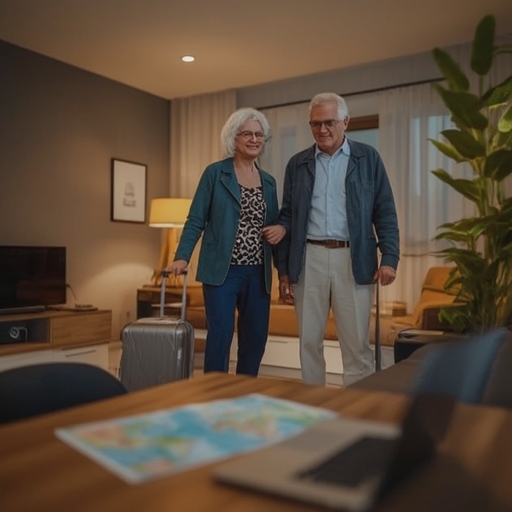
As retirement unfolds for many individuals, it often carries with it an expectation of stability—a home paid off, familiar surroundings, and the comfort of settled routines. Yet for some, the end of their professional years marks the beginning of a radically different journey, one defined by constant motion, curiosity, and reinvention. In this particular story, a couple chose to exchange the permanence of homeownership for the transience of travel, selling their house to live from one Airbnb to another. What began as a decision grounded in practicality and health considerations gradually evolved into a lifestyle that defies convention, embodying both exhilarating freedom and subtle fragility.
The couple’s experience illustrates the growing phenomenon of nomadic retirement, a trend that intertwines financial strategy, personal fulfillment, and the emotional complexities of aging in a mobile world. For them, traditional notions of security—owning a house, remaining in one neighborhood—gave way to an openness toward exploration, community diversity, and continual renewal. Every new Airbnb becomes, however briefly, a substitute for the concept of ‘home.’ Each space welcomes them with unique surroundings, from a sunlit coastal cottage to a mountain-view loft, offering fresh perspectives and a renewed zest for life. Yet beneath this freedom lies an undercurrent of uncertainty. There are practical concerns—rising rental costs, accessibility issues, the challenges of medical care on the move—that cannot be entirely dismissed. Health, in particular, becomes a decisive factor in shaping how long such a lifestyle remains sustainable.
Their adult child observes this journey with a mixture of admiration and anxiety. On one hand, the parents’ courage to redefine retirement challenges the assumption that growing older must entail stillness; on the other, their lack of a permanent base raises understandable fears about long-term stability. What happens if mobility becomes physically demanding? How can one plan for emergencies, healthcare, or aging in place when ‘place’ itself is constantly shifting? These questions extend far beyond this single family—they touch upon a broader societal tension between adventure and assurance, between the desire for freedom and the need for safety.
In professional and personal contexts alike, such stories prompt reflection on how families and financial advisors approach the future of retirement planning. The digital age has made unprecedented mobility feasible: with remote booking platforms, minimal possessions, and virtual networks, older adults can craft lives of continuous movement. But emotional preparedness and supportive structure remain essential. Financial wellness, healthcare access, and intergenerational communication must adapt alongside this newfound flexibility.
Ultimately, this couple’s nomadic existence represents both a celebration of possibility and a quiet meditation on vulnerability. Their path reminds us that ‘home’ need not be a fixed location; it can also be an evolving sense of belonging found wherever comfort, curiosity, and connection coexist. Whether one views their choice as liberating or precarious likely depends on personal temperament and family perspective. Yet their story—at once daring, tender, and reflective—invites each of us to reconsider what it truly means to settle down in a world where permanence itself has become optional.
Sourse: https://www.businessinsider.com/retired-parents-live-in-airbnbs-sold-house-2026-3