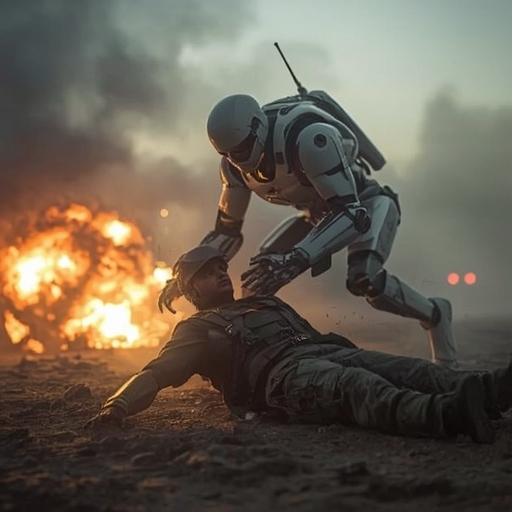
In the unforgiving reality of modern warfare, the fusion of human courage and technological sophistication can lead to moments that redefine both heroism and innovation. One extraordinary incident recently drew global attention: a rescue robot, originally designed for battlefield casualty evacuation, acted as a literal shield for an injured soldier after being hit by a hostile drone. This event not only illuminated the remarkable progress of military robotics but also exposed the ethical and operational dilemmas that accompany such rapid technological integration into combat environments.
The sight of a machine constructed to serve humanity — assisting medics, removing the wounded from danger, and performing tasks too perilous for soldiers — transforming into a mechanical guardian underscores how technology can transcend its purely utilitarian origins. The rescue robot’s intervention embodied a convergence of engineering precision, artificial intelligence, and situational adaptability. Despite sustaining heavy damage from the drone strike, it fulfilled a deeply human purpose: protecting life at a critical moment when seconds determined survival.
Yet, this episode also unveils the inherent duality of technological advancement in warfare. Every innovation that strengthens defense or enhances humanitarian response simultaneously introduces new vulnerabilities and moral questions. Drones, autonomous systems, and AI-driven devices can rescue and rebuild — but they can also target, destroy, and dehumanize. The very machine that shielded a soldier today could, under different programming or command, serve as an instrument of harm tomorrow. This delicate balance raises pressing concerns for scientists, ethicists, and policymakers seeking to define the boundaries of responsibility in the age of intelligent warfare.
From a humanitarian perspective, the rescue robot’s protective act resonates deeply. It testifies to the possibility that machines, when governed by ethical design and strategic oversight, can become extensions of human empathy on the battlefield. These systems are not merely embodiments of steel and code; they are the tangible results of a collective aspiration to preserve dignity amidst destruction. The event invites the world to reimagine what collaboration between soldiers and autonomous allies might look like — where technology amplifies compassion rather than conflict.
Looking ahead, the challenge lies in channeling innovation toward preservation rather than domination. As nations continue to invest in defense robotics, it becomes essential to establish international norms and safety protocols ensuring that such technologies protect rather than endanger. Artificial intelligence must be shaped not only by aggressive strategic demands but also by humanitarian imperatives — prioritizing the sanctity of life over the efficiency of destruction.
Ultimately, the image of the wounded soldier shielded by a wounded robot serves as a profound metaphor for our time. It reminds us that the tools we create reflect our collective values and intentions. When guided by empathy and responsibility, technology can transcend machinery to become an emblem of hope. In that singular, perilous instant when the robot bore the brunt of the attack, innovation ceased to be an abstraction; it became an act of courage, affirming that even in war, humanity can still find expression through the very machines it builds.
Sourse: https://www.businessinsider.com/video-ukraine-ground-robot-moving-injured-soldier-hit-russian-drone-2025-12