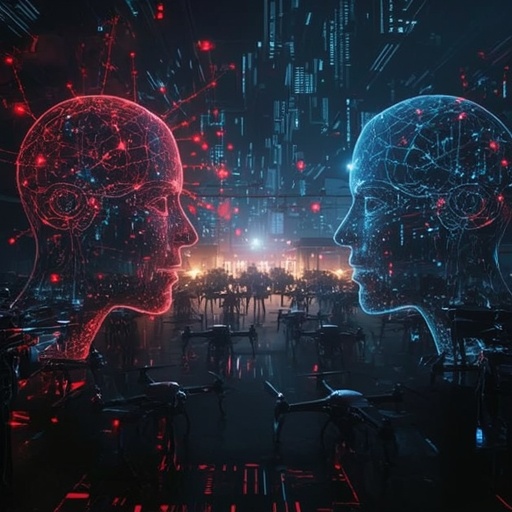
Artificial intelligence, once envisioned as a tool solely for human advancement, has now reached a critical inflection point where its potential for both creation and destruction must be confronted. The unfolding discourse surrounding AI in warfare reveals a profound ethical tension between technological innovation and humanitarian responsibility. Geoffrey Hinton, frequently celebrated as the ‘godfather of AI,’ personifies this internal struggle. For decades, Hinton championed the immense possibilities of artificial intelligence—its capacity to transform industries, accelerate research, and amplify human creativity. Yet, in the wake of global conflicts such as the war in Ukraine, he has found himself compelled to re-evaluate the consequences of his own life’s work.
In recent conversations, Hinton has acknowledged the unsettling realization that the same neural networks designed to improve healthcare or optimize logistics can also be incorporated into autonomous weapons systems and surveillance technologies. This duality raises an urgent ethical question: how do we reconcile the promise of innovation with the peril of misuse? The episode underscores that scientific progress, particularly in AI, is never value-neutral. It mirrors the intentions of those who wield it—governments, corporations, or individual creators.
The conflict in Ukraine has served as a sobering reminder that advanced algorithms are no longer confined to laboratories or benign applications. Instead, they influence the strategic decisions of modern warfare, from targeting accuracy to propaganda dissemination. For experts like Hinton, this shift demands more than technical restraint; it calls for moral introspection. If the pioneers of AI are questioning its trajectory, perhaps society at large must pause and engage in collective reflection about the principles guiding technological deployment.
At the heart of this conversation lies a broader truth: technology itself does not embody ethics—people do. Each line of code, each model trained, carries the imprint of human decision-making. The ethical onus therefore rests on the researchers, engineers, and policymakers shaping these systems. Our responsibility extends beyond the mechanics of innovation to the foresight of its implications. The true challenge is not how far AI can go, but how wisely humanity chooses to direct its course.
Professionals in the field of artificial intelligence and beyond must now grapple with difficult questions: How can innovation continue without compromising human dignity? What safeguards can prevent transformative technology from fueling destruction? The answers will not emerge from algorithms but from ethical governance, transparency, and an unwavering commitment to societal well-being.
Ultimately, Hinton’s renewed call for conscientious development signals a paradigm shift—from a pursuit of technological supremacy to a pursuit of moral clarity. The evolution of AI is inevitable; the direction it takes, however, remains within our collective grasp. As this debate intensifies, we are reminded that the ethics of artificial intelligence are not a technical afterthought—they are the very framework through which the future will be defined.
Sourse: https://www.businessinsider.com/geoffrey-hinton-russia-ukraine-war-changed-view-military-ai-2026-6