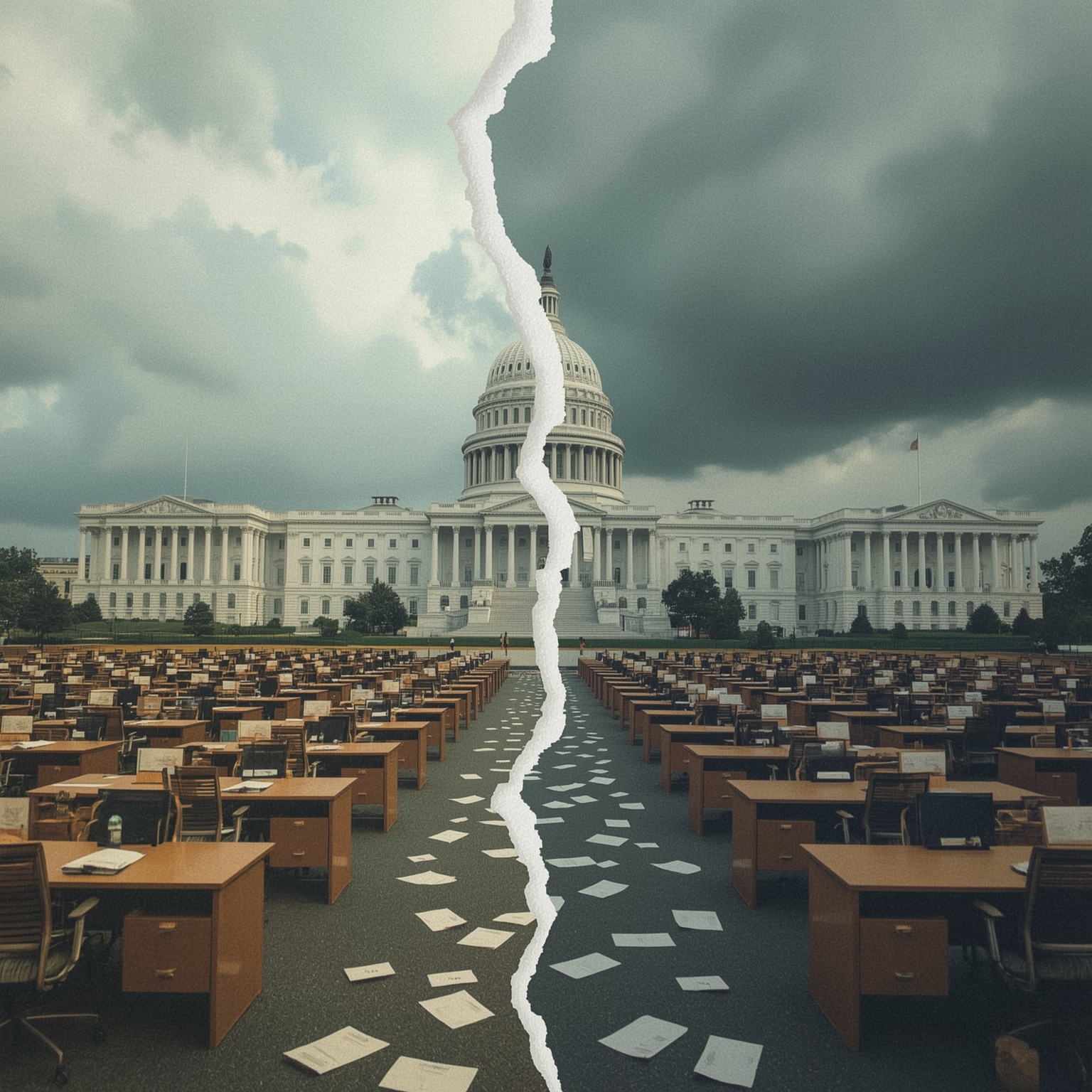
According to the White House, an immense number of federal employees—estimated in the hundreds of thousands—may not automatically receive compensation for their lost wages once the government ultimately reopens. This prospect emerged from the contents of a memo authored by the Office of Management and Budget (OMB), whose existence was verified by a White House official in correspondence with Business Insider. The document asserts that individuals classified as “furloughed,” meaning they have been temporarily suspended from their duties due to the ongoing government shutdown, do not possess an inherent or automatic right to receive retroactive payment for the period in which they were prohibited from working.
This interpretation stands in stark contrast to the assumptions widely held since the enactment of the Government Employee Fair Treatment Act of 2019. That piece of legislation has generally been understood by lawmakers, unions, and the federal workforce alike to ensure that all federal employees—both those who continued to work without pay and those locked out via furlough—would be guaranteed full back pay once federal operations resumed. However, the OMB memo appears to challenge that consensus, suggesting instead that the guarantee is conditional and may require additional congressional action.
The memo also contradicts guidance issued not long ago by the White House Office of Personnel Management (OPM). In a notice distributed to federal agencies at the end of the previous month, OPM explicitly stated that all employees placed on unpaid furlough status as a result of the lapse in appropriations would be compensated retroactively without exception once normal funding resumed. The OPM directive employed unequivocal language: once a shutdown concludes, it affirmed, workers who were furloughed because of the funding lapse will receive their owed wages “on the earliest date possible,” regardless of preexisting pay schedules or routine administrative delays. This prior directive seemed designed to reassure a workforce faced with significant personal and financial uncertainty, especially among those dependent on regular paychecks to meet rent, mortgage, or childcare expenses.
The central legal debate hinges on the interpretation of a single clause within the 2019 statute, which stipulates that federal employees are to be compensated “subject to the enactment of appropriations Acts ending the lapse.” The White House legal team now contends that this phrasing obliges Congress to take explicit legislative action—specifically, to pass a new appropriations measure or related bill in order to restore the withheld compensation. In their view, the law does not automatically trigger payments once the shutdown ends but instead requires an affirmative act of Congress to unlock the funds. This reading effectively frames the issue as one of procedural necessity and constitutional authority over federal spending, setting up a complex intersection between legal interpretation and political responsibility.
Business Insider has not yet reviewed the OMB memo directly, but Axios first reported on its existence. Should the White House interpretation prevail, the practical consequences would be considerable: many employees within the administration itself, nearly one-third of the White House’s own workforce, have been furloughed because of the current shutdown. Ironically, the impact would extend inward, affecting even those responsible for managing the crisis. By contrast, all forty-five members of the Department of Government Ethics staff—one specialized office within the executive branch—reportedly remain on active duty.
Political reaction to this development was immediate. Senator Patty Murray, the highest-ranking Democrat on the Senate Appropriations Committee, accused the administration of deliberately sowing fear and confusion among federal workers. She characterized the OMB memo as a calculated attempt to intimidate civil servants, calling the tactic “baseless” and in direct defiance of the letter and spirit of the law. Through a statement posted on X (formerly Twitter), she reiterated that the text of the 2019 statute is crystal clear: all federal employees, including those furloughed due to a shutdown, are legally entitled to full back pay once government funding is restored. Murray’s rebuke underscored a growing division between congressional interpretations of the law and the executive branch’s restrictive reading.
Further complicating the situation, the Trump administration has also floated the possibility of widespread terminations of federal personnel in connection with the shutdown, a suggestion that has stirred alarm within the civil service community. Yet despite this rhetoric, no mass firings have occurred, even as a full week has elapsed since the threat was initially raised. For now, employees remain in limbo—caught between legal ambiguity, administrative caution, and the enduring uncertainty of a prolonged shutdown that continues to disrupt both livelihoods and operations across the federal government. In sum, the OMB memo introduces new tension into an already fraught scenario, one that blends questions of statutory intent, political power, and the human cost of bureaucratic paralysis.
Sourse: https://www.businessinsider.com/white-house-furloughed-federal-workers-back-pay-2025-10