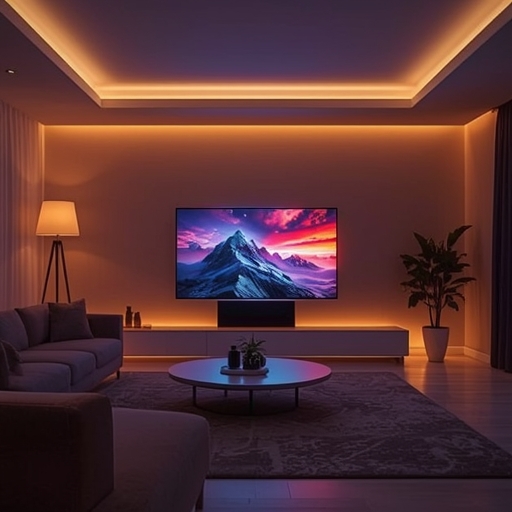
Amazon Fire TV Omni QLED Series represents one of Amazon’s most recent innovations in the vast and ever-evolving realm of smart televisions. With a starting price of $429 for the 50-inch variant, the line aims to offer accessible excellence to consumers who desire premium picture quality without entering a luxury price range. During the evaluation period, the 65-inch model—priced at approximately $850—served as the primary entertainment centerpiece in my household, allowing for a true understanding of its capabilities in a variety of everyday viewing scenarios. This model quickly distinguished itself through its breathtaking image fidelity, completely hands-free Alexa+ integration, and the inclusion of Amazon’s innovative Ambient Experience feature, which together make it feel as intelligent and interactive as it is visually impressive. If one minor element could be improved, it would be the absence of a built-in remote-finding feature, a convenience reserved for users who purchase Amazon’s separate Alexa Voice Remote Pro.
When Amazon unveiled a number of new devices toward the close of 2025, the Fire TV Omni QLED Series stood out as a particularly notable release. Having spent over a month rigorously testing it, I found it to deliver a remarkably elevated viewing experience compared with my four-year-old LG UN7000 TV. That older unit, while serviceable, was a basic 4K entry-level model—not a QLED display—purchased in 2021 for around $500. In contrast, the new Omni QLED Series now provides a significantly enhanced visual performance even at comparable or lower prices. In fact, buyers today can obtain a 55-inch version of this newer QLED set for roughly $530, a figure that highlights just how dramatically television technology has advanced and how consumer accessibility has increased over the past few years. Nevertheless, had I been asked to choose between LG and Amazon several years ago, I likely would have favored LG until firsthand experience with the newer Fire TV demonstrated its impressive performance.
This Omni QLED stands as the third Fire TV I have incorporated into my home. In addition to this 65-inch test unit, I own a 50-inch Series 4 Fire TV and a 43-inch earlier-generation Omni model. Both of these earlier televisions were acquired during Amazon Prime Day events at approximately $100 apiece—truly low-risk purchases that yielded surprisingly strong viewing experiences for the cost. The 43-inch Omni was installed in my bedroom, where its image quality proved vastly superior to an aging Westinghouse set. Yet, by comparison, the newest Omni QLED Series transcends its predecessors, offering significantly deeper contrast, finer gradations of brightness, and a richer color palette that makes each frame come alive.
Visually, the TV performs exactly as Amazon claims. The display renders textures and details with such crispness and depth that lower-quality content becomes instantly identifiable, a clear testament to the precision of the QLED panel. Its full-array local dimming technology ensures an impressive dynamic range, delivering true-to-life contrasts where blacks maintain their depth without losing shadow detail, and whites appear clean and luminous without excessive glare. The resulting image quality, complemented by HDR10+ Adaptive support, reproduces scenes that feel remarkably realistic—perfect for streaming high-resolution films or gaming.
In terms of physical design, the Fire TV Omni QLED exhibits striking visual restraint, framed by ultra-thin bezels measuring roughly one centimeter or less. This minimalist border allows the screen itself to command attention, creating an immersive presence whether the television is active or idle. When not in use, the display seamlessly transitions into Amazon’s Ambient Experience, transforming the dark screen into a dynamic digital canvas capable of showcasing famous artwork or personal photographs. This design choice underscores Amazon’s effort to make its televisions feel integral to the living-space aesthetic rather than mere electronics.
Another element that imbues this TV with intelligence is its support for Omnisense—a sensing technology capable of detecting motion or changes within the room environment. This function allows the display to awaken automatically when a person enters the space, enhancing convenience while minimizing power waste. The user maintains full control over whether to enable this sensor-driven interaction, preserving flexibility and privacy for all household members.
Sound performance holds its own among the TV’s virtues. Equipped with Dolby Audio support, the Omni QLED produces rich, well-layered sound. Listeners who prefer higher-end audio experiences can effortlessly connect external speakers or soundbars via the digital audio port or Bluetooth, further elevating sonic depth. In practical testing, pairing the television with devices such as Apple’s HomePod mini or the Sonos Era 300 generated an encompassing tonal range capable of complementing the screen’s high visual impact. The combination consistently produced satisfying results, regardless of whether music playback or cinematic dialogue was the focus.
Embedded within the Omni Series philosophy is deep Alexa integration. This model incorporates Alexa+—an iteration of Amazon’s voice assistant enhanced through generative AI. Users can interact with the TV entirely hands-free, issuing commands not only to switch channels or adjust settings but to control connected smart-home devices spread throughout the household. Beyond typical tasks, Alexa+ broadens conversational AI capabilities: one can request film recommendations, inquire about storylines or actors, or even ask it to produce contextually relevant recipes for a movie-night snack using ingredients presently available at home. While Google offers a somewhat parallel experience through its Gemini-powered TV ecosystem, Alexa+ proves particularly advantageous for users already invested in Amazon’s connected environment. Within my own household, it consistently integrated more seamlessly with existing Alexa-enabled devices across various rooms and even outdoor spaces, reinforcing Amazon’s holistic ecosystem approach.
If any shortcoming must be acknowledged, it lies in the absence of a remote-locating function—a feature confined to owners of the separate Alexa Voice Remote Pro, which retails for roughly $35. The default included controller, the Fire TV Alexa Voice Remote Enhanced, remains highly capable. It includes a dedicated microphone button that allows instant voice interaction with Alexa but lacks an audible locator function for times when the remote vanishes into the couch cushions.
From a performance perspective, the Omni QLED Series impresses far beyond its price point. Powered by a quad-core processor, the TV provides consistently responsive navigation throughout menus and applications, making it the most fluid and stable Fire TV device currently in my possession. After extensive daily use over the course of a full month, no software bugs, freezes, or lag events were encountered—a rare and reassuring outcome in the smart TV landscape, where complex software can often hinder user experience. For buyers seeking a midrange television that harmonizes dependable speed, vivid QLED imagery, and the convenience of a voice-driven, AI-augmented smart assistant, the 65-inch Fire TV Omni QLED Series presents itself as an exceptionally balanced option. It perfectly encapsulates Amazon’s ongoing mission to merge intelligent design with strong performance, ultimately redefining what consumers can expect from a mid-tier home entertainment centerpiece.
Sourse: https://www.zdnet.com/article/amazon-fire-tv-omni-tv-2026-review/