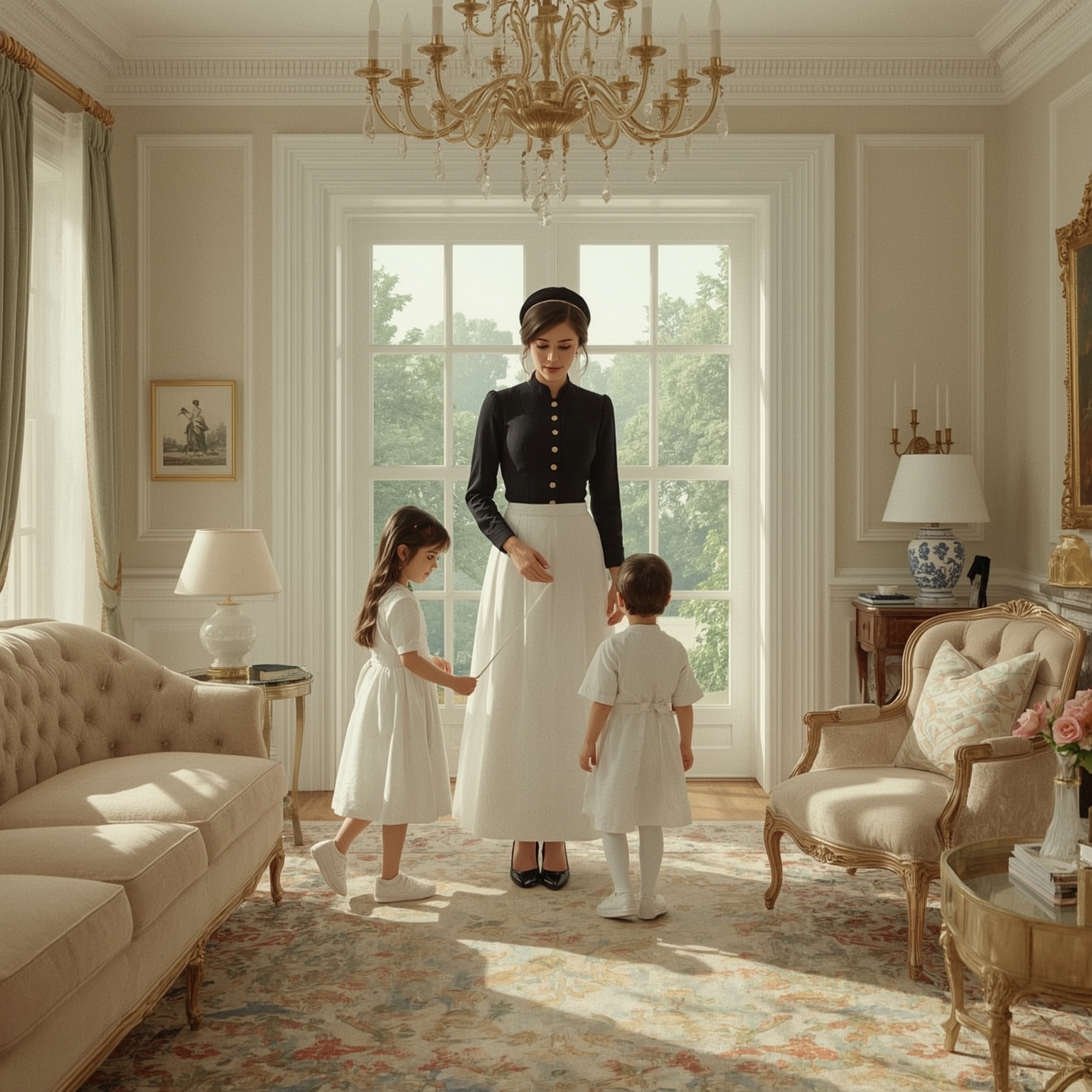
When Roxanne shares with others that she is studying to become a professional nanny, she often encounters a mixture of surprise and curiosity. Many people instinctively respond by asking her how such a career path could possibly be sustainable in the long term, she told Business Insider’s Robert Leslie. Roxanne, who hails from New Orleans, is quick to clarify that her ambitions stretch far beyond becoming an ordinary childcare worker. She is pursuing a specialization rooted in one of the most distinguished and respected traditions in the world of domestic care.
To understand her vision, it helps to consider the current landscape of the profession. In the United States, the average annual salary for a nanny is approximately $49,000, according to ZipRecruiter, a figure that places it firmly within the sphere of respectable but modest employment. However, the select group of nannies who graduate from the prestigious Norland College in Bath, England, achieve markedly higher earnings that reflect their elite training and status. Founded 133 years ago, Norland College has earned a reputation as a world-renowned institution dedicated to educating and refining the skills of top-tier childcare professionals. Its graduates are frequently sought after by some of the planet’s most affluent and influential families, including members of the British royal household and celebrities such as Mick Jagger.
According to the college’s own records, newly qualified Norland graduates can expect to earn starting salaries of around $75,000—a figure that already well exceeds the U.S. average. With experience, those earnings can rise dramatically, reaching as much as $170,000 after roughly a decade in the field, which is approximately three times what standard nannies in the U.S. typically bring home. Increasingly, Norland-trained nannies have become highly desirable in the United States, where affluent parents are demonstrating a growing willingness to invest substantial sums—often exceeding $100,000 annually—for their children’s exceptional care and safety. As Norland’s principal, Janet Rose, revealed, the demand is intense: in New York alone, almost a hundred positions were advertised over the last few years, yet the school struggled to find enough qualified candidates to meet that need. Roxanne, often photographed tending to a lively trio of triplets, is among the rising number of American trainees who have joined the college’s ranks to help fill this widening gap between supply and demand.
The six-figure salaries commanded by these nannies are not solely the result of Norland’s longstanding prestige but also of the comprehensive, multidimensional training its students undergo. Beyond mastering the fundamentals of childcare and early childhood education, trainees participate in extensive courses covering self-defense, gourmet cooking, skidpan driving for evasive maneuvers, neuroscience, child psychology, and even cyber safety—skills that collectively prepare them for an extraordinarily wide range of challenges. Graduates can perform everything from crafting delicate pastries such as chocolate eclairs and sushi rolls to repairing torn garments, safely controlling a car in a skid, or reacting with composure and precision in the face of a potential physical threat. Principal Rose humorously remarked that outsiders often compare Norland’s students to a fusion of James Bond and Mary Poppins; yet she insists that the goal is not to train bodyguards but rather to prepare well-rounded professionals capable of safeguarding the children entrusted to their care in both everyday moments and in the rare but critical event of an emergency.
One alumna, Alice, recounted a particularly harrowing example that underscores the value of this exhaustive preparation. She described an incident during which a stranger attempted to take a child she was looking after. Alice confronted the man, firmly demanding that he return the child, and when he refused, she physically intervened—securely retrieving the child while maintaining control of the stroller that held her infant sibling. The episode was undeniably frightening, but Alice explained that these unpredictable, high-stress circumstances are precisely why parents so deeply appreciate Norland-trained nannies. Their education incorporates rehearsed readiness for the kinds of “worst-case scenarios” that most caretakers are simply never trained to handle.
Roxanne, who was in her second year of study when she was interviewed in June, observed that in the United States, societal expectations often steer ambitious young people toward careers in science, technology, engineering, or medicine—fields collectively known as STEM. Choosing a path in caregiving rarely draws the same admiration. When she told peers she wanted to become a nanny, she was frequently met with confusion or dismissal. However, she believes Norland is revolutionizing this perception. The institution, she said, is transforming the traditional image of a nanny—from the outdated notion of being “the help” to a respected expert in child development and domestic management.
Addressing the challenge of meeting growing interest from American families, Principal Rose explained that cultural compatibility also plays a significant role. Every household, she noted, operates within its own unique cultural framework, and Norland’s mission is to prepare graduates who can adapt gracefully to those contexts. For many years, the college exclusively enrolled British students, but in 2021, it obtained a license that allowed it to admit international students. This change made it possible for American students like Roxanne, Frankie, and Emma to attend. The first cohort of U.S. enrollees is scheduled to graduate in 2026, potentially signaling a new era in transatlantic childcare standards.
Frankie, a first-year student from North Carolina, reflected candidly on her decision to move abroad for education. Previously, after spending a year studying in Italy at age fifteen, she had vowed never to study internationally again. Yet discovering Norland altered her perspective completely. The college’s philosophy, structure, and renowned emphasis on excellence and tradition resonated with her in ways that no American university program had. The school’s four-year curriculum is intensive and meticulously designed: during the first three years, students pursue a degree in Early Childhood Education, while the fourth year focuses on earning the prestigious Norland Diploma through a year-long placement within a real family setting.
The cost of tuition for international students is approximately $27,000 per year—only about $4,000 more than the annual fees at many U.S. public universities for out-of-state students. However, the value Norland provides extends far beyond the classroom. Upon graduation, every student is guaranteed placement assistance through the college’s own employment agency, which connects them with high-profile clients all over the world. Securing admission, however, is anything but simple. Vice Principal Rebecca Digby explained that the college accepts only around one hundred candidates annually, emphasizing that resilience—alongside dedication, empathy, and professionalism—is one of the core qualities the admissions team seeks.
Emma, a final-year student from Utah, offered a deeply personal account of her journey at Norland. When she first applied, she worried she might struggle academically or fail to fit in with her peers. Over time, those anxieties gave way to growing self-assurance. As she reflected, the demanding courses and constant exposure to challenging real-world practice significantly expanded both her technical expertise and her confidence in herself. Now, she feels equipped not only to respond decisively to emergencies but also to navigate large, busy cities like London with a heightened sense of awareness and safety. Her story encapsulates the transformation many Norland students undergo—a progression from uncertainty to empowerment, from aspiring caretaker to consummate professional prepared to serve families who expect nothing less than excellence.
Sourse: https://www.businessinsider.com/britain-170k-norland-nannies-american-parents-high-demand-new-graduates-2025-10


