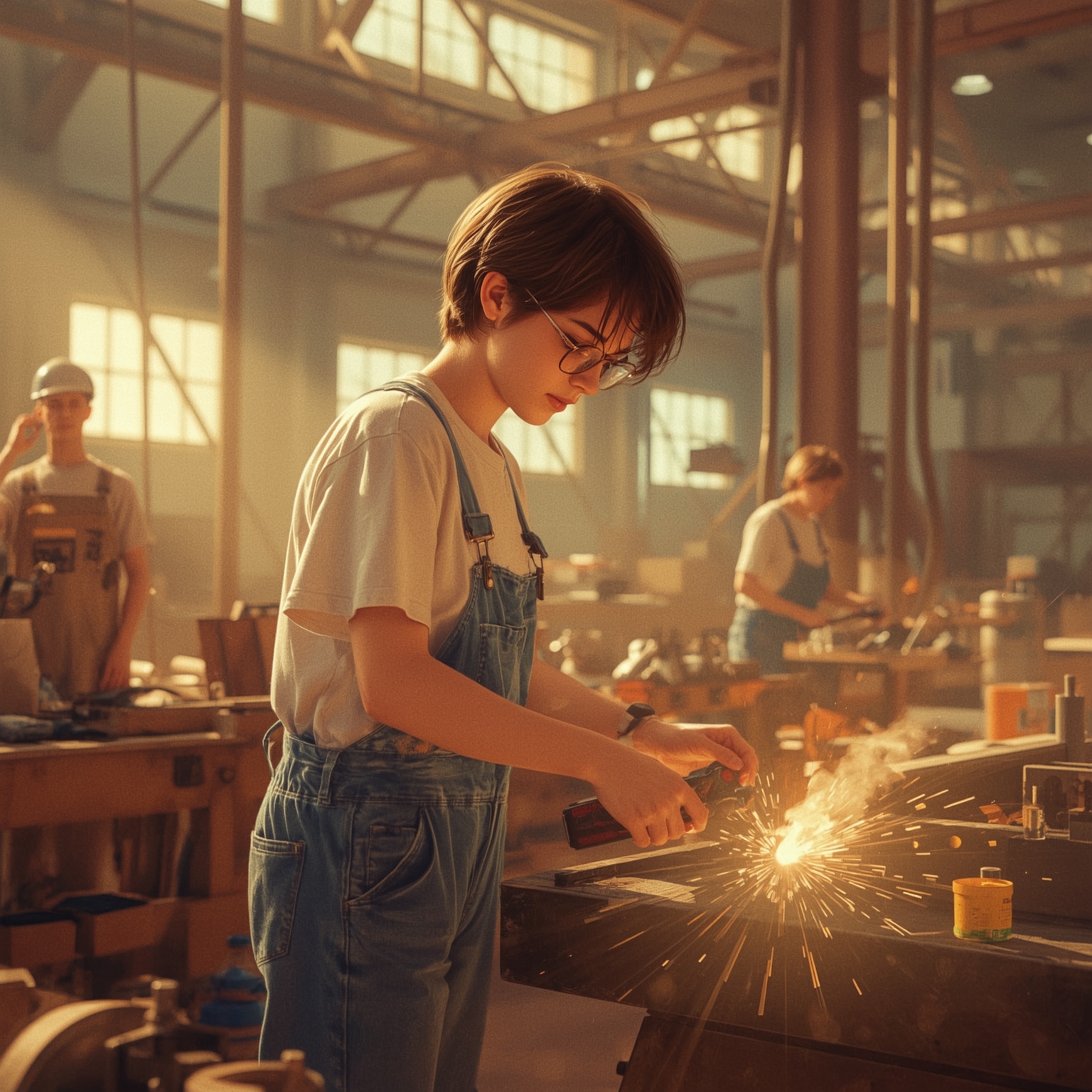
When confronted with the familiar parental challenge of how best to occupy his teenage son Jameson during the lengthy summer break between school years, Jim Farley—chief executive officer of Ford Motor Company—chose a path markedly different from the one that many of his wealthy peers might have taken. Whereas numerous executives in comparable positions frequently arrange elite internships, overseas experiences, or positions cushioned by family connections, Farley deliberately sought out an option that was both practical and unconventional within the context of his station in life. Rather than granting his son a privileged opportunity that would merely reinforce existing social advantages, he ensured that Jameson secured a summer job that required him to dedicate himself to the mastery of welding, one of the most essential yet often underappreciated industrial skills.
In a candid conversation for the “Decoder” podcast, Farley explained how transformative he hoped the experience would be for his 17‑year‑old. According to him, Jameson not only learned how to weld with precision but also gained foundational insights into fabrication, teamwork, and direct, hands‑on labor. Beyond the technical tasks, the summer work provided lessons in interpersonal connection—interacting with colleagues, understanding the rhythms of manual labor, and recognizing the dignity inherent in producing something tangible. By exposing his son to these facets of work, Farley sought to cultivate humility, adaptability, and an appreciation for workers whose skills are vital yet often insufficiently recognized in contemporary American culture.
Farley elaborated that his intention was not to predetermine Jameson’s career choices but rather to offer him a real sense of agency. In his words, he would be deeply gratified whether his son ultimately chose a future as one of the finest welders in the country or as a mechanic repairing the company’s robust Super Duty diesel engines. What mattered was the preservation of possibility. The key lesson, he suggested, was to ensure that his son realized the value of craft, labor, and skill, regardless of whether or not he pursued a white‑collar trajectory in the future.
These comments arrive during a period when Ford itself has intensified its efforts to confront a growing national crisis: the pervasive shortage of labor within the skilled trades and allied service professions. Farley refers to this segment of the workforce as part of the nation’s “essential economy”—a term he uses to emphasize both its indispensability and its vulnerability. Earlier in the week, the automaker even convened a summit in Detroit that gathered influential business leaders to consider how they might collectively bolster productivity, expand investment, and invigorate interest in these vocations. In addressing the assembly, Farley underscored the gravity of the situation, warning that society is simply not supported by a sufficient number of people capable of performing essential roles such as firefighters, emergency medical technicians, plumbers, electricians, repair technicians, and factory workers.
The economic significance of this essential economy is staggering. According to research released in June by the Aspen Institute—which has collaborated with Ford on addressing these issues—the sector accounts for approximately $7.5 trillion of the nation’s gross domestic product and sustains more than 52 million jobs across the United States. In the narrower but crucial area of automotive maintenance, the trade organization TechForce has reported that the United States requires upwards of 100,000 new technicians annually to keep pace with demand while also replacing those leaving the field through retirement or attrition. Numbers of this magnitude illustrate a pressing reality: without a new generation of skilled practitioners, industries that form the backbone of national stability will steadily erode.
For Farley, the decision to introduce his son to welding was meant not only as preparation for life but also as an implicit challenge to prevailing cultural narratives. Over time, American society has tended to glorify elite academic credentials and celebrated the prestige of high‑technology careers, often casting blue‑collar professions as less valuable or desirable. This shift, he argued, has unjustly diminished occupations that earlier generations of parents and grandparents regarded with honor and that, in many respects, built the foundation of the country’s prosperity. By recalling the dignity of emergency responders and tradespeople alike, Farley lamented that contemporary culture is quicker to celebrate the innovations of the latest artificial intelligence engineer while overlooking those who maintain public safety, restore power, and literally build the infrastructure upon which modern life depends.
He further cautioned that this imbalance carries consequences for national security. By leaning too heavily on technology professions while simultaneously neglecting the workforce that manufactures, repairs, and delivers essential goods, the United States exposes itself to serious vulnerabilities. In stressing the point, Farley drew a sharp contrast: multinational technology companies such as Google may lead in data and software, yet they cannot produce the boots, vehicles, and critical equipment that would be required in times of war or logistical crisis. Ford and the skilled trades upon which it relies, however, can shoulder that responsibility. The remark served as a powerful reminder that the true resilience of a nation often resides not in abstract innovation alone but in the tangible capacity to produce, repair, and deliver.
By urging his son to embark on this summer of welding, Jim Farley sought to instill a deep respect for practical work, affirm the dignity of skilled trades, and push back quietly but forcefully against a social order that too often overlooks these imperatives. His reflections remind us that cultivating the next generation of laborers, builders, and essential workers is not merely a matter of corporate responsibility but also of national survival, cultural balance, and parental wisdom.
Sourse: https://www.businessinsider.com/ford-ceo-wanted-his-son-to-learn-to-weld-2025-10