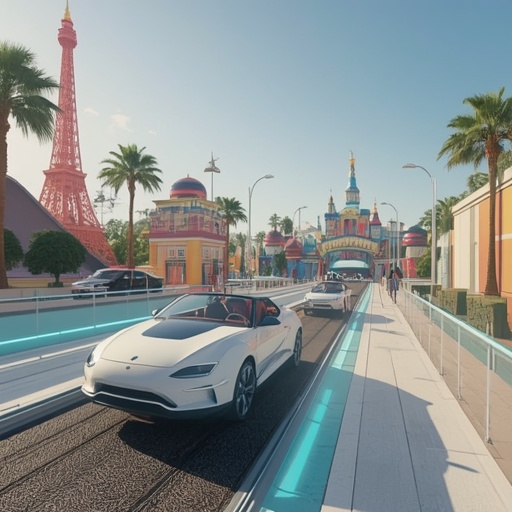
Tomorrowland has long stood as a symbolic gateway to humanity’s imagined future — a shining vision of progress, innovation, and optimism rendered in chrome, neon, and nostalgic dreams of tomorrow. Yet, within this bright utopia, one element feels curiously out of sync with the times. Disneyland’s Autopia continues to rely on traditional gasoline engines, their exhaust lingering as faint reminders of 20th-century transportation rather than beacons of forward-looking innovation. This juxtaposition between the park’s futuristic façade and its relic of fossil-fueled technology creates a fascinating tension: why has a place designed to showcase the promise of progress allowed such a contradiction to persist for decades?
In an era defined by rapid electrification, where automotive brands push boundaries with autonomous vehicles and sustainable energy solutions, Autopia’s mechanical growls seem almost anachronistic. The ride, beloved for generations, still evokes an earlier age of exploration — an age when the open road represented freedom and discovery, when the sound of an engine was synonymous with adventure. But the 21st century has rewritten that narrative. The soundscape of innovation today hums not with combustion but with the quiet, efficient glide of electric propulsion. Society’s collective aspiration has shifted from speed and spectacle to sustainability and stewardship.
The decision to maintain Autopia’s gasoline engines may stem from layers of tradition and emotional connection. The attraction is entwined with Walt Disney’s original vision; it was one of the park’s opening-day experiences in 1955 and stands as a living artifact of mid-century optimism. Perhaps this continuity preserves a tangible thread to Disneyland’s heritage — a testament to how imagination once conceived the future. Yet, this reverence for history also introduces a paradox: the desire to protect nostalgia can inadvertently stall progress, leaving Tomorrowland anchored, if only symbolically, in yesterday.
From a corporate or technological perspective, updating Autopia to an electric or hybrid model would seem an inevitable evolution. It aligns effortlessly with global discussions surrounding environmental responsibility, carbon reduction, and the moral imperative of sustainability. Moreover, it could redefine the aesthetic narrative of Tomorrowland, transforming the area into a celebration of contemporary innovation rather than retro-futuristic sentimentality. Visitors could experience the thrill of motion and control without the haze of exhaust, immersing themselves in an environment where cleanliness and creativity coexist.
Yet the choice is not purely mechanical; it is philosophical. Disneyland has always balanced progress with memory, charting a delicate course between honoring the past and embracing the future. To change Autopia too radically might risk erasing an element of its charm — the nostalgic joy of tiny engines roaring beneath a blue California sky. But to leave it unchanged risks diminishing the park’s credibility as a visionary space, rendering its promise of ‘tomorrow’ merely decorative.
As we stand in 2024, Autopia’s continued use of gasoline invites a broader reflection on how institutions reconcile identity with advancement. Should the magic of tradition take precedence, preserving authenticity even amid obsolescence? Or should the spirit of innovation compel transformation, ensuring that imagination keeps pace with reality? The answer, perhaps, lies in reimagining the balance itself: a Tomorrowland that honors its heritage while embodying the silent, sustainable revolution shaping our real-world future.
In the end, Disneyland’s path forward may serve as a microcosm of society at large — a conversation between memory and progress, sentiment and sustainability, nostalgia and necessity. The choice of whether Autopia will remain fueled by the past or powered by the promise of tomorrow is more than a technical update; it is a statement about what kind of future we wish to believe in, and whether we have the courage to bring that vision to life.
Sourse: https://gizmodo.com/why-the-hell-has-it-taken-so-long-for-disneylands-autopia-to-go-electric-2000755714


