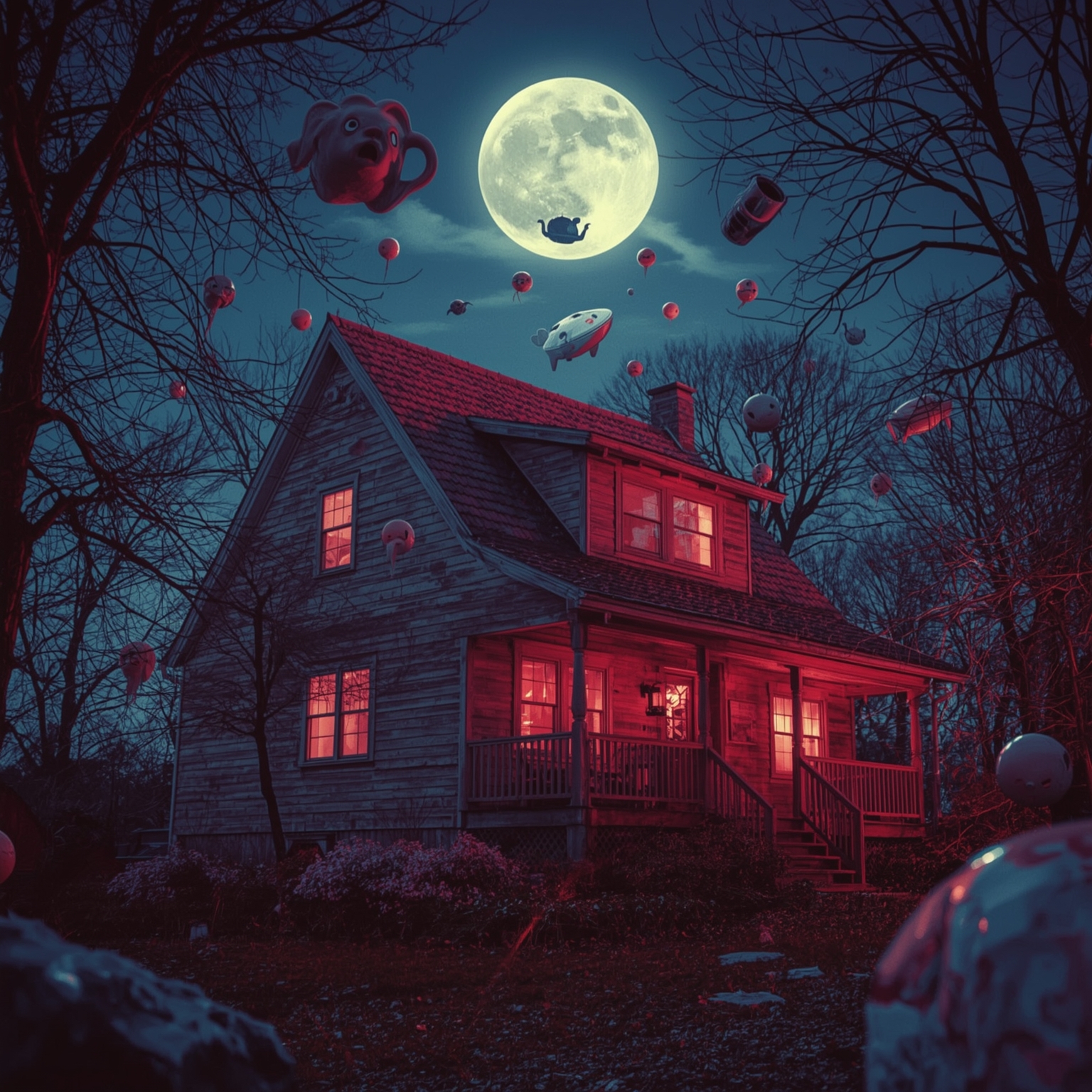
The season of spine-tingling thrills and atmospheric October chills has once again arrived, bringing with it that unmistakable craving for flickering candles, cozy blankets, and cinematic fright. While traditional Halloween movie nights often feature time-honored horror staples such as *Bring Her Back*—a film celebrated for its elegantly gruesome craft—or Sam Raimi’s *The Evil Dead*, a definitive and unshakable classic, there exists another option for those who wish to veer away from the conventionally terrifying. For viewers seeking a viewing experience that is more strange than sinister, more deliriously imaginative than outright horrifying, there is no better choice than the 1977 Japanese fantasy-horror masterpiece *House*.
Attempting to summarize *House* is, quite frankly, an almost impossible undertaking—words inevitably fail to capture its chaotic splendor. At its core, the story appears deceptively straightforward: a high school girl, distressed by her widowed father’s sudden engagement to a mysteriously subdued woman, decides to spend her summer holiday with her eccentric aunt in the countryside. She invites six of her closest friends along for the visit—each a distinct character whose personality borders on caricature. Yet the moment they step into the aunt’s seemingly tranquil estate, the world as they know it begins to collapse. The house itself shifts, breathes, and bleeds, drawing them into a kaleidoscopic nightmare filled with inexplicable supernatural occurrences—from carnivorous pianos to spectral cats, to inexplicable disembodied heads floating through scenes with both menace and whimsy.
This skeletal plot, however, does little to prepare the viewer for the feverish torrent of surreal imagery, disorienting tone changes, and manic energy that defines *House’s* eighty-eight-minute runtime. Every frame teems with visual invention, oscillating between pastel-colored fantasy and grotesque absurdity. Even the film’s own trailer only hints at the delirious spectacle within; it is merely a faint echo of the full-blown aesthetic madness that Nobuhiko Obayashi unleashed onto the screen.
The film owes its unearthly vision to the director’s audacious experimentation and unrestrained imagination. Nobuhiko Obayashi, a filmmaker with a background in avant-garde cinema and television commercials, approached *House* as a hyper-stylized dreamscape rather than a conventional narrative. His filmmaking revels in artifice—matte paintings, stop-motion sequences, split screens, and exaggerated editing rhythms all collide in a way that feels both anarchic and meticulously crafted. Yet the arresting sense of childlike illogic that animates the story stems from an even more unexpected source: the creative influence of Obayashi’s ten-year-old daughter, Chigumi Ôbayashi, who co-conceived key elements of the plot and imagery.
In a candid interview included on the film’s Blu-ray release, Nobuhiko reflected on his unconventional inspiration. He explained that adults, limited by reason and habitual logic, can only imagine within the boundaries of what they already comprehend. Children, on the other hand, possess the freedom to conjure the impossible; their fascination with mystery and the unknown allows them to create worlds that defy explanation. According to Obayashi, the true essence of cinema resides not in rational storytelling but in the capacity to evoke wonder—the strange, the inexplicable, the dreamlike sensations that transcend the conscious mind. This philosophy shapes *House* entirely; it is, in effect, cinema as pure imagination.
The result is an exhilarating tonal collage that veers abruptly and unapologetically from sentimental family melodrama, bathed in soft, hazy lighting, to frenzied slapstick sequences reminiscent of an early music video, then onward to moments of proto–J-horror laced with gore and genuine menace. Traditional cinematic transitions dissolve into playful editing gestures—circle wipes, hand-painted backdrops, sudden animation inserts—all existing side by side with startling outbursts of bright red blood and cartoonish violence. Beneath its dazzling absurdity, however, lies a story steeped in traditional folklore and haunted by the lingering ache of loss. The film’s surrealism often functions as a metaphor for grief and inherited trauma, its grotesque humor offering an unconventional way of confronting deep emotional wounds.
*House* stands as one of the most singular achievements in horror cinema, an anomaly that refuses to fit neatly into any category. As *Philadelphia Inquirer* critic Carrie Rickey once noted, it is “too absurd to be genuinely terrifying, yet too nightmarish to be merely comic”—a paradox that perfectly encapsulates the film’s magnetic allure. Its eccentric energy would later echo in the kinetic slapstick horror of Sam Raimi’s *Evil Dead 2* and find distant resonance in David Lynch’s *Twin Peaks*, both of which explore darkness through surreal disjunctions and ominous humor. In that sense, the film’s bold artistry laid groundwork for generations of filmmakers who sought to marry horror with the surreal and the absurd.
Personally, having watched *House* more times than I can recall, I continue to emerge from each viewing bewildered, exhilarated, and awash in that peculiar mixture of laughter and dread. Every revisit renews the same incredulous reaction—an astonished, delighted “What on earth did I just witness?”—always uttered with utmost admiration. This film defies categorization, defies logic, and yet captivates utterly. It is, unequivocally, a cult classic: a work so visually audacious and emotionally daring that turning away feels impossible. For those who have yet to experience its delirious charm, there is no better time than now to surrender to its spell. *House* currently awaits discovery on the Criterion Channel and HBO Max, gleaming like a hidden cinematic jewel in the haunted treasure chest of film history.
Sourse: https://www.theverge.com/entertainment/798719/watch-japanese-horror-fantasy-film-house-halloween