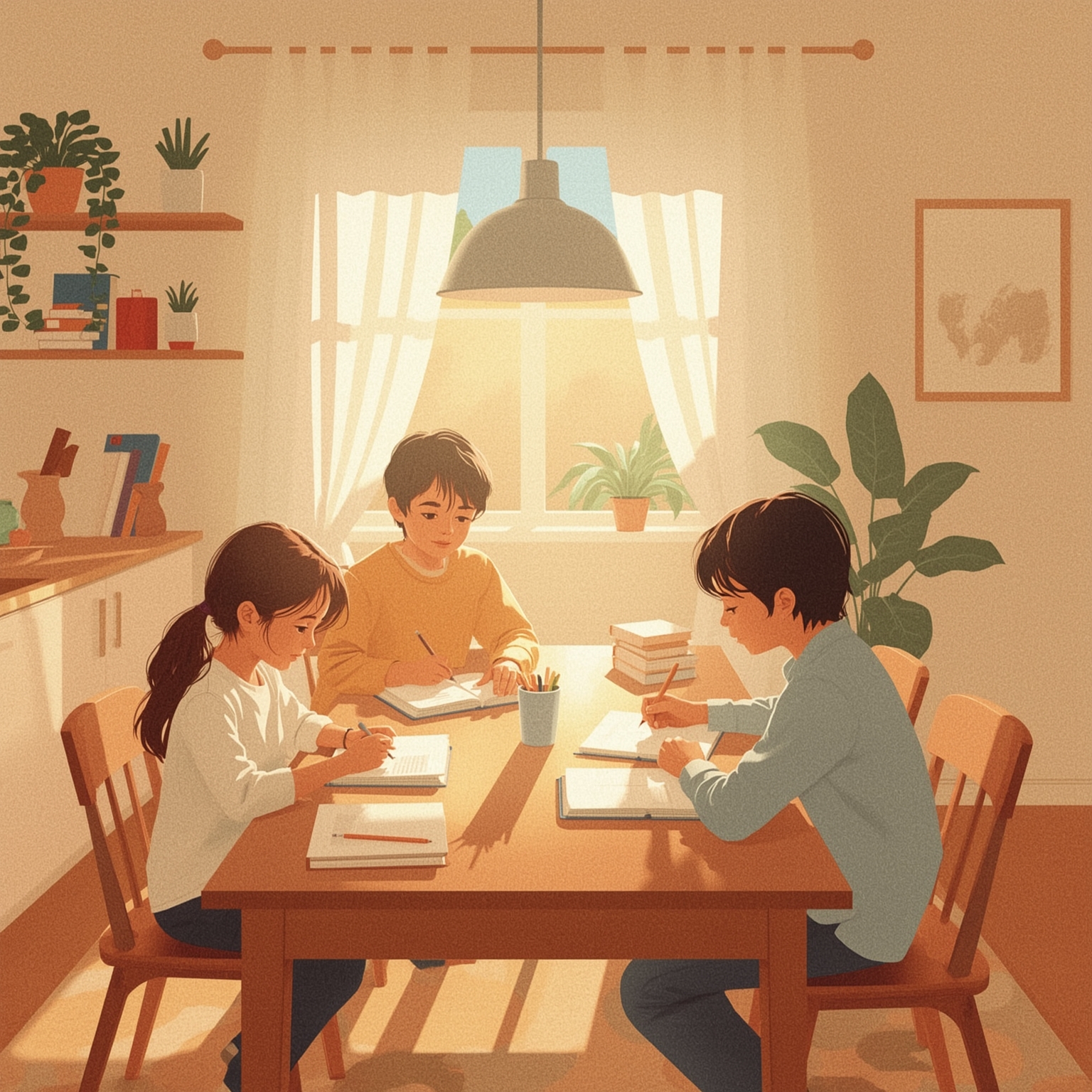
Imagine a typical morning in countless American households today: children sit down at the kitchen table to eat breakfast at eight o’clock sharp, and within only half an hour, the same space—perhaps alongside the dining table—is reorganized into an improvised classroom where math lessons begin. What once may have been considered an unconventional daily rhythm is now becoming an increasingly common experience for young learners across the nation. This shift reflects a growing trend as a rising number of parents make the decision to take full responsibility for their children’s education through homeschooling rather than relying solely on formal schools.
Recent state data compiled by the Johns Hopkins University Homeschool Research Lab, an organization dedicated to monitoring and analyzing educational trends, confirms the measurable growth in homeschooling across the United States. According to their findings, seventeen states have already reported gains in home-based education enrollment for the 2024–2025 academic year. Virginia, for instance, was among the most recent states to release its figures, revealing that just over 56,000 students are now learning from home—a noticeable increase from the 53,680 recorded during the previous year. Meanwhile, states with historically large homeschooling populations such as North Carolina and Georgia continue to report substantial numbers, with 165,243 students and 89,510 students, respectively, pursuing studies outside of traditional schools.
This surge is not entirely unprecedented. In the academic year preceding this one, nineteen states registered increases in homeschooling participation, while only two states experienced declines. Nonetheless, gaps remain in national data collection, as twenty states still either do not track homeschooling enrollment or choose not to release that information publicly. Additional reports from the remaining states are expected to surface over the next several months, which may further define the scope of this national trend.
The dramatic expansion of homeschooling initially accelerated during the height of the COVID-19 pandemic. During that period, many parents grew dissatisfied with the virtual learning programs provided by public schools, often citing what they perceived as insufficient quality or structure. Consequently, large numbers of families opted to educate their children independently. However, educational researchers stress that the current continuation of homeschooling’s growth cannot simply be explained as a lingering aftershock of pandemic-era schooling. Angela Watson, senior research fellow at the Johns Hopkins Institute for Education Policy and the founder of the Homeschool Research Lab, points out that families choosing this path today appear to represent a somewhat younger demographic compared to parents who traditionally selected private or public institutions for their children. According to Watson, this generational difference may help explain why home education has become less socially stigmatized, as younger parents see homeschooling as a valid and normalized alternative rather than a fringe option.
It is important to emphasize that homeschooling, though on the rise, does not dominate the American educational landscape. Even in Virginia—where thousands of students are homeschooled—public schools continue to enroll the overwhelming majority of learners, with approximately 1.2 million students attending full time during the 2024–2025 school year. Nevertheless, the fact that homeschooling is steadily attracting larger numbers of families highlights a broader transformation in the nation’s approach to education. This shift coincides with political and policy initiatives, particularly those promoted during President Donald Trump’s administration, which strongly advocated for the expansion of school voucher programs. These vouchers are designed to allow parents greater freedom by channeling federal funds toward their children’s education in private schools, charter schools, or even homeschooling, rather than restricting those funds solely to traditional public schools. At the same time, public school enrollment figures are declining nationwide, prompting some districts to either consolidate resources or close campuses altogether. The causes for this decline include not only the growth of voucher programs but also broader demographic challenges such as falling birth rates and limited access to federal funding.
Watson has argued that as the educational marketplace continues to diversify, parents are increasingly empowered to choose the learning environments that best align with their children’s needs. In her view, this exodus from traditional schools stems from the perception that standardized, one-size-fits-all institutions often fail to adequately address the individual requirements of students. Families thereby gravitate toward homeschooling and other alternatives because such models offer opportunities for customization, flexibility, and responsiveness to specific learning styles, paces, or interests.
Government policy has also played a pivotal role in reshaping public education. Since taking office, President Trump signed several executive orders aimed at redefining how public schools operate. Among these efforts was an attempt to expand voucher programs by redirecting certain federal education funds toward parental-choice initiatives. However, although the administration expressed strong support for reallocating resources, enacting such structural changes ultimately requires congressional approval. In some instances, federal funding—including allocations for programs dedicated to migrant education and after-school activities—was temporarily withheld and only later released with restrictions designed to ensure alignment with the administration’s broader policy objectives. During a visit to a charter school in Michigan, Education Secretary Linda McMahon emphasized that the federal government does not directly manage curricula, hire teachers, or purchase materials. Instead, she explained, its primary role is to serve as a financial conduit to empower states, while also encouraging them to learn from each other’s best practices.
With homeschooling enrollment growing and public school enrollment shrinking, some districts are beginning to adapt by creating hybrid models. For example, Mesa Public Schools in Arizona has developed special programs allowing homeschooled children to take classes part-time at public schools. This arrangement not only provides families with greater flexibility but also enables schools to receive voucher funds for participating students. Such initiatives highlight the increasingly fluid boundaries between educational models, where families might combine homeschooling with microschooling, online courses, or selective enrollment in public school programs to piece together a personalized educational pathway.
Looking toward the future, Watson suggests that once parents make a non-traditional educational choice for one child, they are likely to continue down that path with subsequent children, reinforcing long-term patterns. She foresees a future in which families will not simply select one exclusive mode of schooling but will instead assemble a blended educational experience customized from an array of available options. In this evolving landscape, homeschooling serves as both a growing movement in its own right and a symbol of the broader transformation underway in American education as families seek to balance autonomy, quality, and opportunity in the schooling of their children.
Sourse: https://www.businessinsider.com/is-homeschooling-on-the-rise-vouchers-public-school-education-2025-9