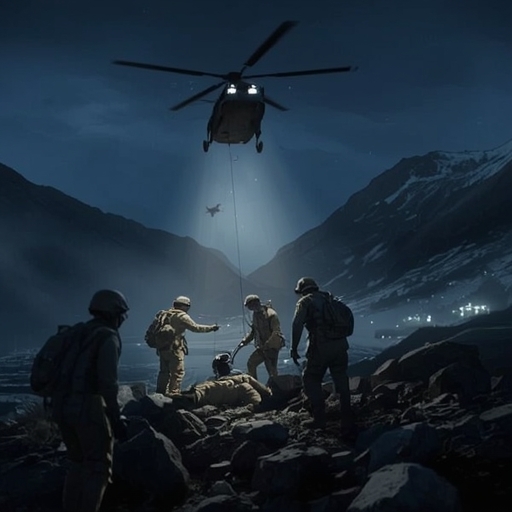
Bravery does not recognize the boundaries of geography or circumstance; it transcends borders, time, and the dangers that often await those in uniform. Among the many acts of selflessness that define the United States military, few exemplify such fierce devotion and moral integrity as its unyielding promise to rescue downed airmen—even when those efforts carry soldiers deep into enemy territory. Each life, every comrade lost or imperiled, is treated as invaluable, and that conviction fuels missions carried out under extraordinary peril.
When an aircraft falls from the sky in hostile regions, far from support or safety, the phrase “no one left behind” becomes far more than a slogan—it transforms into a sacred vow. Combat search and rescue missions are intricate, high-stakes operations combining advanced training, cutting-edge technology, and sheer human courage. Pilots, medics, and ground teams must navigate through treacherous landscapes, uncertain intelligence, and constant threats of interception, relying on absolute coordination and trust. For these teams, success is not measured solely by strategic victory but by the preservation of life—the bringing home of one’s brother or sister in arms.
The choice to risk everything in the pursuit of one life reveals something profound about the spirit of service. It speaks to a deeper moral code within the U.S. military—one that esteems every individual as worth saving regardless of the dangers involved. In an era where military strategy often emphasizes efficiency, the decision to place entire units in jeopardy for a single rescue underscores the humanity that remains at the heart of defense. It is a reflection of values that define both leadership and brotherhood: loyalty, compassion, and the courage to act when hesitation could cost lives.
Behind every rescue operation lies a compelling narrative of resilience and unity. The aircrew that signals distress, the rapid response force that mobilizes in mere minutes, the helicopter teams hovering over rugged, wind-swept terrain—all are bound by a common purpose. Their bravery illustrates a kind of courage that surpasses battlefield valor: the courage to confront uncertainty, to endure fear, and to fight not for conquest but for the life of another. These missions, often unseen by the public, embody the essence of what it means to serve with honor.
Ultimately, such efforts remind us that courage is not defined solely by the act of battling an opponent, but by never giving up on each other. Each successful extraction serves as a testament to the intricate web of duty, sacrifice, and love that threads through every branch of service. The U.S. military’s unwavering resolve to recover its downed airmen is more than an operational practice—it is a living proof of compassion in uniform, a profound message that even in war’s darkest hours, humanity and hope will not be forsaken.
Sourse: https://www.businessinsider.com/why-the-us-risks-so-much-to-save-downed-airmen-2026-4