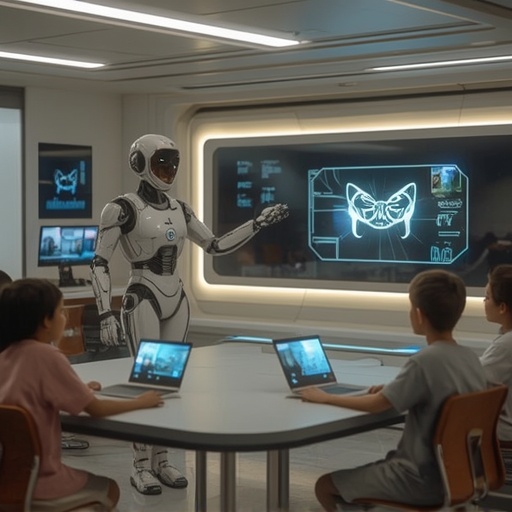
By the middle of the decade, education may undergo a transformation so profound that it challenges every preconceived idea we hold about teaching and learning. Imagine walking into a classroom in the year 2026, not to find a traditional human instructor, but a sophisticated humanoid entity—an artificial intelligence embodied in a form remarkably similar to our own—standing at the front of the room. This AI-powered teacher, once perhaps designed for vastly different purposes, has been repurposed to instruct, nurture curiosity, and interact with students using advanced emotional intelligence algorithms.
This potential evolution of the educational landscape extends far beyond mere novelty. It represents a confluence of technological innovation, social adaptation, and ethical reflection. The integration of autonomous robots into roles once exclusively occupied by humans compels society to ask challenging questions: Can empathy, creativity, and moral reasoning truly be mirrored by code? Will the presence of such machines enhance intellectual growth, or will it erode the essential human dimension of teaching?
Advancements in robotics and artificial intelligence have already blurred the boundaries between what is mechanical and what feels alive. Reprogramming emotionally responsive humanoids for pedagogical purposes may be both groundbreaking and unsettling. While such technology promises perfectly patient, endlessly knowledgeable, and unbiased tutors, it simultaneously confronts us with difficult moral considerations about intimacy, authenticity, and human identity. The label ‘sex robot’—when redefined within a scholastic context—forces us to confront how fluid the roles of AI might become, and how society must establish ethical constraints long before such machines become commonplace in classrooms.
In the classroom of tomorrow, every interaction could be quantified, analyzed, and optimized for each learner’s cognitive pattern. Lessons taught by AI educators might adapt instantaneously to a student’s strengths and weaknesses, creating hyper-personalized learning experiences. However, amid the excitement over efficiency and accessibility, the absence of a human soul in the teaching relationship could create unforeseen consequences—ones that algorithms alone cannot predict or repair.
Ultimately, the notion of humanoid educators invites both hope and hesitation. It may democratize quality education, eliminate bias in instruction, and break geographical barriers. Yet it also demands urgent reflection on what it means to learn from another being—not just to absorb facts, but to share emotion, experience, and meaning. As 2026 approaches and the line between teacher and technology continues to fade, society faces a pivotal question: in our pursuit of progress, how do we preserve the essence of what makes education profoundly human?
Sourse: https://gizmodo.com/your-childs-next-teacher-could-be-a-sex-robot-2000787284