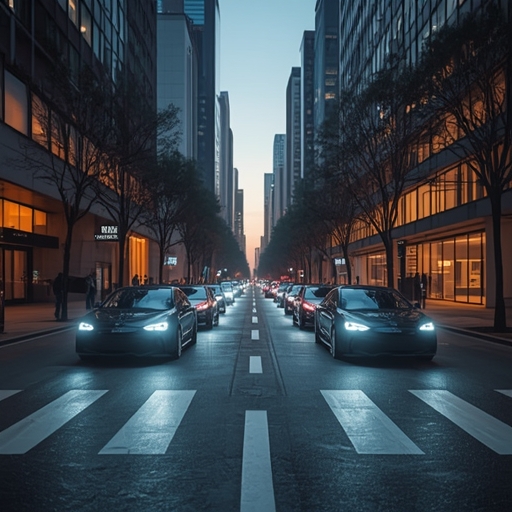
Uber’s latest strategic collaboration with Waabi marks a monumental leap forward in the evolution of autonomous transportation. The announcement of 25,000 newly developed robotaxis, designed and powered by Waabi’s state-of-the-art self-driving technology, signifies far more than just a partnership—it heralds a decisive step toward redefining the modern urban mobility landscape. By merging Uber’s massive global ride-hailing network with Waabi’s pioneering expertise in artificial intelligence and autonomous vehicle systems, this alliance ventures into a realm where innovation meets scalability on an unprecedented scale.
Through this initiative, Uber aims to transition from conventional human-operated vehicles toward a seamlessly automated future that prioritizes safety, sustainability, and operational efficiency. Each robotaxi will embody years of research, development, and technological refinement, representing not simply machines on wheels but intelligent entities capable of learning from real-world environments through advanced simulation and adaptive deep learning systems. Waabi’s unique approach to autonomous driving utilizes a revolutionary “AI-first” methodology—one that leverages powerful virtual training environments to enable vehicles to handle an almost limitless range of driving scenarios before ever hitting the road.
This deployment of 25,000 robotaxis is not merely a numerical benchmark; it symbolizes the maturation of autonomous technology into a viable large-scale service model. By integrating Waabi’s autonomous systems into Uber’s operational network, the companies aim to significantly reduce ride costs, minimize human error, and enhance accessibility across bustling metropolitan regions. For cities already grappling with congestion and environmental concerns, fleets of electric or hybrid robotaxis could provide a cleaner, more adaptive mode of transport that balances efficiency with sustainability.
Beyond the technological implications, this partnership also poses intriguing questions about the future of employment and the shifting dynamics within mobility ecosystems. While some may view automation as a disruptor, both Uber and Waabi present it as an opportunity to transform mobility into a smarter, safer, and more inclusive service for diverse populations—from commuters and business travelers to individuals seeking affordable, on-demand transport.
In essence, this collaboration stands as a milestone in the global pursuit of fully autonomous mobility. It reinforces Uber’s long-term commitment to innovation and Waabi’s position as a frontrunner in computational intelligence. Together, these two companies are not merely launching a fleet of self-driving vehicles—they are inviting society to envision a future where transportation operates at the intersection of human ingenuity and machine precision. The era of driverless rides, once the domain of science fiction, is now rapidly crystallizing into tangible urban reality.
Sourse: https://www.businessinsider.com/uber-plans-to-deploy-25k-robotaxis-with-autonomous-trucking-startup-2026-1