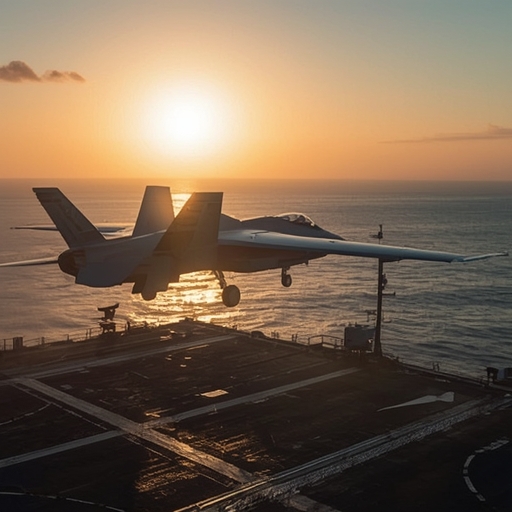
The United States Navy has achieved an extraordinary technological and strategic milestone with the inaugural flight of its $209 million MQ‑25A Stingray, the first carrier‑based aerial refueling drone ever to take to the skies. This groundbreaking moment not only marks the successful realization of a highly ambitious engineering project, but also symbolizes the Navy’s decisive shift toward a new epoch of autonomous and semi‑autonomous aviation capability. The Stingray’s first flight, conducted under carefully monitored and meticulously planned test conditions, serves as clear evidence of years of research, innovation, and collaboration between military engineers, aerospace manufacturers, and defense technologists determined to expand the operational reach of future carrier strike groups.
Designed specifically to meet the pressing logistical demands of long‑range deployment, the MQ‑25A Stingray introduces a revolutionary approach to in‑flight refueling and endurance extension. By functioning as an unmanned tanker, it allows piloted carrier‑based aircraft—such as the F/A‑18 Super Hornet and forthcoming next‑generation fighters—to increase their missions’ range and duration without the need for human‑operated tanker support. In other words, the Stingray acts as an intelligent force multiplier, simultaneously enhancing the efficiency of flight operations and reducing the risks posed to human personnel in potentially hostile environments.
The dawn of this capability represents a substantial evolution in naval combat readiness and fleet sustainability. Unlike traditional systems that require frequent, human‑intensive resupply missions, the MQ‑25A can autonomously operate from an aircraft carrier deck, integrate seamlessly into coordinated flight schedules, and execute precision refueling maneuvers with exceptional reliability. Through these capacities, the Stingray not only revolutionizes air‑to‑air refueling but also opens the door to a host of future applications in surveillance, reconnaissance, and advanced communication networks, each underpinned by artificial intelligence‑driven control architecture.
Beyond its impressive technological prowess, the broader implications of the MQ‑25A’s maiden flight are strategic and forward‑looking. The Navy is signaling its enduring commitment to innovation, demonstrating a proactive response to the shifting realities of modern warfare and the need for adaptable, data‑augmented operational systems. The successful flight reflects years of investment in autonomy, software precision, and next‑generation sensor integration—elements that collectively redefine what is possible for unmanned military aviation. This achievement also reinforces the essential partnership between defense industry leaders and government research institutions, highlighting how cross‑sector collaboration can accelerate progress in critical domains.
In many ways, the Stingray’s ascent into operational testing symbolizes more than the mere proof of concept for a single aircraft; it embodies an evolution in doctrine. By introducing autonomous aerial refueling to carrier operations, the Navy is preparing for a future in which human pilots, robotic systems, and intelligent analytics coexist in synchronized harmony to enhance both safety and mission success. The MQ‑25A Stingray’s debut flight therefore not only propels the Navy’s technological capabilities skyward—it secures its place at the vanguard of twenty‑first‑century military innovation and defines a new horizon for autonomous naval aviation.
Sourse: https://www.businessinsider.com/navy-just-tests-209-million-stingray-refueling-drone-2026-4


