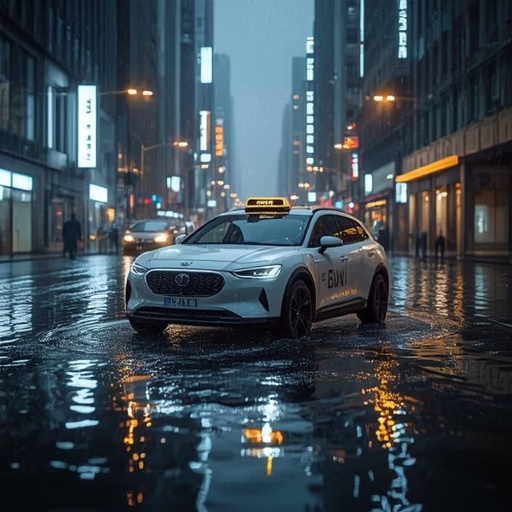
Waymo, Alphabet’s autonomous vehicle subsidiary, has announced a significant and precautionary expansion of its operational pause, temporarily halting its robotaxi services across four major cities. This course of action follows unsettling reports of several of its self-driving vehicles traversing through flooded streets—an environmental scenario that continues to challenge even the most sophisticated algorithms in the autonomous mobility sector. The decision underscores the undeniable truth that cutting-edge technology, no matter how advanced, must continually adapt to the unpredictable variables of the real world.
The company’s earlier suspension had included specific test regions, but recent incidents have motivated Waymo to broaden the scope to encompass a total of four urban markets: Atlanta, San Antonio, and two others previously identified in internal evaluations. Each of these locations presents its own unique environmental and infrastructural complexities, including drainage irregularities, rapid stormwater accumulation, and inconsistent topographical gradients—all of which can create deceptive illusions of shallow water, posing hidden risks to both human drivers and artificial intelligence systems.
Waymo’s engineers and safety teams are now redoubling their focus on refining the vehicle’s environmental perception stack, particularly in enhancing its flood detection capabilities. This improvement involves the development of advanced sensor-fusion models that integrate lidar, radar, and optical cameras with sophisticated weather and geospatial datasets. By achieving more accurate water-depth estimation and roadway reflectivity analysis, the company hopes to ensure that its autonomous systems can distinguish between simple surface wetness and conditions of hazardous inundation.
According to internal briefings, the current pause serves two primary objectives. First, it provides the necessary time to collect extensive environmental data under controlled conditions, enabling data scientists to simulate complex flood scenarios within Waymo’s powerful virtual testing framework. Second, it allows the safety oversight division to reevaluate emergency response protocols, ensuring that vehicles can not only identify and avoid flooded zones but can also execute fail-safe maneuvers and communicate effectively with human operators if unpredictable circumstances arise.
This measured suspension is not a setback but rather an important recalibration—one that reflects the delicate balance between innovation and responsibility in the fast-evolving landscape of autonomous mobility. Industry observers note that these challenges are not unique to Waymo; they exemplify the broader obstacles that all self-driving technologies face when confronted with nature’s unpredictability. Floods, heavy precipitation, and rapidly changing microclimates can overwhelm visual sensors and compromise decision-making algorithms, illustrating that full autonomy must coexist with human oversight, localized weather intelligence, and continuous system learning.
As the company works diligently to strengthen its technical safeguards, Waymo reiterates its commitment to safety as the guiding principle of its mission to redefine transportation. Each pause, though temporary, represents an investment in long-term reliability and public trust. Once operations resume, it is expected that the company’s expanded flood-awareness and detection protocols will serve as new benchmarks for resilience across the entire autonomous driving industry.
In essence, this development is both a cautionary and inspiring moment. It highlights the transformative potential of autonomous vehicles, while reminding innovators, policymakers, and consumers alike that technological progress must evolve hand in hand with adaptability and humility toward the natural environment. Through this process of reflection and refinement, Waymo aims to lead not merely with speed, but with wisdom—paving the way for a future in which intelligence on the road truly meets the rigor of the real world.
Sourse: https://techcrunch.com/2026/05/21/waymo-pauses-service-in-four-cities-as-robotaxis-keep-driving-into-floods/