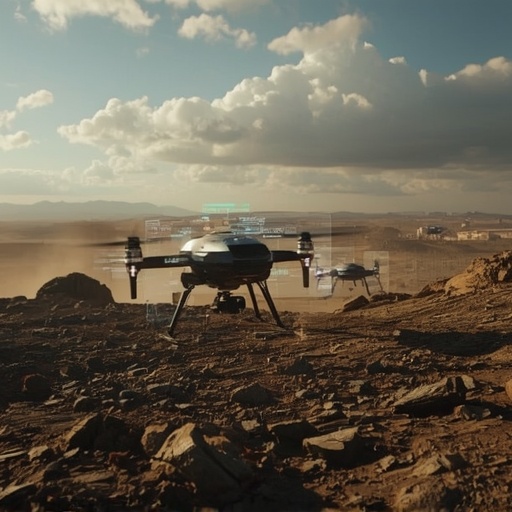
Over the span of a brief six months, the Ukrainian military has witnessed an extraordinary transformation in the technological character of its battlefield operations. The nation’s reliance on autonomous and semi-autonomous ground drones — mechanical systems designed to execute reconnaissance, logistical support, and tactical engagement — has increased by an astonishing 122%. In quantifiable terms, this surge means that the number of ground-robot missions soared from 7,511 in January to a remarkable 16,676 by June. This data not only represents a statistical shift but also symbolizes a fundamental change in the philosophy and practice of modern warfare.
This rapid escalation in unmanned ground operations reflects the military’s growing confidence in robotic and artificial intelligence–enhanced platforms. Such systems are not merely experimental adjuncts but have become indispensable components of modern defense strategies. Their utilization allows for expanded operational reach, continuous surveillance, and engagement in high-risk zones where human soldiers would otherwise be exposed to severe danger. By intensifying their deployment, Ukraine underscores its commitment to safeguarding human life while simultaneously amplifying the scope and precision of its combat capabilities.
The implications extend well beyond the immediate theater of conflict. Globally, defense analysts are observing this trend as a clear indicator of how robotics and AI are redefining the anatomy of war. The shift toward automation introduces new ethical, strategic, and logistical dimensions — from questions about decision-making autonomy in lethal operations to challenges surrounding cybersecurity and control reliability. For instance, while the utilization of drones drastically reduces soldier casualties, it also raises pressing concerns regarding the potential desensitization to violence and the moral consequences of delegating life-and-death decisions to algorithms.
Furthermore, Ukraine’s technological advancement exemplifies how innovation often accelerates under the pressure of necessity. In an environment defined by asymmetrical warfare and rapid adaptation, the integration of ground robots transforms the landscape of military engagement. These systems can traverse hazardous terrain, conduct supply deliveries under fire, or even perform search-and-rescue missions among ruins. In this way, the deployment of drones represents a convergence of engineering sophistication, data-driven strategy, and human ingenuity, forming a prototype for the wars of tomorrow.
Consequently, the 122% escalation is not merely a statistic of progress; it is a testament to the ongoing redefinition of warfare itself. The battlefield is evolving from a domain dominated by human endurance and intuition into one shaped by sensors, networks, and autonomous decision-making. As technology continues to advance, nations are compelled to confront an urgent question: how to balance efficiency, ethics, and accountability in a world where machines increasingly share the responsibility for defense and survival.
Sourse: https://www.businessinsider.com/ukraine-uncrewed-ground-vehicle-drone-usage-double-kill-zone-expand-2026-7