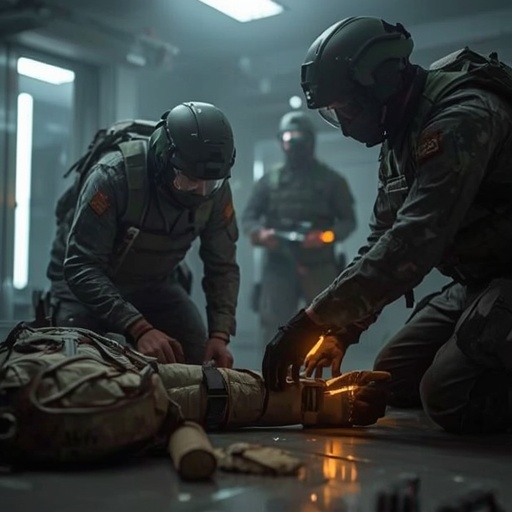
Across the war-torn landscapes of Ukraine, a profound transformation is underway in the field of military medicine—one that is redefining how battlefield care is conceived, taught, and executed. The realities of modern warfare, marked by the brutal immediacy of injury and the urgent necessity of saving lives under fire, have led U.S. Special Operations medics to expand their training beyond the established realm of emergency intervention. Traditionally, the emphasis has been on the swift and decisive application of tourniquets, a life-saving maneuver designed to arrest catastrophic bleeding in seconds. Now, medics are learning that survival is not the only measure of success—preserving the quality of life and the functionality of the wounded soldier is equally crucial.
This nuanced shift in approach focuses on mastering the delicate art of tourniquet removal, a process that demands clinical precision and sound judgment. In previous doctrinal models, once a tourniquet was applied, it often remained in place until surgical care was available, which sometimes led to irreversible tissue damage or even the need for amputation. Experience gained from the frontlines in Ukraine has challenged this convention. Medical professionals observed situations in which the timely and carefully monitored release of the tourniquet could restore circulation and prevent the loss of limbs while maintaining patient safety. Consequently, U.S. combat medics are being trained not only in when to apply a tourniquet in the chaos of combat but also in how and when to relieve it safely—a procedural evolution that bridges rapid trauma response with sustained, long-term care.
This adaptation represents far more than a technical adjustment; it signals a paradigm shift in the philosophy of military healthcare. War has long served as a crucible for medical innovation—from the development of antibiotics and trauma surgery techniques in earlier conflicts to the emergence of forward surgical teams and tactical combat casualty care in more recent decades. The lessons emerging from Ukraine extend this progression. They underscore the importance of dynamic decision-making, interdisciplinary collaboration, and the seamless integration of medical science with tactical reality. In essence, the current generation of combat medics is being trained to think not only as field rescuers but also as clinicians capable of critical assessment under extreme pressure.
The implications reach well beyond the battlefield. Insights gained through these updated methods are poised to influence civilian emergency medicine, especially in scenarios where rapid hemorrhage control and subsequent limb preservation intersect—such as disaster response, industrial accidents, and mass casualty events. Moreover, this evolution reflects a broader truth that adversity often accelerates progress. Every adjustment in doctrine, every refinement in training, and every life saved or limb preserved testifies to the resilience and ingenuity of those who serve in the harshest conditions.
Ultimately, the unfolding developments in Ukraine are not just rewriting manuals on combat medicine; they are reshaping the ethos of how medics prepare for the unpredictable. In that transformation lies both the tragedy and the triumph of modern conflict—a reminder that the pursuit of innovation often begins where necessity is greatest.
Sourse: https://www.businessinsider.com/ukraine-is-changing-how-us-troops-train-with-tourniquets-2026-7