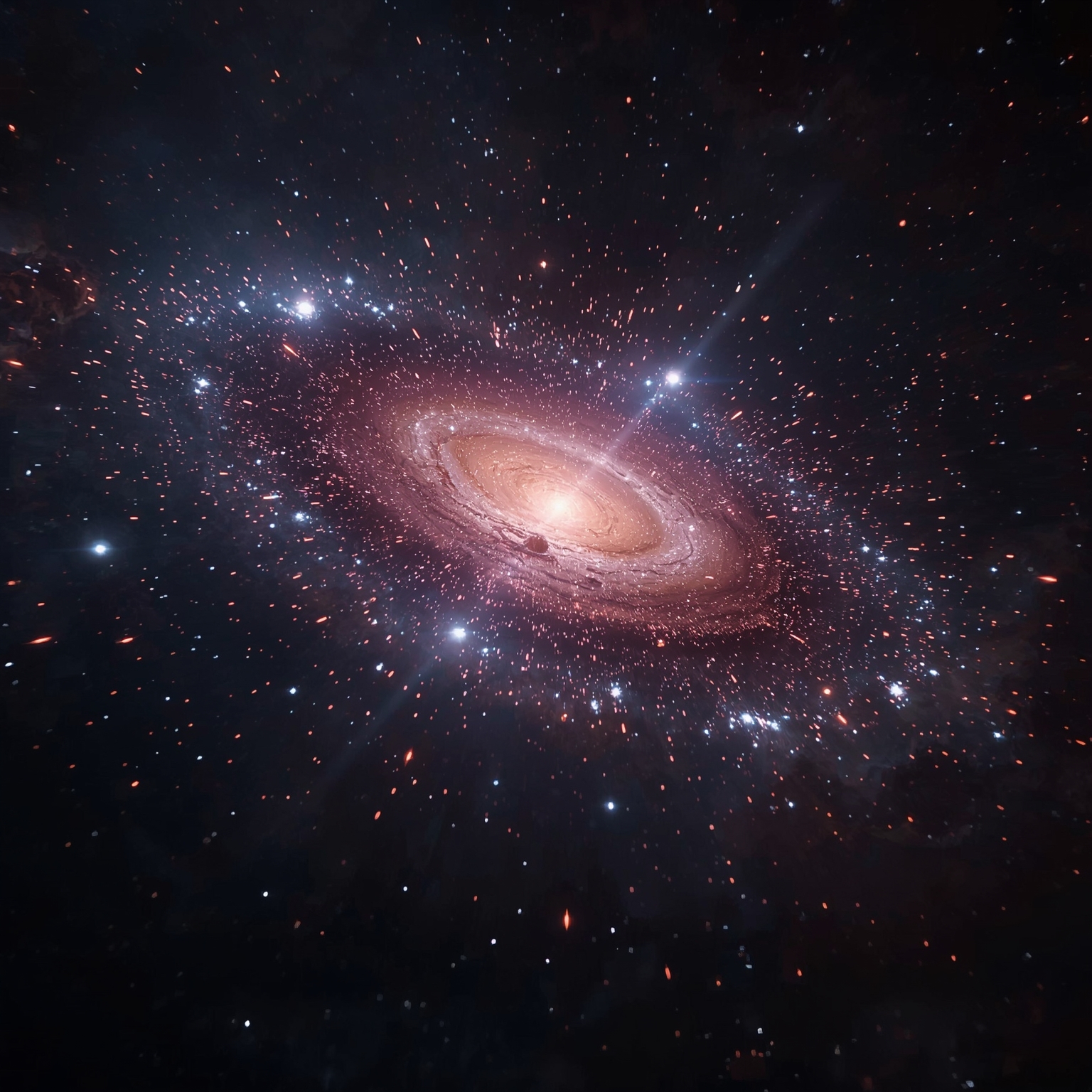
For nearly one hundred years, astronomers and cosmologists have been engaged in an extraordinary and persistent quest to uncover the nature of dark matter — the enigmatic and unseen component of the cosmos that is believed to act as a gravitational framework binding galaxies together. Despite the passage of decades and the accumulation of abundant indirect evidence pointing to its existence, such as gravitational effects that cannot be explained by visible matter alone, dark matter has stubbornly resisted direct detection. Now, a recent study led by Tomonori Totani, an astronomer and professor at the University of Tokyo, proposes what could potentially be a momentous breakthrough in this enduring scientific pursuit.
Totani’s research draws upon data from NASA’s powerful Fermi Gamma-ray Space Telescope, an observatory that has monitored high-energy rays from the cosmos for over fifteen years. Analyzing this rich trove of information, he claims to have identified gamma-ray emissions that appear to originate not from conventional astrophysical processes but possibly from dark matter itself. In a paper published in the *Journal of Cosmology and Astroparticle Physics*, Totani describes emissions consistent with theoretical predictions of radiation produced by collisions between so-called WIMPs—Weakly Interacting Massive Particles—an enduring favorite among candidates proposed to constitute dark matter.
According to Totani, WIMPs have long been theorized to possess mass and gravitational influence, yet interact so faintly with normal matter that they evade direct observation. When two of these elusive particles encounter one another, they are expected to annihilate, releasing bursts of high-energy gamma rays. The Fermi telescope’s data, examined through a newly refined analytical technique that intentionally excludes the extremely luminous galactic center and instead focuses on the more tranquil halo region encasing the Milky Way, revealed gamma-ray signals matching the pattern anticipated from such dark matter interactions.
While this discovery has sparked excitement, many experts remain cautious. Several astrophysicists warn that what appears to be a dark matter signature could in fact result from unrelated cosmic phenomena—perhaps artifacts of background noise or the byproducts of energetic celestial events like pulsars, supernova remnants, or matter spiraling into black holes. Totani himself acknowledges the preliminary nature of his findings. He stresses that although these gamma rays exhibit characteristics compatible with theoretical expectations for dark matter annihilation, one cannot yet assert with certainty that this radiation indeed arises from WIMPs. Nevertheless, the behavior and distribution of the detected gamma rays do not seem to align with any known class of conventional astrophysical sources, rendering the result an especially compelling candidate for further exploration.
The motivation behind the search is simple but profound. Observations across the universe show that galaxies rotate far more rapidly than should be possible if all their mass were contained solely in visible stars, gas, and dust. Likewise, galaxies appear held together by gravitational forces far stronger than the detectable matter can produce. This discrepancy implies the presence of additional, unseen mass—dark matter—that exerts gravitational influence while remaining invisible to every portion of the electromagnetic spectrum. If dark matter did absorb, emit, or reflect light, astronomers would have pinpointed it long ago. Instead, scientists look for indirect signs such as gravitational lensing or, in Totani’s approach, faint emissions that may trace the invisible particle interactions themselves.
The halo surrounding the Milky Way spans a roughly spherical expanse encircling the galaxy’s luminous disk, containing sparse stars and gas but, in current cosmological models, a disproportionately large quantity of dark matter. By analyzing gamma-ray radiation from this halo region and filtering out known astrophysical backgrounds such as the galactic plane’s intense emissions, Totani identified a distribution of high-energy signals that conform closely to what theoretical models predict for WIMP annihilation. Notably, the intensity and energy spectrum of the emissions—around 20 gigaelectronvolts—fit well within the parameters expected for dark matter particles colliding and releasing gamma rays. From these data, Totani was able to estimate an annihilation frequency consistent with established theoretical frameworks, a result that lends additional weight to his interpretation.
However, skepticism remains abundant. As a physicist at Fermilab explained, astrophysical processes offer many ways to generate gamma rays, from the magnetic acceleration around pulsars to the turbulent environments surrounding black holes, or even from shock waves following supernova explosions. High-energy gamma rays are hardly rare in the cosmic landscape; their mere presence, even at such substantial energies, is not in itself definitive evidence of dark matter interactions. Therefore, even if Totani’s observations match theoretical predictions, alternative explanations must be exhaustively ruled out before any claims of discovery can be considered valid.
Totani’s findings must also withstand the scrutiny of independent verification. He has emphasized that conclusive proof would require detecting comparable gamma-ray emissions in different regions of the sky, all exhibiting the same energy signatures and spatial characteristics predicted by dark matter models. Only consistent confirmation from separate analyses could establish these emissions as genuine evidence of WIMP behavior. Meanwhile, scientists such as Dan Hooper, professor of physics at the University of Wisconsin–Madison and director of the Wisconsin IceCube Particle Astrophysics Center, note that numerous researchers have previously examined the same Fermi telescope data set without identifying the excess Totani reports. Variations in methodology—such as Totani’s choice to exclude the central ten degrees of the galactic region, where most models predict a strong dark matter signal—could significantly influence the outcome and interpretation.
Additionally, Hooper and others propose the possibility that the observed high-energy excess might stem from modeling artifacts. If the background emission at lower energies has been excessively subtracted or mischaracterized, it could artificially accentuate the higher-energy portion of the spectrum, creating a misleading impression of an anomalous signal. Such methodological subtleties demonstrate how extraordinarily challenging it is to isolate dark matter’s faint fingerprints from the vivid cosmic background.
In essence, identifying dark matter has proven to be one of the most formidable tasks in modern astrophysics. Its elusiveness persists despite decades of experimentation, from particle detectors buried deep underground to cosmic ray studies and orbital observatories. As one Fermilab physicist succinctly summarized, the hunt requires multiple, independently validated lines of evidence before any claim can be deemed credible. A single suggestive measurement, however tantalizing, cannot stand as proof.
Thus, the scientific journey continues. Whether Totani’s findings ultimately herald a major step toward verifying the existence of dark matter or represent another instructive false lead, they will undoubtedly refine future search strategies and sharpen our collective understanding of the universe’s hidden architecture. Each new effort brings humanity a little closer to illuminating the invisible matter that shapes galaxies, governs cosmic structure, and constitutes most of what our universe truly is.
Sourse: https://gizmodo.com/controversial-new-study-points-to-the-most-promising-dark-matter-signal-yet-2000691553